
| Disclaimer: This article is for educational purposes only. It is not professional financial or legal advice. Credit outcomes vary by individual. Consult a certified credit counsellor before taking action on credit-related matters. |
| ℹ Quick Summary A poor credit score in the US can affect your ability to qualify for loans, rent a home or secure competitive interest rates. This guide outlines the steps that credit experts most commonly recommend for addressing bad credit in a structured way. The six-month timeframe is illustrative – improvement depends on your specific credit history and circumstances. For personalized guidance, certified nonprofit counselors at the NFCC are available at no cost. |
| 📘 What You’ll Learn In this guide you will find: How FICO scores are calculated and which factors carry the most weight How to access your credit reports from all three US bureaus for free The dispute process for errors under the Fair Credit Reporting Act How credit utilization affects your score and how to address it Steps to strengthen your payment history over time Free and legitimate credit help resources across the United States |
Table of Contents
- How Your FICO Score Is Calculated
- Step 1: Get Your Credit Reports From All Three Bureaus
- Step 2: Review Every Entry for Errors
- Step 3: Dispute Inaccurate Items Under the FCRA
- Step 4: Reduce Your Credit Utilization
- Step 5: Build a Consistent Payment History
- Step 6: Approach New Credit Carefully
- What Progress Can Look Like Over Six Months
- How AI Tools Can Support Credit Monitoring
- Frequently Asked Questions
Who This Guide Is For
This guide is for Americans dealing with a FICO score below 670 who want to understand the steps most likely to improve it. It covers the key factors in the FICO model, the dispute process under federal law and the habits that contribute to score recovery over time.
Credit repair is not an overnight process. It involves addressing specific items on your credit report, managing your balances and building a consistent payment record. This guide explains each of those steps clearly and in the order that tends to produce the best results.
For context, according to FICO, scores range from 300 to 850. A score below 580 is considered poor. Between 580 and 669 is considered fair. Lenders typically offer better terms to borrowers above 670. Each step in this guide targets one or more of the five factors that determine where your score falls on that range.
How Your FICO Score Is Calculated
Understanding the scoring formula helps you prioritize where to focus. FICO publishes the following breakdown:
| Factor | Weight | What It Measures |
| Payment History | 35% | Whether bills are paid on time across all accounts |
| Credit Utilization | 30% | How much of your available revolving credit you are using |
| Length of Credit History | 15% | How long your accounts have been open on average |
| Credit Mix | 10% | The variety of credit types you carry |
| New Credit Inquiries | 10% | How recently you have applied for new credit |
Payment history and utilization together account for 65 percent of the score according to FICO. Addressing those two factors tends to produce the most noticeable improvement in the shortest period, which is why Steps 1 through 4 of this guide focus on them before moving to the remaining factors.
Step 1: Get Your Credit Reports From All Three Bureaus
The three major US credit bureaus — Equifax, Experian and TransUnion — each maintain a separate file on you. Lenders may report to one, two or all three. Errors and negative items can appear on one report without appearing on the others, which is why reviewing all three separately is essential.
Where to Access Your Free Reports
- AnnualCreditReport.com: the federally authorized source for free reports from all three bureaus. As of 2023, weekly free reports are available under the Fair Credit Reporting Act. Opens in new tab.
- Experian Free: free Experian report with monthly FICO Score 8 updates. Opens in new tab.
- Credit Karma: free TransUnion and Equifax reports with weekly updates. Note: Credit Karma uses VantageScore, which may differ from the FICO score a lender sees. Opens in new tab.
Many Americans have never reviewed their full credit reports. Doing so is the starting point for any credit improvement effort.
Step 2: Review Every Entry for Errors
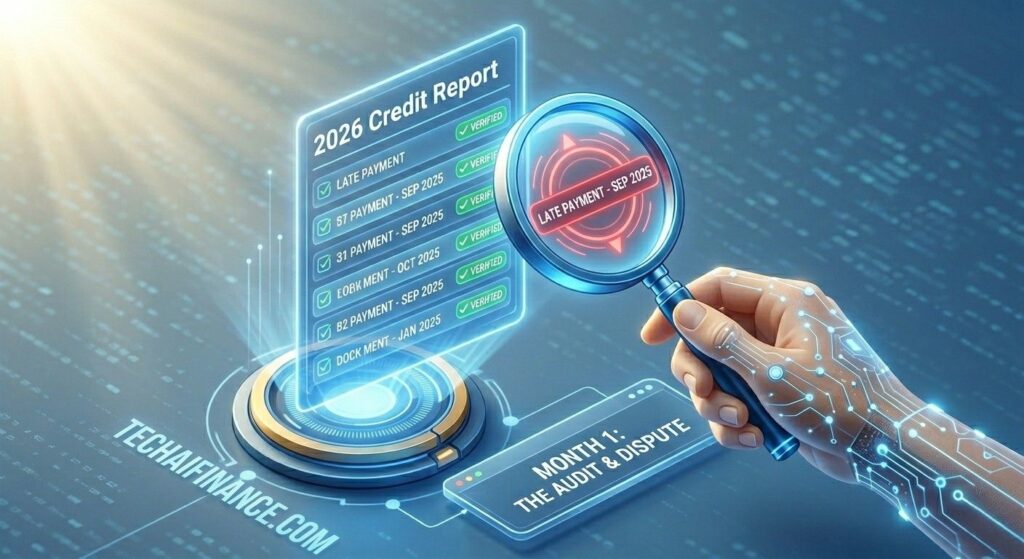
Read through each report carefully. This takes time but it is the step where many people discover issues that are actively reducing their score without their knowledge.
The Federal Trade Commission has published research indicating that approximately one in five Americans has an error on at least one credit report. Some errors are minor. Others can meaningfully affect a score.
What to Look For
- Accounts you did not open: may indicate identity theft or a bureau data error
- Payments marked late that you made on time: one of the most common and impactful errors on US credit reports
- Balances that do not match your records: incorrect balances affect your utilization ratio
- Duplicate accounts: the same debt appearing twice inflates reported debt levels
- Items older than seven years: most negative items must be removed after seven years from the date of first delinquency under the FCRA
Under the FCRA, the burden of verifying disputed information falls on the creditor and the bureau, not the consumer. If an item cannot be verified within the required period, it must be removed from your report.
Step 3: Dispute Inaccurate Items Under the FCRA
The Fair Credit Reporting Act gives every American the legal right to dispute information on their credit report that is inaccurate, incomplete or unverifiable. This process has defined timelines that bureaus are required to follow.
How to File a Dispute
- Identify the specific item: note the account name, number and the exact nature of the error
- Gather supporting documentation: payment receipts, statements or correspondence that support your case
- Submit your dispute in writing: written disputes sent by certified mail create a paper trail. Online disputes are faster but provide less documentation
- Dispute with each bureau separately: an error on all three reports requires a separate submission to each bureau
- Wait for the outcome: bureaus must generally complete investigations within 30 days and notify you of the result in writing
- Follow up if needed: if a dispute is rejected and you have additional evidence, you may resubmit. You also have the right to add a 100-word consumer statement to your report
Where to File
- Equifax Dispute Center: online, by mail or by phone.
- Experian Dispute Center: online with document upload.
- TransUnion Dispute: online portal with status tracking.
| ⚠ Watch Out Be cautious of paid credit repair companies that claim to remove accurate information from your report. Under the Credit Repair Organizations Act, you have the right to do everything a paid credit repair company can do – at no cost. The Consumer Financial Protection Bureau advises consumers to watch for companies that ask for payment before services or guarantee specific results. Free certified help is available through the NFCC at nfcc.org. |
Step 4: Reduce Your Credit Utilization
Credit utilization accounts for 30 percent of your FICO score. It measures how much of your available revolving credit you are currently using across all accounts.
Many credit professionals suggest keeping utilization below 30 percent of your total available credit. Reducing it further, toward 10 percent or below, often produces additional improvement, though the exact impact depends on your full credit profile.
| Illustrative Example: A card with a $3,000 limit and a $1,800 balance carries 60 percent utilization. Paying the balance to $900 brings it to 30 percent. For many borrowers, this change alone can produce a noticeable shift in their score, depending on their overall credit profile. |
Practical Approaches
- Pay down existing balances: prioritize cards with the highest utilization relative to their limit
- Request a credit limit increase: a higher limit with the same balance reduces utilization. Be aware that some issuers perform a hard inquiry for this request
- Keep old accounts open: closing an old card reduces total available credit and raises your overall utilization ratio
- Pay before your statement closes: issuers typically report balances around the statement closing date. Paying early reduces the balance reported to the bureaus
Step 5: Build a Consistent Payment History
Payment history is the largest factor in your FICO score at 35 percent. For borrowers with past late payments, the most effective long-term action is establishing a consistent record of on-time payments going forward.
Past negative payment history does affect your score, but its impact diminishes over time as recent positive activity accumulates. A late payment from three years ago carries less weight than one from three months ago.
What Helps
- Automatic minimum payments: set these up on every account to prevent future missed payments, even during difficult months
- Contact creditors before missing a payment: many creditors have hardship arrangements that may be available in specific circumstances. Proactive contact is generally more effective than calling after a payment has been missed
- Credit builder loans: designed specifically for borrowers with limited or damaged credit, these are offered by community banks and credit unions and establish a payment record without requiring existing credit
- Secured credit cards: regular on-time payments on a secured card are reported to bureaus identically to payments on unsecured cards

Step 6: Approach New Credit Carefully
New credit applications account for approximately 10 percent of your FICO score. Each application from a lender generates a hard inquiry, which can reduce your score by a small amount. Multiple applications in a short period can compound that effect.
Practical Guidelines
- Minimize new applications: during a focused repair period, unnecessary credit applications are generally worth avoiding
- Use pre-qualification tools: many US lenders offer soft-inquiry pre-qualification checks that show your likelihood of approval without affecting your score
- Rate shopping exceptions: multiple mortgage or auto loan inquiries within a 14 to 45 day window are often treated as a single inquiry under most scoring models. This exception does not apply to credit card applications
For readers also managing debt alongside credit repair, our guide on getting out of debt on a low income covers complementary strategies.
What Progress Can Look Like Over Six Months
The following table illustrates the types of changes and their general impact. Individual results depend on starting score, specific negative items, lender reporting timelines and how consistently steps are applied.
| Action | Potential Impact | Typical Timeline |
| Removing a verified error from one bureau | May be significant – varies by item | 30 to 60 days from dispute |
| Reducing utilization from 70 percent to below 30 percent | Often meaningful for many profiles | 1 to 2 billing cycles |
| Six months of consecutive on-time payments | Gradual positive trend | Cumulative month by month |
| Adding a secured card with low utilization | Small addition to credit mix | 3 to 6 months |
| Collections item aging past 7 years | Automatic removal per FCRA | Per reporting limit date |
An Illustrative Example
| Illustrative Only – Not a Guarantee A hypothetical borrower in Georgia starts with a 541 FICO score. Their report shows two late payment notations, a medical collections account and utilization of approximately 72 percent across three cards. The process was gradual. An initial dispute came back unverified. A second submission with documentation resulted in the removal of one late payment notation. Over the same period, balances were reduced to bring utilization to 28 percent. After six months of consistent on-time payments and the steps above, this borrower’s score improved by approximately 74 points. Circumstances will differ for every individual. “The consistency mattered more than any single action. Doing the right things every month added up.” |
How AI Tools Can Support Credit Monitoring
Credit monitoring tools have improved considerably in recent years. The primary value they offer during a credit repair period is visibility – weekly score updates, immediate alerts for report changes and an ongoing record of what is working and what is not.
Tools Worth Considering
- Credit Karma: free weekly TransUnion and Equifax updates with change alerts. Useful for tracking the impact of disputes and payment history changes over time.
- Experian Free with Experian Boost: monthly FICO Score 8 updates at no cost. Experian Boost allows you to add on-time utility and phone payments to your Experian report. Results vary by profile.
- Credit Sesame: free TransUnion monitoring with $50,000 identity theft insurance included.
Score simulators within these apps can be useful for understanding the approximate direction of an action’s impact. They are not precise predictions and should not be treated as guarantees.
Setting up monitoring before beginning the dispute and utilization steps gives you a documented starting point. Without a baseline, it is difficult to assess which actions are producing results.
Frequently Asked Questions
Can a credit score realistically improve in six months?
For some borrowers, yes – particularly those who successfully dispute errors, reduce utilization significantly and maintain on-time payments. For those with primarily accurate negative history, improvement tends to be more gradual. Results vary considerably by individual.
Does checking my own credit score hurt it?
No. Reviewing your own credit report or score is a soft inquiry and has no effect on your FICO score. Only lender applications generate hard inquiries that affect scoring.
Can accurate negative information be removed?
Generally, no. Verified accurate items remain on your report until their reporting period expires – typically seven years under the FCRA, or ten years for bankruptcy. The Consumer Financial Protection Bureau at consumerfinance.gov explains consumer rights in this area. Opens in new tab.
How long does a dispute investigation take?
The FCRA requires bureaus to complete most dispute investigations within 30 days. If an item cannot be verified in that period, it must be removed.
Are paid credit repair services worth using?
The CFPB and FTC both state that consumers can legally do everything a credit repair company offers themselves, at no cost. Free certified counseling is available through the NFCC. Opens in new tab.
What free resources are available in the US?
- National Foundation for Credit Counseling: free certified counselors in every US state.
- Consumer Financial Protection Bureau: free tools, guidance and complaint filing.
- AnnualCreditReport.com: free weekly reports from all three bureaus.
| Every reader who reaches this point has a clearer picture of how credit scoring works in the US than they did before. The next step is choosing one action from this guide and taking it today. |
Conclusion
Improving a credit score in the US is achievable through a structured and patient process. The core actions are straightforward: review your reports, dispute errors, reduce utilization, maintain on-time payments and be selective about new credit applications.
None of these steps produces guaranteed results in a fixed timeframe. What they do is address the five factors that FICO uses to calculate your score – systematically and in the order that typically produces the most impact.
If your situation involves collections, bankruptcy or significant errors that feel complex to navigate, consider speaking with a certified counselor through the NFCC before taking action. The service is free and the guidance is personalized to your actual credit file.
| 📥 Free Download: Credit Repair Action Tracker A simple educational tool to help organize your credit repair steps and track your score across all three bureaus. Free. Email required. Educational purposes only. Not a substitute for professional advice. |
Read Next
Continue building your financial knowledge on TechAIFinance.com:
- How to Get Out of Debt on a Low Income in the US
- How to Create a Budget When Living Paycheck to Paycheck
- What Affects Your FICO Credit Score: Key Factors Explained
| 📲 Share This Article If this guide has been useful to you, consider sharing it with someone managing a similar situation. Access to clear, straightforward financial information can make a meaningful difference. Share this on WhatsApp, Facebook or by text message. Thank you for reading TechAIFinance.com. |
| ✍ About the Author Written by: TechAIFinance Editorial Team Edited and Fact-Checked by: Olayinka Adejugbe Olayinka Adejugbe is not a licensed financial advisor. The content on TechAIFinance.com is produced for educational purposes only and should not be treated as personalized financial advice. Olayinka is the founder and lead editor of TechAIFinance.com. He holds a Global Certification in Artificial Intelligence and Applied Innovation and an Award of Completion in Behavioral Counseling from the World Health Organization. With a strong working knowledge of personal finance and accounting principles, Olayinka oversees the editorial review of every article on this site to ensure accuracy, currency and practical usefulness. Every article on TechAIFinance.com is produced by our research team and reviewed by Olayinka before publication. We verify statistics against named authoritative sources and update content when circumstances change. Visit our About page to learn more about our editorial process. Use our Contact page to get in touch. |
Important Disclaimer
The content published on TechAIFinance.com is for educational and informational purposes only. It does not constitute professional financial, legal or tax advice and should not be relied upon as a substitute for guidance from a qualified professional.
Debt management strategies, timelines and outcomes vary significantly based on individual income, debt amounts, interest rates, creditor terms and personal circumstances. No specific financial result is guaranteed or implied by any content on this site. Always consult a qualified financial advisor, credit counselor or attorney before making significant financial decisions. Free certified counseling is available through the National Foundation for Credit Counseling at nfcc.org.