| Content Note This guide provides information about credit monitoring services available to Americans. It is not financial or legal advice. Credit monitoring alerts you to changes on your credit report but does not prevent identity theft. If you believe you are a victim of identity theft, contact the FTC at identitytheft.gov and consider placing a credit freeze at all three bureaus. All app pricing and features were verified in June 2026. |
Your credit score affects more of your financial life than most Americans realize. It determines whether you qualify for a mortgage and at what rate, whether a landlord approves your rental application, whether an employer runs a background check that includes credit, and how much you pay for auto insurance in most US states. A single fraudulent account opened in your name can drop your score by 50 to 100 points overnight and take months to resolve. Credit monitoring is the early warning system that catches these problems before they become expensive ones.
The challenge for American consumers is that the credit monitoring market has become crowded with apps that offer dramatically different levels of protection at dramatically different price points, and the word free means very different things across different products. Some apps show you one bureau’s score updated monthly and call it monitoring. Others check all three bureaus daily and alert you within hours of any change. Understanding what you are actually getting before you sign up saves you from either overpaying for features you do not need or underprotecting yourself with a service that misses the alerts that matter most.
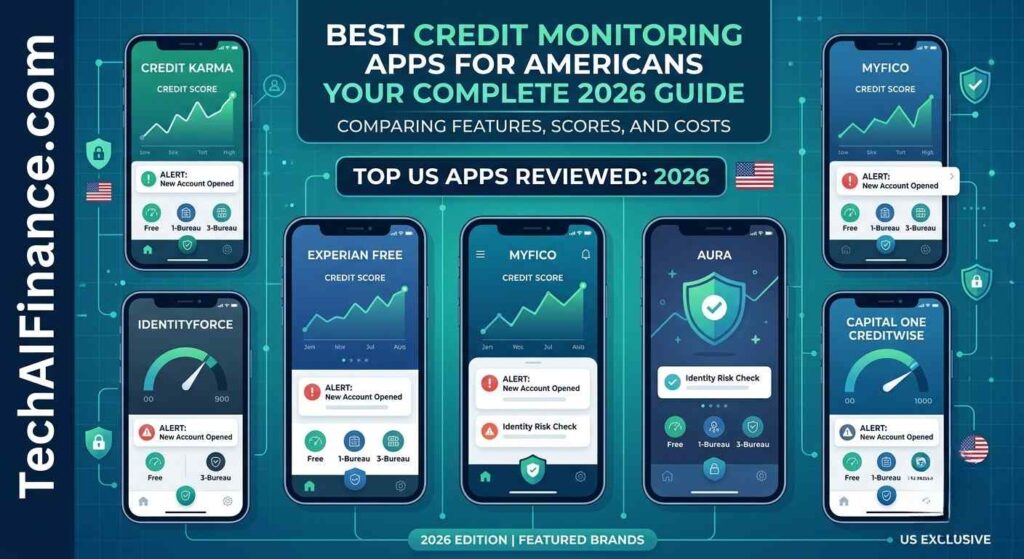
This guide reviews six credit monitoring apps available to Americans in 2026, evaluates each one honestly and gives you a clear decision framework for choosing the right level of protection for your specific situation.
This guide was written by Olayinka Adejugbe, founder of TechAIFinance.com and holder of a Global Certification in Artificial Intelligence and Applied Innovation.
| ℹ Quick Summary Credit monitoring and identity theft in the US in 2026: the numbers Americans filed approximately 1.4 million identity theft reports with the FTC in 2025, making it the most reported consumer fraud category for the fifteenth consecutive year, per the FTC Consumer Sentinel Network Data Book 2025. The average time between when identity theft occurs and when the victim discovers it is 6 months, per the Identity Theft Resource Center 2025 Annual Data Breach Report. Active credit monitoring reduces this detection window to hours or days. Credit card fraud is the most common form of identity theft reported by Americans, representing 40.2 percent of all identity theft reports in 2025, per FTC data. Americans with active credit monitoring detected fraudulent accounts an average of 5.3 months earlier than those without monitoring, per a 2025 Javelin Strategy and Research identity fraud study. The three major credit bureaus, Equifax, Experian and TransUnion, each maintain separate credit files that can differ significantly. Monitoring only one bureau misses activity reported to the other two. Sources: FTC Consumer Sentinel Network Data Book 2025 at ftc.gov. Identity Theft Resource Center 2025 Annual Report at idtheftcenter.org. Javelin Strategy and Research 2025 Identity Fraud Study. |
| 📘 What This Guide Covers In this guide you will find: What credit monitoring actually does and what it cannot do The difference between one-bureau, two-bureau and three-bureau monitoring Full reviews of six credit monitoring apps: Credit Karma, Experian, myFICO, IdentityForce, Aura and Capital One CreditWise Which apps are genuinely free versus which have hidden costs The credit score models each app uses and why it matters How to combine free tools for maximum protection at zero cost When to upgrade to a paid identity theft protection service How to freeze your credit at all three bureaus for free |
Table of Contents
- What Credit Monitoring Does and Does Not Do
- One Bureau vs Three Bureau Monitoring: Why It Matters
- Credit Karma: Full Review
- Experian Free: Full Review
- myFICO: Full Review
- IdentityForce: Full Review
- Aura: Full Review
- Capital One CreditWise: Full Review
- Complete Comparison Table
- How to Get Maximum Protection for Free
- When to Upgrade to Paid Identity Theft Protection
- How to Freeze Your Credit at All Three Bureaus
- Frequently Asked Questions
What Credit Monitoring Does and Does Not Do
What does credit monitoring do?
| Credit monitoring tracks your credit reports and credit scores at one or more of the three major bureaus and sends you alerts when significant changes occur. These changes include new accounts opened in your name, hard inquiries from lenders, changes to existing account balances, derogatory marks like collections or late payments, and personal information changes like a new address. Credit monitoring does not prevent identity theft but it dramatically reduces the time between when fraud occurs and when you discover it. |
Credit monitoring is a detection tool, not a prevention tool. This distinction matters because many Americans sign up expecting their credit monitoring service to stop fraud from happening. It does not. What it does is tell you quickly when something on your credit report changes, which gives you the ability to respond before the damage compounds.
What credit monitoring catches
- New account alerts: When a lender opens a new credit card, loan or line of credit in your name, it appears on your credit report as a new account. If you did not open it, monitoring alerts you immediately.
- Hard inquiry alerts: When someone applies for credit using your information, the lender pulls your credit in a hard inquiry. An inquiry you did not authorize is often the first sign that someone has your personal information.
- Address change alerts: Fraudsters sometimes change the address on your credit accounts to redirect mail and statements. Address change alerts catch this early.
- Score change alerts: A sudden unexplained drop in your credit score often indicates fraudulent activity, a new collection account or a missed payment on an account you did not know existed.
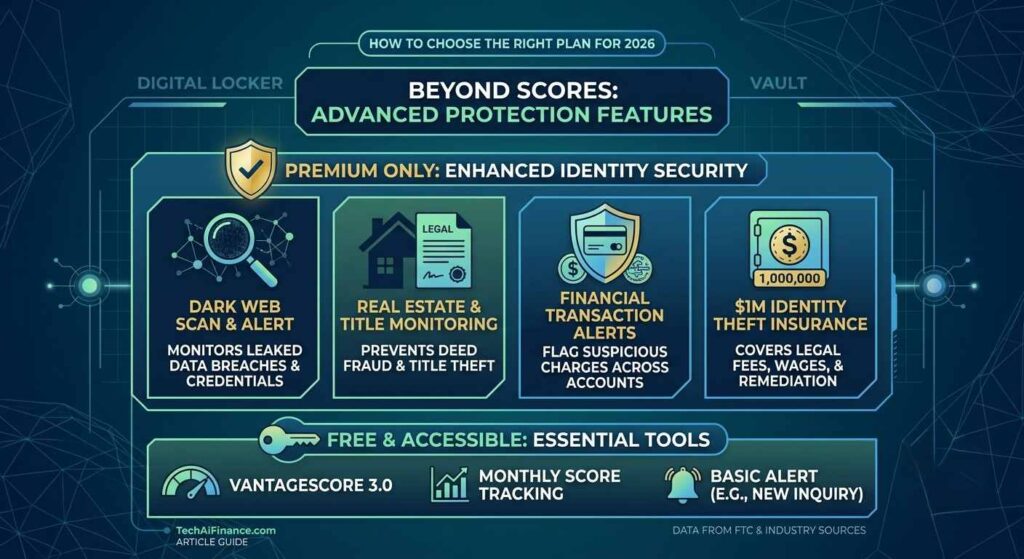
- Dark web alerts (paid services): Premium monitoring services scan dark web marketplaces for your Social Security number, email addresses, bank account numbers and other personal information being sold or traded.
What credit monitoring cannot do
- It cannot stop a fraudster from opening an account in your name if your information has already been compromised.
- It cannot remove fraudulent accounts from your report. It only tells you they exist. You must dispute them separately.
- It cannot monitor bank account fraud, medical identity theft or tax identity theft, which occur outside the credit reporting system.
- It cannot guarantee you will receive an alert before damage occurs, since there is always a lag between when activity happens and when it appears on your credit report.
One Bureau vs Three Bureau Monitoring: Why It Matters
Should I monitor one or all three credit bureaus?
| You should monitor all three credit bureaus because lenders report to different bureaus and fraud can appear on one report without appearing on the others. Equifax, Experian and TransUnion each maintain separate credit files. A fraudulent account opened with a lender that only reports to TransUnion will not appear on your Equifax or Experian report. Single-bureau monitoring misses any activity reported exclusively to the other two bureaus. |
The three major credit bureaus in the US, Equifax, Experian and TransUnion, operate independently. Each collects credit information from lenders separately and each maintains a distinct credit file for every American consumer. Lenders are not required to report to all three bureaus and many report to only one or two. This means your credit scores can differ across bureaus, and fraudulent activity can appear on one report without appearing on the others.
Single-bureau monitoring, which is what most free apps provide for only one bureau, misses any fraudulent activity that occurs on the two unmonitored bureaus. Three-bureau monitoring, which checks all three simultaneously, provides complete coverage but typically costs more or requires combining multiple free services strategically.
| Monitoring Level | Bureaus Covered | Miss Rate for Fraud | Cost | Best Approach |
| Single bureau free | 1 of 3 | Up to 67% of fraud activity | Free | Combine with other free tools |
| Two bureau | 2 of 3 | Up to 33% of fraud activity | Varies | Better but not complete |
| Three bureau | All 3 | Minimal gaps | Free to $39.99/month | Ideal for complete protection |
| Credit freeze (all 3) | All 3 | Prevents new account fraud | Free by law | Best prevention tool available |
Credit Karma: Full Review
Is Credit Karma actually free?
| Yes. Credit Karma is genuinely free with no paid tier. It provides credit score and credit report monitoring for TransUnion and Equifax, updated daily, with alerts for significant changes to either report. Credit Karma earns revenue by recommending financial products like credit cards and loans based on your credit profile. You are never charged a fee for credit monitoring, score access or alerts. The trade-off is targeted financial product recommendations throughout the app experience. |
| Credit Karma Best Free Credit Monitoring App for Most Americans Cost: 100% Free – no paid tier | Bureaus Monitored: TransUnion and Equifax (2 of 3) Credit Score Model: VantageScore 3.0 from TransUnion and Equifax | Our Rating: 9.3/10 – best free credit monitoring app for most Americans What this app is Credit Karma is the most widely used free credit monitoring app in the US with over 130 million members as of 2026. It provides free access to your TransUnion and Equifax credit reports and VantageScore 3.0 credit scores, updated daily, with alerts when significant changes occur on either report. Credit Karma also shows you a full breakdown of the factors affecting your score, a credit report card grading each factor and personalized recommendations for credit cards, loans and other financial products matched to your credit profile. The app is owned by Intuit, the same company behind TurboTax and QuickBooks. How it works Download the Credit Karma app on iOS or Android or sign up at creditkarma.com. Create an account with your name, address, date of birth and Social Security number, which is used to pull your credit files. Credit Karma performs a soft inquiry that does not affect your credit score. After setup, your dashboard shows your current TransUnion and Equifax VantageScore 3.0 scores, a summary of open accounts, recent inquiries and any alerts from the past 30 days. Alerts arrive as push notifications and emails when Credit Karma detects a new account, new inquiry, address change or score movement above a set threshold. AI and smart features: Credit Karma’s AI-powered features include a Credit Score Simulator that models how specific actions like paying off a credit card or opening a new account would affect your score, a smart recommendation engine that matches financial products to your specific credit profile and approval odds percentages that estimate your likelihood of being approved for specific cards or loans before you apply. The approval odds feature uses machine learning trained on actual approval data and is more accurate than generic credit score ranges for predicting approval outcomes. Honest limitation: Credit Karma monitors only two of the three major bureaus. Experian is not included, which means any fraudulent activity reported exclusively to Experian will not trigger an alert. For complete three-bureau coverage at no cost, pair Credit Karma with Experian’s free monitoring service. Credit Karma’s revenue model means the app consistently presents financial product recommendations, which some users find intrusive. The VantageScore 3.0 model used by Credit Karma is not the same as the FICO scores used by most lenders, so scores shown may differ from what a lender sees when you apply for credit. Best for: Americans who want free daily two-bureau monitoring with a polished interface and useful financial product recommendations Sources: Credit Karma at creditkarma.com. Intuit Credit Karma member count 2026. VantageScore 3.0 model documentation. Verified June 2026. |
Experian Free: Full Review
What does Experian free credit monitoring include?
| Experian’s free credit monitoring service provides daily monitoring of your Experian credit report only, with FICO Score 8 access updated monthly and alerts for new accounts, inquiries and personal information changes on your Experian file. The free tier also includes Experian Boost, which allows you to add on-time utility, phone and streaming service payments to your Experian credit file to potentially raise your FICO score immediately. Experian’s paid IdentityWorks plans add TransUnion and Equifax monitoring plus dark web surveillance. |
| Experian Free Best Free App for FICO Score Access and Experian Bureau Monitoring Cost: Free tier available | IdentityWorks Plus $24.99/month | Premium $34.99/month | Bureaus Monitored: Experian only (free tier) | All 3 bureaus (paid tier) Credit Score Model: FICO Score 8 – the most widely used score model by lenders | Our Rating: 8.8/10 overall | 9.5/10 for free FICO score access What this app is Experian offers a free credit monitoring service that covers your Experian credit report with FICO Score 8 access and monthly updates. The free tier is particularly valuable because it provides access to a genuine FICO score rather than VantageScore, which most lenders use for credit decisions. Experian also offers IdentityWorks, a paid identity theft protection service that upgrades to three-bureau daily monitoring, dark web surveillance, identity theft insurance of up to $1 million and fully managed identity restoration services if theft occurs. How it works Sign up at experian.com or download the Experian app. Create an account and verify your identity with your Social Security number. The free dashboard shows your current Experian FICO Score 8, your Experian credit report summary, active alerts for your Experian file and the Experian Boost tool. To use Experian Boost, connect your bank account and Experian identifies eligible on-time payment history for utilities, phone bills, Netflix, Spotify and other streaming services and adds it to your Experian credit file. The average Boost user sees an immediate FICO score increase of 13 points, per Experian 2025 data, with some users seeing increases of 40 points or more. AI and smart features: Experian’s AI features include a personalized credit improvement plan that analyzes your specific credit profile and identifies the two or three actions most likely to improve your score based on your current factors, a smart score simulator similar to Credit Karma’s that models score impact of various actions and an AI-powered product matching engine that recommends credit cards and loans with high approval probability. Experian’s free tier also includes real-time fraud alerts from Experian’s database of known fraud patterns, which flags suspicious activity even before it appears on your credit report. Honest limitation: The free tier monitors only Experian, leaving TransUnion and Equifax unmonitored. Experian Boost adds positive payment history to your Experian file only, so it does not affect your TransUnion or Equifax scores. The paid IdentityWorks plans are priced higher than some competitors offering comparable three-bureau coverage. Monthly FICO score updates on the free tier are less frequent than the daily VantageScore updates on Credit Karma. Best for: Americans who want free FICO score access rather than VantageScore, Experian Boost users and those who want to upgrade to three-bureau monitoring with one provider Sources: Experian at experian.com. Experian IdentityWorks pricing verified June 2026. Experian Boost average score increase from experian.com/boost. |
myFICO: Full Review
What is myFICO and is it worth the cost?
| myFICO is the official consumer credit monitoring service from Fair Isaac Corporation, the company that created the FICO scoring model. It provides access to FICO scores from all three bureaus in the specific score versions lenders actually use, including mortgage scores, auto loan scores and credit card scores that differ from the generic FICO Score 8. myFICO offers a free plan with monthly Equifax FICO Score 8 access, while paid plans start at $19.95 per month for one-bureau monthly monitoring and go up to $39.95 per month for three-bureau monthly monitoring. The paid tiers are worth the cost mainly for Americans actively preparing for a mortgage or major loan application. |
| myFICO Best App for Americans Preparing for a Mortgage or Major Loan Cost: Free plan available (1 bureau, monthly) | Basic $19.95/month | Advanced $29.95/month | Premier $39.95/month | Bureaus Monitored: 1 bureau (Basic) | 3 bureaus (Advanced and Premier) Credit Score Model: Multiple FICO score versions including mortgage, auto and bankcard specific scores | Our Rating: 9.0/10 for mortgage and loan preparers | 5.0/10 for general monitoring due to cost What this app is myFICO is operated by Fair Isaac Corporation, the creator of the FICO scoring model, and is the only consumer service that provides access to the industry-specific FICO score versions that lenders use rather than just the generic FICO Score 8. When a mortgage lender evaluates your application, they typically pull FICO Score 2 from Equifax, FICO Score 5 from Experian and FICO Score 4 from TransUnion, which can differ meaningfully from your FICO Score 8. myFICO shows you all of these scores so you know exactly what a mortgage lender will see before you apply. This intelligence is particularly valuable when you are trying to reach a specific score threshold for a mortgage rate tier. How it works Sign up at myfico.com and select your plan tier. The Basic plan at $19.95 per month provides one bureau FICO monitoring. The Advanced plan at $29.95 per month provides three bureau FICO monitoring with quarterly score updates and identity theft insurance. The Premier plan at $39.95 per month adds daily three-bureau monitoring and $1 million in identity theft insurance. After signing up, your dashboard shows your FICO scores from each bureau in multiple versions, a score analysis showing how you compare to the population, score simulators and credit report access. myFICO also provides a mortgage payment calculator that updates based on your actual scores to show how different score ranges affect your rate. AI and smart features: myFICO’s smart features include a FICO Score Planner that shows exactly which actions will move each specific score version most significantly, a mortgage savings calculator that quantifies in dollar terms how much your current score costs you in interest over the life of various loan amounts and an alert system that notifies you of any change across all three bureaus on the Premier tier. The specificity of myFICO’s score modeling is its primary AI advantage: it does not just show you a generic score but shows you exactly where you stand for the specific financial product you are preparing for. Honest limitation: myFICO’s free plan provides only Equifax FICO Score 8 with monthly updates and no credit monitoring alerts, so most of its value is locked behind paid tiers, making it the most expensive consumer credit monitoring service reviewed in this guide once you need real monitoring rather than score lookup. For Americans who are not actively preparing for a major loan application, the premium pricing is difficult to justify when free alternatives provide adequate general credit health monitoring. The quarterly score updates on the Advanced plan are less frequent than the daily monitoring provided by free alternatives like Credit Karma. Best for: Americans actively preparing to apply for a mortgage, auto loan or other major credit product who need to see the exact FICO score versions lenders will use Sources: myFICO at myfico.com. FICO scoring model documentation. Pricing verified June 2026. |
IdentityForce: Full Review
| IdentityForce Best Comprehensive Identity Theft Protection for High-Risk Americans Cost: No free tier | UltraSecure $17.99/month | UltraSecure+Credit $23.99/month | Bureaus Monitored: All 3 bureaus (UltraSecure+Credit plan) Credit Score Model: VantageScore 3.0 from all three bureaus (UltraSecure+Credit) | Our Rating: 9.1/10 for comprehensive identity protection | 7.5/10 for credit-only monitoring needs What this app is IdentityForce is a comprehensive identity theft protection service that goes significantly beyond credit report monitoring to cover a broader range of identity threats. Beyond standard credit monitoring, IdentityForce monitors court records, sex offender registries, Social Security number usage, payday loan applications, change of address filings, social media accounts for personal information exposure and dark web marketplaces for compromised credentials. Its UltraSecure plan covers these non-credit identity threats without credit monitoring. The UltraSecure+Credit plan adds three-bureau daily credit monitoring, credit scores and alerts. IdentityForce also provides fully managed identity restoration where a certified specialist handles the entire recovery process if identity theft occurs. How it works Sign up at identityforce.com and choose your plan. After account creation and identity verification, IdentityForce begins monitoring your credit files, social media accounts, court records and dark web sources simultaneously. Alerts arrive by push notification, text and email based on your preferences. The resolution center within the app guides you through responding to any alert with specific recommended next steps. If identity theft is confirmed, IdentityForce assigns a certified identity theft restoration specialist who works on your behalf with creditors, agencies and institutions to resolve the theft, with $1 million in identity theft insurance covering losses and legal fees. AI and smart features: IdentityForce’s AI monitoring system continuously analyzes patterns across all monitored data sources and prioritizes alerts by severity level so you know immediately whether an alert requires urgent action or routine review. Its social media monitoring uses AI to scan for personal information appearing in unexpected public contexts, which is increasingly relevant as social engineering attacks using public social media data become more sophisticated. The dark web monitoring component uses AI to identify credential combinations involving your personal information even when sold in encrypted bundles that manual scanning would miss. Honest limitation: IdentityForce does not have a free tier and its pricing, while competitive for comprehensive protection, is higher than basic credit monitoring apps. The UltraSecure plan without credit monitoring is unusual in that it covers many identity threats but not the credit report changes that most consumers associate with identity theft protection. For Americans who primarily want credit score tracking and credit report monitoring, a free service like Credit Karma plus Experian provides adequate protection at zero cost. Best for: Americans who have been victims of identity theft, who have high public profiles or who want the most comprehensive identity monitoring beyond credit reports Sources: IdentityForce at identityforce.com. Pricing and features verified June 2026. |
Aura: Full Review
| Aura Best All-in-One Digital Security and Identity Protection for Families Cost: No free tier | Individual $12/month | Couple $22/month | Family $37/month | Bureaus Monitored: All 3 bureaus Credit Score Model: VantageScore and FICO scores depending on bureau | Our Rating: 9.0/10 for families and digital security bundlers | 7.0/10 for credit-monitoring-only needs What this app is Aura is an all-in-one digital security platform that combines three-bureau credit monitoring with a comprehensive suite of cybersecurity tools: a VPN for secure browsing, antivirus and anti-malware protection, a password manager, safe browsing protection against phishing sites and dark web monitoring. Rather than treating identity theft as a standalone financial problem, Aura addresses the digital security ecosystem that enables identity theft in the first place. For consumers who currently pay separately for a VPN, antivirus software and a password manager alongside a credit monitoring service, Aura’s bundled pricing can produce meaningful savings while providing better integrated protection. How it works Sign up at aura.com and choose individual, couple or family coverage. After account creation, Aura guides you through setting up each component: installing the VPN app, configuring the password manager, enabling the antivirus and connecting your financial accounts for transaction monitoring. The credit monitoring component begins once you verify your identity with your Social Security number. Aura monitors all three credit bureaus daily and sends alerts through the app, email or text. The family plan covers up to five adults and unlimited children, making it particularly cost-effective for households with multiple people to protect. AI and smart features: Aura’s AI system provides real-time transaction monitoring that uses behavioral pattern analysis to flag unusual financial activity beyond what appears on credit reports, including bank account transactions and investment account activity if connected. Its spam call protection uses AI to identify and filter fraudulent calls in real time before you answer. Aura’s identity threat intelligence aggregates data across credit reports, dark web sources, data breach databases and public records to provide a comprehensive risk score for your identity, updated continuously rather than only when a specific change occurs. Honest limitation: Aura does not have a free tier and its individual plan at $12 per month is competitive but not free. Americans who only want credit monitoring and do not need a VPN, antivirus or password manager will find better value in free alternatives. The family plan’s per-person cost is excellent but requires the full subscription commitment. Some users report the app interface is feature-dense and takes time to navigate efficiently. Best for: Families and individuals who want identity theft protection, credit monitoring, a VPN, antivirus software and password manager combined in a single subscription Sources: Aura at aura.com. Pricing and features verified June 2026. |
Capital One CreditWise: Full Review
Is Capital One CreditWise free for non-Capital One customers?
| Yes. Capital One CreditWise is completely free for any American regardless of whether they have a Capital One account. It provides TransUnion credit report monitoring with VantageScore 3.0 updates and dark web scanning for your Social Security number and email addresses at no cost. CreditWise is one of the few free credit monitoring apps that includes dark web monitoring, which most free services do not offer. The limitation is that it monitors only TransUnion and does not include Equifax or Experian coverage. |
| Capital One CreditWise Best Free App With Dark Web Monitoring Included at No Cost Cost: 100% Free – available to anyone, not just Capital One customers | Bureaus Monitored: TransUnion only Credit Score Model: VantageScore 3.0 from TransUnion | Our Rating: 8.7/10 overall | 9.5/10 for free dark web monitoring value What this app is Capital One CreditWise is a free credit monitoring service available to any American with a valid email address and Social Security number, not just Capital One cardholders or banking customers. It monitors your TransUnion credit report with weekly VantageScore 3.0 updates and includes dark web scanning for your Social Security number, email addresses and phone numbers, a feature typically reserved for paid identity protection services. CreditWise also provides a credit score simulator and alerts for significant changes to your TransUnion credit file. How it works Download the CreditWise app on iOS or Android or access it at capitalone.com/creditwise. Create an account with your email and personal information. CreditWise performs a soft inquiry that does not affect your score. Your dashboard shows your current VantageScore 3.0, a credit report summary from TransUnion, recent alerts and the dark web monitoring status for your personal information. Alerts arrive as push notifications and emails when CreditWise detects a new account, inquiry, address change or dark web mention of your personal information. AI and smart features: CreditWise’s credit score simulator is powered by TransUnion data and models the score impact of specific financial actions including paying off debt, closing an account or opening a new credit card. The dark web monitoring component continuously scans dark web sources, hacker forums and data breach databases for your Social Security number and email addresses, alerting you when your information appears. This AI-powered scanning capability at zero cost is CreditWise’s strongest differentiator from other free monitoring apps. Honest limitation: CreditWise monitors only TransUnion, leaving Equifax and Experian unmonitored. For complete coverage, pair CreditWise with Credit Karma for Equifax monitoring and Experian’s free service for Experian monitoring. CreditWise is managed by Capital One and while it is available to all Americans, some users are uncomfortable sharing personal information with a financial institution they do not have a relationship with. The interface, while functional, is slightly less polished than Credit Karma’s. Best for: Any American who wants free TransUnion monitoring with dark web scanning included, regardless of whether they bank with Capital One Sources: Capital One CreditWise at capitalone.com/creditwise. Features verified June 2026. |
Complete Credit Monitoring Comparison Table
| App | Cost | Bureaus | Score Model | Dark Web? | Identity Insurance? | Our Rating |
| Credit Karma | Free | TransUnion + Equifax | VantageScore 3.0 | No | No | 9.3/10 |
| Experian Free | Free / $24.99+ | Experian only (free) | FICO Score 8 | Paid only | Paid only | 8.8/10 |
| myFICO | $19.95 to $39.95 | 1 or 3 (plan based) | Multiple FICO versions | Premier plan | Advanced+ | 9.0/10 for mortgage |
| IdentityForce | $17.99 to $23.99 | All 3 (paid) | VantageScore 3.0 | Yes | $1 million | 9.1/10 |
| Aura | $12 to $37 | All 3 | Mixed | Yes | $1 million | 9.0/10 |
| Capital One CreditWise | Free | TransUnion only | VantageScore 3.0 | Yes – free | No | 8.7/10 |
How to Get Maximum Protection for Free
| How do I monitor all three credit bureaus for free? You can monitor all three credit bureaus for free by combining three free services. Use Credit Karma for daily TransUnion and Equifax monitoring, use Experian’s free service for Experian monitoring and FICO Score 8 access and use Capital One CreditWise for additional TransUnion monitoring with free dark web scanning. Together these three free apps cover all three bureaus at no cost and provide dark web monitoring that most people pay for. |
Complete three-bureau coverage at zero cost is achievable by combining three free apps strategically. Each covers a different bureau and together they provide comprehensive monitoring without paying for a single subscription.
| The Free Three-Bureau Coverage Stack App 1: Credit Karma (free) – Monitors TransUnion and Equifax daily with VantageScore 3.0 scores. Alerts for both bureaus. Score simulator included. App 2: Experian Free (free) – Monitors Experian with FICO Score 8 access monthly. Includes Experian Boost to potentially raise your score. Fills the Experian gap left by Credit Karma. App 3: Capital One CreditWise (free) – Adds free dark web monitoring for your Social Security number and email addresses. No Capital One account required. Total cost: $0 Total bureaus covered: All three. TransUnion and Equifax via Credit Karma. Experian via Experian Free. Dark web via CreditWise. |
| 💡 Pro Tip Set up all three free apps in one afternoon. The total setup time is approximately 45 minutes. Use Credit Karma as your primary daily monitoring app since it covers two bureaus and has the best interface. Check Experian monthly when your FICO score updates. Enable push notifications on all three apps so alerts reach you immediately regardless of which bureau detected the change. Together these three apps provide monitoring that rivals paid services costing $20 to $30 per month, with the only gap being no identity theft insurance and no fully managed restoration service if theft occurs. |
When to Upgrade to Paid Identity Theft Protection
Free monitoring is adequate for most Americans most of the time. There are specific situations where upgrading to a paid identity theft protection service like IdentityForce, Aura or Experian IdentityWorks is genuinely worth the cost.
- You have been the victim of identity theft previously: Once your personal information has been compromised and used fraudulently, the risk of repeat victimization is elevated. Paid services with managed restoration and insurance provide meaningful additional protection for people in this situation.
- Your personal information was exposed in a major data breach: After a significant data breach involving your Social Security number, bank account information or medical records, upgrading to paid monitoring with dark web surveillance for 12 months is a reasonable precaution.
- You are a public figure or have a high public profile: People whose personal information is widely available online are at higher risk of targeted identity theft. Paid services with more comprehensive monitoring and faster response provide better protection for this group.
- You want identity theft insurance coverage: If having $1 million in identity theft insurance and access to a managed restoration specialist is important to your peace of mind, paid services provide this where free options do not.
- You want family coverage: Paid services like Aura offer family plans that cover multiple adults and children under one subscription, which can be more cost-effective than attempting to set up multiple free monitoring stacks for each family member.
How to Freeze Your Credit at All Three Bureaus
How do I freeze my credit at all three bureaus?
| Freezing your credit at all three bureaus is free by federal law and is the single most effective action you can take to prevent new fraudulent accounts from being opened in your name. Freeze at Equifax at equifax.com/personal/credit-report-services, at Experian at experian.com/freeze and at TransUnion at transunion.com/credit-freeze. Each freeze takes approximately 5 minutes online. You can temporarily lift a freeze when you apply for credit and refreeze it immediately after. |
A credit freeze, also called a security freeze, prevents lenders from accessing your credit report to open new accounts. Since most lenders require a credit check before approving a new account, freezing your credit makes it virtually impossible for a fraudster to open a new credit card, loan or line of credit in your name even if they have your full Social Security number and personal information.
How to freeze your credit
- Equifax freeze: Go to equifax.com/personal/credit-report-services/credit-freeze or call 1-800-685-1111. Free. Instant online.
- Experian freeze: Go to experian.com/freeze or call 1-888-397-3742. Free. Instant online.
- TransUnion freeze: Go to transunion.com/credit-freeze or call 1-888-909-8872. Free. Instant online.
After freezing at all three bureaus, store your PIN or account credentials from each bureau in a secure password manager. You will need these to temporarily lift your freeze when you apply for credit. Lifting a freeze typically takes minutes online and can be done for a specific lender or for a defined time period, after which the freeze automatically reinstates.
| ⚠ Watch Out A credit freeze does not affect your existing accounts, your current credit scores or your ability to use existing credit cards. It only prevents new accounts from being opened. Existing creditors can still access your report and your credit score continues to update normally. A freeze is not the same as a fraud alert. A fraud alert lasts 1 year and asks lenders to verify your identity before opening an account but does not prevent the inquiry. A freeze is stronger protection because it blocks the credit pull entirely. |
| 💡 Real-World Example Consider two Americans who both had their personal information exposed in the same data breach at a major retailer in early 2026. Sandra is 41 and had been using Credit Karma for two years. When she received the breach notification she also downloaded the Experian app, enabled Experian Boost and set up Capital One CreditWise for dark web monitoring. She froze her credit at all three bureaus immediately after the breach notification. Six weeks later, Credit Karma sent her an alert about a new hard inquiry on her TransUnion report for a store credit card she did not apply for. Because her credit was frozen, the lender was unable to open the account and the inquiry was quickly disputed and removed. Kevin is 38 and did not have any credit monitoring set up. He received the same breach notification but took no action assuming the retailer would handle it. Four months later he discovered a fraudulent auto loan in his name when he was denied for an apartment because his debt-to-income ratio had apparently become too high. The fraudulent loan had been open for three months, had a missed payment and had dropped his credit score by 87 points. Resolving it took six months of disputes and documentation. Same breach. Same risk. Completely different outcomes based entirely on whether monitoring and a credit freeze were in place. These examples are illustrative. Individual outcomes depend on the nature of the fraud and the speed of detection and response. |
Frequently Asked Questions
Does credit monitoring hurt my credit score?
No. Credit monitoring services use soft inquiries to check your credit report, which do not affect your credit score. Only hard inquiries, which occur when a lender checks your credit to evaluate a credit application, affect your score. You can check your own credit and enroll in monitoring services as many times as you want without any impact on your credit score.
What is the difference between a credit freeze and a fraud alert?
A credit freeze blocks all new credit inquiries entirely, preventing any lender from pulling your credit to open a new account. A fraud alert asks lenders to take extra steps to verify your identity before opening an account but does not block the inquiry. A fraud alert lasts one year and is easier to manage for people who apply for credit regularly. A credit freeze is stronger protection but requires you to temporarily lift it each time you want to apply for credit. Both are free under federal law.
How quickly do credit monitoring apps alert you to fraud?
Alert speed depends on how frequently the app checks your credit reports and how quickly the fraudulent activity appears on your credit file after it occurs. Apps that check daily, like Credit Karma and Experian, typically send alerts within 24 to 48 hours of a change appearing on your credit report. The delay between when fraud occurs and when it appears on your credit report varies: new account inquiries typically appear within 24 to 72 hours, while new accounts themselves may take 1 to 4 weeks to appear after being opened.
Should I pay for credit monitoring or use a free service?
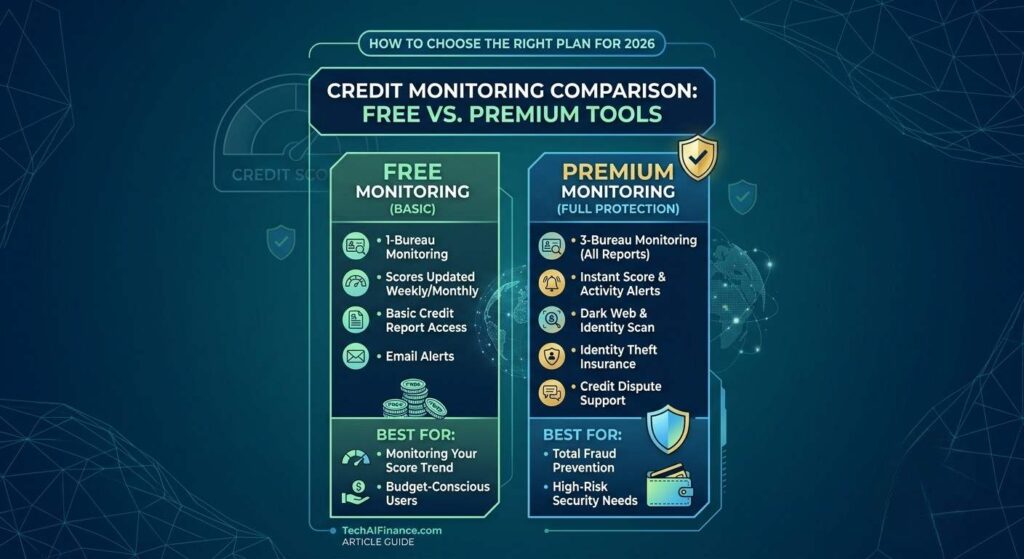
Free services are adequate for most Americans for general credit health monitoring. The free three-bureau stack described in this guide, combining Credit Karma, Experian Free and Capital One CreditWise, provides comprehensive coverage at zero cost. Paid services add value primarily through identity theft insurance, managed restoration services, dark web monitoring for a broader range of personal information and family coverage. If you have been a recent victim of identity theft or had a major data breach expose your Social Security number, a paid service for 12 months is a reasonable additional investment.
Can credit monitoring prevent identity theft?
No. Credit monitoring detects identity theft after it occurs by alerting you to changes on your credit report. It does not prevent fraud from happening. The most effective prevention tool is a credit freeze at all three bureaus, which prevents new accounts from being opened in your name. Combine a credit freeze with free credit monitoring for the strongest combination of prevention and detection available at no cost.
| ⭐ Key Takeaway You do not need to pay for credit monitoring to protect yourself effectively in 2026. The free three-app stack of Credit Karma plus Experian Free plus Capital One CreditWise covers all three bureaus, provides FICO score access, includes free dark web monitoring and costs exactly $0. Add a free credit freeze at all three bureaus and you have the most powerful combination of fraud detection and prevention available to any American consumer. The credit freeze is free by federal law and takes 15 minutes to set up at all three bureaus. |
Conclusion
Credit monitoring is not a luxury product. It is a practical tool that gives you visibility into one of the most important financial assets you own, your credit profile, and alerts you when something changes without your knowledge. The identity theft landscape in 2026 makes early detection genuinely valuable: the average American who catches fraudulent activity within days rather than months saves significant time, money and stress in the resolution process.
The right credit monitoring setup for most Americans costs nothing. Use the free three-app stack for bureau coverage, freeze your credit at all three bureaus for prevention and upgrade to a paid service only if your specific situation, a past identity theft event, a major data breach or a family protection need, justifies the additional cost.
For Americans who want to understand how their credit score is calculated and how to improve it before applying for major credit, our guide on how to improve your credit score fast covers every factor in the FICO scoring model and the specific actions that produce the fastest improvement. For those preparing to use their credit score for a mortgage application, our guide on how to buy your first home in the US step by step covers what credit score is needed at each loan tier and how lenders use scores differently from credit monitoring apps.
| 📲 Share This Guide If this guide helped you set up better credit monitoring or understand which app is right for your situation, share it with someone who checks their credit score only once a year. Share on WhatsApp, Facebook or by text message. Thank you for reading TechAIFinance.com. |
Read Next
Continue building your financial knowledge on TechAIFinance.com:
- How to Buy Your First Home in the US Step by Step 2026
- How to Build Generational Wealth in the US
- Best High Yield Savings Accounts in the US 2026
- How to Make Money From Real Estate Without Buying Property
- How to Build Generational Wealth in the US
| ✍ About the Author Written by: TechAIFinance Editorial Team Edited and Fact-Checked by: Olayinka Adejugbe Olayinka Adejugbe is not a licensed financial advisor. The content on TechAIFinance.com is produced for educational purposes only and should not be treated as personalized financial advice. Olayinka is the founder and lead editor of TechAIFinance.com. He holds a Global Certification in Artificial Intelligence and Applied Innovation and an Award of Completion in Behavioral Counseling from the World Health Organization. With a strong working knowledge of personal finance and accounting principles, Olayinka oversees the editorial review of every article on this site to ensure accuracy, currency and practical usefulness. Every article on TechAIFinance.com is produced by our research team and reviewed by Olayinka before publication. We verify statistics against named authoritative sources and update content when circumstances change. Visit our About page to learn more about our editorial process. Use our Contact page to get in touch. |
Important Disclaimer
The content published on TechAIFinance.com is for educational and informational purposes only. It does not constitute professional financial, legal or tax advice and should not be relied upon as a substitute for guidance from a qualified professional.
Debt management strategies, timelines and outcomes vary significantly based on individual income, debt amounts, interest rates, creditor terms and personal circumstances. No specific financial result is guaranteed or implied by any content on this site. Always consult a qualified financial advisor, credit counselor or attorney before making significant financial decisions. Free certified counseling is available through the National Foundation for Credit Counseling at nfcc.org.