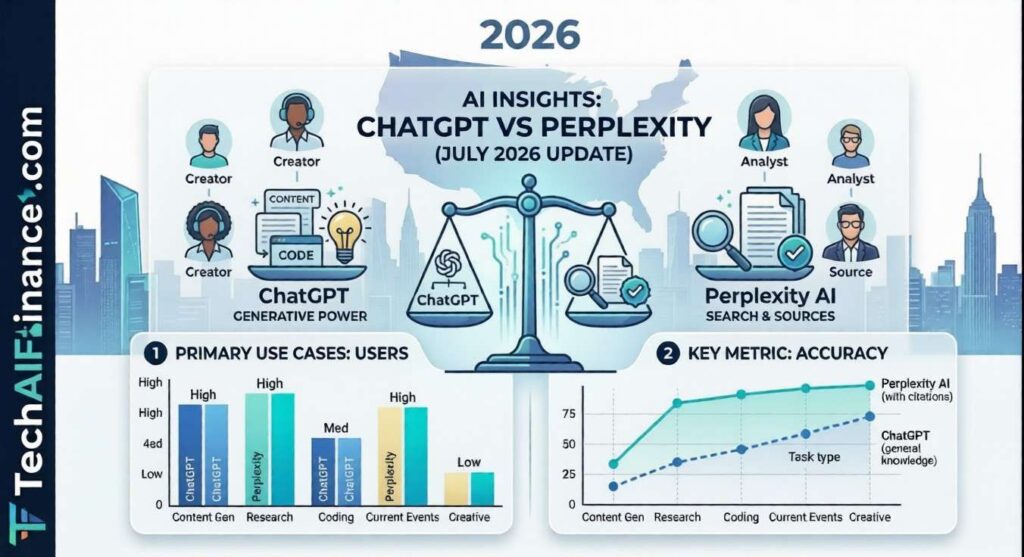
Most Americans using AI tools in 2026 started with ChatGPT and never looked further. That made sense in 2023 when ChatGPT was the clear leader and the alternatives were genuinely weak. In 2026 the landscape is different. Perplexity AI has grown to over 15 million active monthly users in the US and built a loyal following specifically among people who need accurate, sourced answers to real questions rather than creative generation. The two tools solve different problems well, and picking the wrong one wastes both money and time.
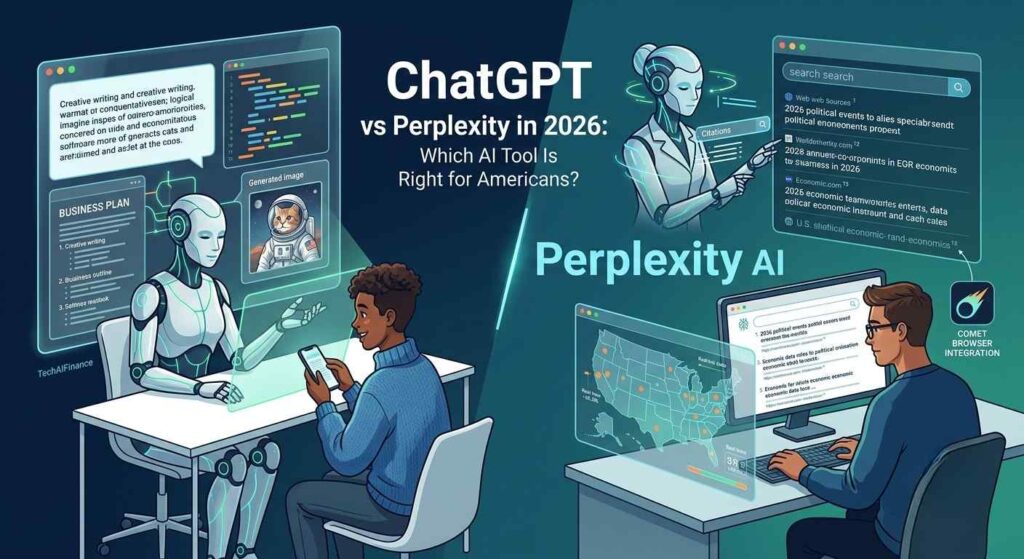
The core difference is this. ChatGPT is a generative AI assistant that produces text, code, analysis and creative content from a large language model trained on data up to a knowledge cutoff. Perplexity is an AI-powered search engine that retrieves current information from the web in real time and presents it with citations you can verify. Using ChatGPT for current events research is like asking a very knowledgeable friend who has not read the news in months. Using Perplexity for creative writing is like asking a librarian to write a novel.
This guide breaks down exactly what each tool does well, where each one fails, how the free and paid tiers compare and which situations call for which tool. By the end you will have a clear answer to whether you need ChatGPT, Perplexity or both.
This guide was written by Olayinka Adejugbe, founder of TechAIFinance.com and holder of a Global Certification in Artificial Intelligence and Applied Innovation.
| ℹ Quick Summary ChatGPT reached over 200 million weekly active users globally by early 2026, making it the most widely used AI assistant in the world, per OpenAI company announcements and Reuters reporting 2026. Perplexity AI grew to approximately 45 million monthly active users globally by mid-2026, more than doubling from 22 million at the start of 2025, driven largely by demand for real-time cited AI search results and the rollout of its Comet browser integration, per DemandSage 2026 and TechCrunch 2026 reporting. Approximately 58 percent of American knowledge workers used an AI assistant at least weekly by Q1 2026, up from 37 percent in Q1 2025, per the McKinsey Global Institute AI at Work Report 2026. Americans who use AI tools for research tasks report saving an average of 2.1 hours per week compared to traditional search-based research workflows, per a Stanford HAI Human-Centered AI Report 2025. The paid AI tool subscription market in the US grew to approximately $4.8 billion in annual consumer spending by early 2026, with ChatGPT Plus and Perplexity Pro among the three most subscribed individual AI products, per Sensor Tower consumer subscription data 2026. |
| 📘 What This Guide Covers The fundamental difference between ChatGPT and Perplexity and why it matters for your use case Full honest review of ChatGPT: free tier, Plus subscription, strengths and real limitations Full honest review of Perplexity AI: free tier, Pro subscription, strengths and real limitations Side-by-side comparison across 8 key use cases: research, writing, coding, math, current events and more Free tier comparison: exactly what each tool gives you without paying a dollar Which tool is worth paying for and which subscription pays for itself fastest A real-world example showing two Americans using each tool for different goals A clear decision framework: which tool to use for which task |
Table of Contents
- The Core Difference Between ChatGPT and Perplexity
- ChatGPT in 2026: Full Review
- Perplexity AI in 2026: Full Review
- Head-to-Head Comparison: 8 Key Use Cases
- Free Tier Comparison: What You Get Without Paying
- Paid Plans: Which Subscription Is Worth It
- Which Tool Is Right for Your Situation
- Real-World Example: Two Americans, Two Tools
- Frequently Asked Questions
The Core Difference Between ChatGPT and Perplexity
What is the difference between ChatGPT and Perplexity?
| ChatGPT is a generative AI assistant that creates original text, code, analysis and creative content from a language model trained on data up to a knowledge cutoff date. Perplexity is an AI-powered search engine that retrieves real-time information from the web and presents it with clickable source citations. ChatGPT excels at writing, analysis and creative tasks. Perplexity excels at research, current events and questions where accuracy and source verification matter most. |
The easiest way to understand the difference is through what each tool is doing when you ask it a question. ChatGPT generates a response from patterns learned during training. It is producing new text based on what it knows, not looking anything up in real time. Perplexity searches the current web, reads multiple sources, synthesizes the information and shows you exactly which sources it used. Neither approach is universally better. They are different tools for different jobs.
When the difference matters
- Use ChatGPT when: you need original writing, creative content, code, detailed explanations, brainstorming, summarizing documents you provide or any task where generation quality matters more than real-time accuracy.
- Use Perplexity when: you need current information, factual research with verifiable sources, news, recent data, prices, company information, local information or any question where you need to be able to check the source.
- Use both when: your workflow involves research followed by writing. Use Perplexity to gather current sourced facts, then paste those into ChatGPT to write the final output around them.
ChatGPT in 2026: Full Review
| ChatGPT remains the strongest general-purpose AI assistant available to Americans in 2026 for writing, coding, analysis and creative tasks. The free GPT-5.3 Instant tier available in 2026 is genuinely capable for most everyday tasks. ChatGPT Plus at $20 per month adds faster response times, access to advanced reasoning models and higher usage limits. The limitation is that ChatGPT’s knowledge has a cutoff date and it does not reliably cite real-time sources, making it weaker than Perplexity for current research. |
| ChatGPT (OpenAI) Best All-Purpose AI Assistant for Writing, Coding and Analysis Cost: Free tier available | ChatGPT Plus $20/month | ChatGPT Pro $200/month | Platform: iOS, Android, Web, API | Our Rating: 9.4/10 What it is ChatGPT is OpenAI’s flagship AI assistant, the most widely used AI product in the world with over 200 million weekly active users globally by early 2026, per Reuters 2026. It uses large language models to generate text, write and debug code, analyze data, answer complex questions, summarize documents and assist with virtually any language-based task. The free GPT-5.3 Instant tier available in 2026 is meaningfully more capable than what ChatGPT offered even on its paid tiers in previous years. How it works Open a free account at chatgpt.com. Type or paste your prompt in the conversation window. ChatGPT generates a response you can refine through follow-up messages in the same conversation. The conversation context allows you to build on previous responses, ask for revisions, request different formats or go deeper on any point. You can upload images, documents and files for analysis. You can use the voice feature to speak rather than type. ChatGPT remembers the context of your current conversation and can reference earlier messages in that session. Real numbers: The free tier includes GPT-5.3 Instant with usage limits that reset daily. ChatGPT Plus at $20 per month provides higher usage limits, faster response times during peak hours and access to flagship GPT-5.5 models. ChatGPT also offers a $100 per month Pro tier for heavy individual power users and a $200 per month tier for enterprise users, both providing maximum throughput, priority access and complex reasoning via GPT-5.6 Sol. Pricing verified at openai.com July 2026. AI strength: ChatGPT’s strength is generation quality across a wider range of tasks than any competitor. Writing quality, code accuracy, reasoning depth and instruction-following are consistently among the highest of any AI assistant available to American consumers. The flagship GPT-5.6 Sol model available on Pro tiers in 2026 is particularly strong at multi-step problems, advanced math and complex analysis that requires working through a problem sequentially rather than generating a quick answer. Honest limitation: ChatGPT does not search the web in real time by default on the free tier. Its knowledge has a training cutoff, meaning it cannot tell you what happened last week, what the current price of a stock is or what a company announced yesterday. While ChatGPT has a web browsing feature on paid tiers, it is slower and less reliable than Perplexity’s core real-time search capability. Using ChatGPT for current events research without the browsing feature produces confident-sounding but potentially outdated answers. Best for: Americans who need high-quality writing, code generation, document analysis, creative content or complex reasoning on tasks where real-time accuracy is less critical than output quality Source: ChatGPT pricing and features verified at openai.com, July 2026. User count per Reuters 2026 reporting. |
Perplexity AI in 2026: Full Review
Is Perplexity AI worth paying for in 2026?
| Perplexity AI’s free tier is genuinely useful for everyday research and is worth using before paying for anything. Perplexity Pro at $20 per month adds access to more powerful underlying AI models including GPT-5.5 and Claude for generating responses, deeper search across more sources, file upload and analysis capability and higher daily usage limits. Perplexity Pro is worth paying for if you conduct significant research regularly and need reliable sourced answers to current questions as part of your daily work. |
| Perplexity AI Best AI Tool for Real-Time Research With Verifiable Sources Cost: Free tier available | Perplexity Pro $20/month or $200/year | Platform: iOS, Android, Web, API | Our Rating: 9.1/10 What it is Perplexity AI is an AI-powered answer engine that combines real-time web search with AI synthesis to produce sourced, cited answers to questions. Rather than generating text from a static training dataset the way ChatGPT does by default, Perplexity actively searches the current web, reads multiple sources simultaneously and synthesizes the information into a direct answer with numbered citations linking to the original sources. Every factual claim in a Perplexity response is tied to a source you can click and verify. How it works Go to perplexity.ai and type your question in natural language as if asking a knowledgeable colleague. Perplexity searches the web, processes the results using its AI model and delivers an answer with numbered inline citations. Below the answer you see a list of the sources used. Click any citation to read the original source. You can ask follow-up questions in the same thread and Perplexity maintains context. The free tier uses Perplexity’s own search model. The Pro tier lets you choose which AI model generates the response, including GPT-5.5, Claude and others, on top of Perplexity’s real-time search layer. Real numbers: The free tier includes unlimited basic searches with standard AI model responses and source citations at no cost. Perplexity Pro at $20 per month or $200 per year adds access to advanced AI models for generating responses, deeper web search, file and image upload for analysis, and significantly higher daily usage limits. The annual plan saves $40 per year over monthly billing. Pricing verified at perplexity.ai July 2026. AI strength: Real-time web search with source citations is Perplexity’s core capability and the feature no other free AI tool matches as reliably. The ability to read a Perplexity answer and click every factual claim to verify it against the original source addresses the hallucination problem that affects generative AI tools like ChatGPT. For research tasks where accuracy matters and where the information may have changed recently, Perplexity’s citation model is a meaningful practical advantage. Honest limitation: Perplexity is weaker than ChatGPT at generative tasks including long-form writing, creative content, code generation and complex multi-step analysis. Its responses are typically shorter and more factual than ChatGPT’s, which suits research but is limiting for writing assistance. The quality of responses on the free tier is also noticeably lower than Perplexity Pro for complex questions since the Pro tier’s access to GPT-5.5 and Claude for response generation produces significantly better synthesis of the research it finds. Best for: Americans who need current, accurate, source-verified information for research, work, investing decisions, news tracking, product research or any task where being able to check the source matters Source: Perplexity AI pricing and features verified at perplexity.ai, July 2026. User growth per TechCrunch 2026 reporting. |

Head-to-Head Comparison: 8 Key Use Cases
Which is better for research: ChatGPT or Perplexity?
| Perplexity is better than ChatGPT for research in 2026 because it retrieves current information from the live web and cites every source. ChatGPT generates responses from its training data which has a knowledge cutoff and does not cite sources by default. For research on recent events, current statistics, company information or anything that may have changed in the past year, Perplexity produces more reliable and verifiable results. | ||||
| Use Case | ChatGPT | Perplexity | Winner | |
| Current events and news | Weak – knowledge cutoff limits recency | Strong – real-time web search | Perplexity | |
| Long-form writing | Excellent – highest quality output | Average – response style is factual not narrative | ChatGPT | |
| Research with citations | Moderate – does not cite sources by default | Excellent – every claim linked to source | Perplexity | |
| Code writing and debugging | Excellent – strongest coding AI available free | Weak – not designed for code generation | ChatGPT | |
| Math and complex reasoning | Excellent – GPT-5.6 Sol is the flagship reasoning model | Average – handles basic math reliably | ChatGPT | |
| Product and price research | Weak – prices outdated at knowledge cutoff | Strong – current pricing from live web | Perplexity | |
| Summarizing documents you upload | Excellent – handles long documents well | Good – file upload on Pro tier only | ChatGPT | |
| Quick factual questions | Good – accurate for established facts | Excellent – real-time sourced answer | Perplexity | |
Free Tier Comparison: What You Get Without Paying
Both tools offer genuinely useful free tiers in 2026. Before paying for either, understand exactly what the free version includes and whether it covers your actual use case.
| ChatGPT Free Tier (2026) Model: GPT-5.3 Instant with daily usage limits Web browsing: Basic web search included on free tier File upload: Yes, with limits Features: Standard response speeds, file attachments and image analysis Image generation: Not included on free tier Memory: Basic memory features included Best for: Writing, coding, general questions and casual everyday tasks where real-time accuracy is not critical |
| Perplexity Free Tier (2026) Model: Perplexity standard search model with unlimited basic searches Web search: Real-time web search with citations on every response File upload: Not included on free tier Advanced AI models: Not available on free tier. Pro models require subscription Daily limits: 5 Pro searches per day included free Best for: Research, current events and sourced factual questions where verifiability matters |
| 💡 Pro Tip Use both free tiers before paying for either one. The ChatGPT free tier and Perplexity free tier together cover most American users’ AI needs without any subscription cost. The combination of ChatGPT for writing and generation plus Perplexity for research and sourced facts is more powerful than either paid tier alone for most use cases. Only upgrade to a paid subscription if you are hitting the usage limits of the free tier regularly. |
Paid Plans: Which Subscription Is Worth It
Is ChatGPT Plus or Perplexity Pro worth paying for?
| ChatGPT Plus at $20 per month is worth paying for if you use AI daily for writing, coding or complex analysis and regularly hit the free tier’s usage limits. The jump in reasoning and generation quality from GPT-5.3 Instant to GPT-5.5 on Plus is noticeable for complex tasks. Power users needing maximum compute can also explore the $100 Pro tier. Perplexity Pro at $20 per month is worth paying for if you conduct significant research regularly and need access to advanced AI models including GPT-5.5 and Claude for higher quality synthesis of live web search results. If budget is limited, choose the tool that matches your primary use case. | ||
| Feature | ChatGPT Plus $20/month | Perplexity Pro $20/month |
| Primary value | Higher usage limits, GPT-5.5 flagship and $100 Pro tier option | Advanced AI models plus unlimited Pro searches |
| AI models included | GPT-5.5, GPT-5.6 Sol on Pro tiers and others | GPT-5.5, Claude, Sonar Large and others |
| Real-time web search | Yes but slower than Perplexity | Yes – core feature, fast and reliable |
| File upload | Yes with higher limits | Yes included on Pro |
| Image generation | Yes – DALL-E included | Not included |
| Annual discount | $240/year (no annual discount) | $200/year saves $40 vs monthly |
| Best for | Daily AI writers, coders and analysts | Daily researchers and information workers |
| ⚠ Watch Out Do not pay for both ChatGPT Plus and Perplexity Pro simultaneously unless you have a specific professional workflow that genuinely requires both at scale. For most Americans, the ChatGPT free tier plus Perplexity free tier covers everyday needs. If one tool is clearly more central to your work, pay for that one only. Both products offer trial periods. Use the free tiers for two full weeks before committing to any paid subscription. | ||
Which Tool Is Right for Your Situation
| Quick Decision Guide I need to write something: ChatGPT I need to research something current: Perplexity I need to write code: ChatGPT I need today’s news or recent data: Perplexity I need to analyze a document I upload: ChatGPT (free) or Perplexity Pro I need sourced facts I can verify: Perplexity I need creative content: ChatGPT I need complex math or reasoning: ChatGPT Plus or Pro with GPT-5.5 or GPT-5.6 Sol I need both research and writing: Use Perplexity to research then ChatGPT to write |
| 💡 Real-World Example Consider two hypothetical Americans who both started using AI tools in early 2026 with different goals. Marcus is 34 and works as a financial analyst in Chicago, Illinois. He needs to research market trends, company earnings reports and economic data daily. He started with ChatGPT but found it consistently gave him figures that were months out of date with no way to verify them against a source. He switched to Perplexity and immediately noticed the difference: every answer came with clickable citations he could verify against the original press release or financial filing. He upgraded to Perplexity Pro at $20 per month and reports saving approximately 90 minutes per day compared to his previous workflow of manually searching and reading multiple sources for each research question. Diana is 29 and works as a marketing manager in Austin, Texas. She uses AI primarily to draft email campaigns, write social media copy and brainstorm campaign concepts. She tried Perplexity first because a colleague recommended it, but found it gave her short factual responses rather than the engaging, creative marketing copy she needed. She switched to ChatGPT and found it produced polished first drafts she could refine in minutes rather than hours. She uses the free tier and has never felt the need to upgrade since her primary use case stays well within the free usage limits. Marcus and Diana both use AI tools daily. They chose different ones because they needed different things from AI. Neither choice is wrong. The tool fits the task. These examples are illustrative. Actual results depend on individual circumstances and workflow. |
Frequently Asked Questions
Can Perplexity replace Google Search in 2026?
For many research queries Perplexity produces better results than a standard Google search because it synthesizes information from multiple sources into a direct answer rather than requiring you to click through multiple pages and read each one. However Perplexity does not replace Google entirely. Google is still stronger for local searches, image searches, finding specific websites and navigating to pages you already know exist. The two tools serve overlapping but distinct needs.
Does ChatGPT still hallucinate in 2026?
Yes, though less frequently than in earlier versions. ChatGPT and other large language models can still generate confident-sounding but factually incorrect statements, particularly for specific facts, statistics, dates, names and citations. This is the core reason Perplexity is the better choice for research tasks where accuracy matters. When using ChatGPT for factual claims, verify important statistics against an independent source before using them.
Is Perplexity Pro better than ChatGPT Plus for the same price?
They are better at different things and the same price comparison misses the point. Perplexity Pro at $20 per month is better than ChatGPT Plus at the same price for research, current events and sourced factual questions. ChatGPT Plus is better than Perplexity Pro for writing, code, creative tasks and complex reasoning. The question is which one you actually use most. Subscribe to the one that matches your primary use case and use the free tier of the other as a supplement.
Which tool is better for students?
For academic research Perplexity is significantly better because it provides citations that can be verified, which is essential for academic work where sourcing claims matters. For writing assistance, essay drafting and concept explanation ChatGPT is stronger. Most students benefit from using both: Perplexity to find and verify sources, ChatGPT to help structure arguments and refine writing. Both tools have free tiers adequate for most student use cases without requiring a subscription.
Is there a free way to use ChatGPT with real-time web search?
The free ChatGPT tier includes limited web browsing capability but it is slower and less reliable than Perplexity’s core search function. For real-time research at no cost, Perplexity’s free tier is the better option. If you need both generation quality and real-time search in one tool, ChatGPT Plus includes more reliable browsing than the free tier, but Perplexity Pro’s search layer remains more consistent for pure research tasks even on its ow
n paid tier.
Which AI tool is better for side hustle and small business use?
For side hustle and small business use the answer depends entirely on what the business does. Content creators, writers and marketers get more value from ChatGPT’s generation capabilities. Consultants, researchers and information workers get more value from Perplexity’s sourced real-time answers. Many small business owners use both: Perplexity to research competitors, market trends and current information, and ChatGPT to turn that research into content, proposals and communications. Our guide on how to use AI to get out of debt faster in the US 2026 covers additional ways to use AI tools for financial goals alongside your primary income.
| ⭐ Key Takeaway ChatGPT and Perplexity are not competing for the same job. ChatGPT generates. Perplexity searches. The right answer for most Americans is to use both free tiers rather than paying for one. If your primary AI use is writing, code or creative work, ChatGPT is your main tool and Perplexity is your research supplement. If your primary use is research, current information and sourced facts, Perplexity is your main tool and ChatGPT is your writing supplement. Only pay for a subscription when you are consistently hitting the free tier limits of the tool you use most. |
Conclusion
The ChatGPT vs Perplexity question does not have a single right answer because the tools are genuinely different in what they do well. ChatGPT is the strongest generative AI assistant available to American consumers in 2026 for creating original content, code and analysis. Perplexity is the strongest AI-powered research tool for accessing current, sourced, verifiable information from the live web. Using one for what the other is better at produces consistently worse results than matching the tool to the task.
For Americans building income through AI-assisted work, our guide on how to use AI to get out of debt faster in the US 2026 shows how to apply AI tools including ChatGPT practically to real financial goals. For those comparing a wider range of AI tools for specific professional tasks, our how to use AI to write a resume that gets interviews in the US 2026 guide covers the best AI workflow for job seekers using both research and writing tools together.
| 📲 Share This Guide If this comparison helped you decide which AI tool fits your situation, share it with someone still using the wrong one for their needs. Share on WhatsApp, Facebook or by text message. Thank you for reading TechAIFinance.com. |
Read Next
Continue building your AI knowledge on TechAIFinance.com:
- How to Use AI to Get Out of Debt Faster in the US 2026
- How to Use AI to Write a Resume That Gets Interviews in the US 2026
- How to Negotiate a Higher Salary Using AI Tools in the US 2026
- Best Credit Monitoring Apps for Americans 2026
- How to Build Wealth on a Single Income in the US 2026
| ✍ About the Author Written by: TechAIFinance Editorial Team Edited and Fact-Checked by: Olayinka Adejugbe Olayinka Adejugbe is not a licensed financial advisor. The content on TechAIFinance.com is produced for educational purposes only and should not be treated as personalized financial advice. Olayinka is the founder and lead editor of TechAIFinance.com. He holds a Global Certification in Artificial Intelligence and Applied Innovation and an Award of Completion in Behavioral Counseling from the World Health Organization. With a strong working knowledge of personal finance and accounting principles, Olayinka oversees the editorial review of every article on this site to ensure accuracy, currency and practical usefulness. Every article on TechAIFinance.com is produced by our research team and reviewed by Olayinka before publication. We verify statistics against named authoritative sources and update content when circumstances change. Visit our About page to learn more about our editorial process. Use our Contact page to get in touch. |
Disclaimer & Content Note
The information provided on TechAIFinance.com—including content on personal finance, side hustles, AI tools, and tech reviews is for educational and informational purposes only and does not constitute professional financial, legal, tax, or technical advice. Financial outcomes, business earnings, and tech performance vary based on individual circumstances and market conditions. TechAIFinance.com makes no guarantees regarding results or tool performance. Always consult a qualified professional before making major financial, business, or tech purchasing decisions. Free certified credit counseling is available through the National Foundation for Credit Counseling at nfcc.org.