| ⚠ Affiliate Disclosure Some links in this article are affiliate links. If you sign up through a link on this page, TechAIFinance.com may earn a commission at no additional cost to you. This does not influence our ratings or rankings. Every card was evaluated on its published rewards structure, fees, and terms as of the publish date above. |

Most professions do not require employees to buy their own supplies just to do the job properly. Teaching is a well-known exception. According to a September 2025 survey of American Federation of Teachers members, K-12 teachers expected to spend up to $600 of their own money on their students during the 2025-2026 school year, and that figure covers only what teachers reported, not what many quietly absorb without tracking.
None of that spending gets reimbursed in most districts. It comes out of a paycheck that, per Nurse.com-style salary data for the broader public sector, already trails inflation in many states. The one lever teachers do control is which card they reach for at the checkout counter. Used deliberately, a rewards card can turn a portion of unavoidable classroom spending into real cash back, and a federal tax deduction can claw back a bit more at filing time.
This guide compares five cards against the categories where teachers actually spend: groceries and classroom snacks, Amazon orders for books and supplies, dining and drugstore runs, and everything else that does not fit a bonus category. We also cover the Educator Expense Deduction, since it works alongside any card you choose and most eligible teachers never claim the full amount they are entitled to.
This guide was written by Olayinka Adejugbe, holder of a Global Certification in Artificial Intelligence and Applied Innovation, for TechAIFinance.com.
| ℹ Quick Summary K-12 teachers expected to spend up to $600 of their own money on students during the 2025-2026 school year. Source: American Federation of Teachers member survey, September 2025. The Educator Expense Deduction lets eligible K-12 educators deduct up to $300 in unreimbursed classroom expenses for the 2025 tax year, rising to $350 for the 2026 tax year. Source: IRS Topic No. 458, 2026. The Amex Blue Cash Preferred Card earns 6% cash back at U.S. supermarkets on up to $6,000 per year, then 1%, for a $0 intro annual fee that becomes $95 after year one. Source: americanexpress.com, 2026. The Amazon Prime Visa earns 5% back at Amazon.com and Whole Foods for Prime members, with no annual card fee. Source: chase.com, 2026.The Wells Fargo Active Cash Card earns a flat 2% cash back on every purchase with no bonus categories to track and no annual fee. Source: wellsfargo.com, 2026. The Chase Freedom Unlimited Card earns 3% on dining and drugstores, alongside a 1.5% flat baseline on general spending, with no annual fee. Source: chase.com, 2026. The NEA Customized Cash Rewards Card gives NEA members a customizable 3% choice category (6% intro in year one) for targeted shopping. Source: neamb.com, 2026. |
| 📘 What This Guide Covers Why teachers need a different approach to picking a rewards credit card Full reviews of the Amex Blue Cash Preferred, Amazon Prime Visa, Wells Fargo Active Cash, Chase Freedom Unlimited, and NEA Customized Cash Rewards cards A side-by-side comparison table covering all five cards at a glance How the federal Educator Expense Deduction works alongside your credit card rewards A real-world example comparing two teachers with different card strategies Answers to common questions about credit cards and classroom spending |
Table of Contents
1. Why Teachers Need a Different Kind of Rewards Card
2. The Five Best Credit Cards for Teachers in 2026
3. Best Credit Cards for Teachers at a Glance
4. The Educator Expense Deduction: Reclaiming Part of What You Spend
5. Real-World Example: Two Teachers, Two Card Strategies
6. Frequently Asked Questions
7. Key Takeaway
8. Conclusion
Why Teachers Need a Different Kind of Rewards Card
| Teachers spend out of pocket on groceries for class parties, Amazon orders for books and supplies, and general classroom decor, categories that rarely line up with premium travel card perks. The right card for a teacher rewards ordinary spending at supermarkets and online retailers rather than airport lounges or hotel stays most educators rarely use. |
Most credit card rewards guides are built around travel: airport lounges, hotel status, airline miles. That framework does not map onto how most teachers actually spend, both because classroom budgets do not stretch to premium annual fees and because the spending categories are different. A teacher buying pencils, folders, and snacks for a class party is spending at a grocery store or a big-box retailer, not booking business class to Tokyo.
The practical filter for a teacher-friendly card is simple: does it reward supermarkets, does it reward Amazon or general online retail, and does it keep the annual fee low enough that the rewards clearly outpace the cost. Cards that only pay well on travel or dining miss most of what a teacher actually charges during a school year.
| ⚠ Watch Out Do not put classroom spending on a card you cannot pay off in full each month. Interest rates on the cards in this guide run from roughly 18 percent to 30 percent variable APR. A single month of carried balance at those rates erases far more value than any cash back rate can recover, even on a 6 percent grocery card. |
The Five Best Credit Cards for Teachers in 2026
Each of these cards leads in a different category that matters to teachers: groceries and streaming, Amazon and classroom books, simple flat-rate spending with nothing to track, dining and drugstore runs, or a customizable category for NEA members.
| Card A: Blue Cash Preferred Card from American Express Best for Groceries and Class Party Supplies Key Metrics: 6% cash back at U.S. supermarkets on up to $6,000/yr (then 1%), 6% on select U.S. streaming, 3% on gas and transit, $0 intro annual fee for year one then $95 What It Is: A cash back card built around grocery spending, which covers most class party snacks, tissues, hand sanitizer, and other supermarket-bought classroom items How It Works: Cash back is earned as Reward Dollars redeemable as a statement credit or at Amazon checkout, which means grocery-run classroom purchases and Amazon supply orders can both draw from the same rewards balance Real Numbers: A teacher spending $500 a month at U.S. supermarkets earns $360 a year at the 6% rate, before counting streaming, gas, or transit categories, comfortably covering the $95 fee that kicks in after the first year AI Tools Angle: The card itself uses no AI-driven features. Amex’s fraud detection systems use machine learning behind the scenes to flag unusual transactions, but this is a security layer, not a spending tool the cardholder interacts with Honest Limitation: The 6% rate excludes warehouse clubs and superstores; Costco, Sam’s Club, Walmart, and Target purchases only earn the base 1% rate, which matters since many teachers buy classroom supplies at exactly those retailers Best For: Teachers who do most of their classroom snack and supply shopping at traditional grocery stores rather than big-box retailers Our Rating: 8.8 out of 10 Source: americanexpress.com, terms verified 2026 |
| Card B: Amazon Prime Visa Best for Amazon Classroom Orders Key Metrics: 5% back at Amazon.com and Whole Foods for Prime members (3% without Prime), $0 annual card fee, requires an active Amazon Prime membership What It Is: A co-branded card built around Amazon spending, which covers a large share of what teachers buy for classroom libraries, bulletin board supplies, and small technology purchases How It Works: Rewards post as points worth one cent each, usable directly at Amazon checkout the next day or redeemable for cash back, gift cards, or travel through Chase, so a teacher can apply earned rewards to the next supply order almost immediately Real Numbers: A teacher spending $400 a month on Amazon and Whole Foods earns roughly $240 a year in cash back at the 5% Prime rate, and new applicants can receive an instant Amazon gift card upon approval AI Tools Angle: Amazon’s product recommendation and rotating “10% back or more” category selections rely on Amazon’s internal algorithms, though this affects which items get bonus rewards rather than offering the cardholder a generative AI assistant Honest Limitation: The best rate requires an active Prime membership, which costs $139 a year or $14.99 a month separately from the card, and spending outside Amazon, Whole Foods, and the 2% categories earns only 1% Best For: Teachers who already have Prime and regularly order classroom books, supplies, or technology through Amazon Our Rating: 8.5 out of 10 Source: chase.com and amazon.com, terms verified 2026 |
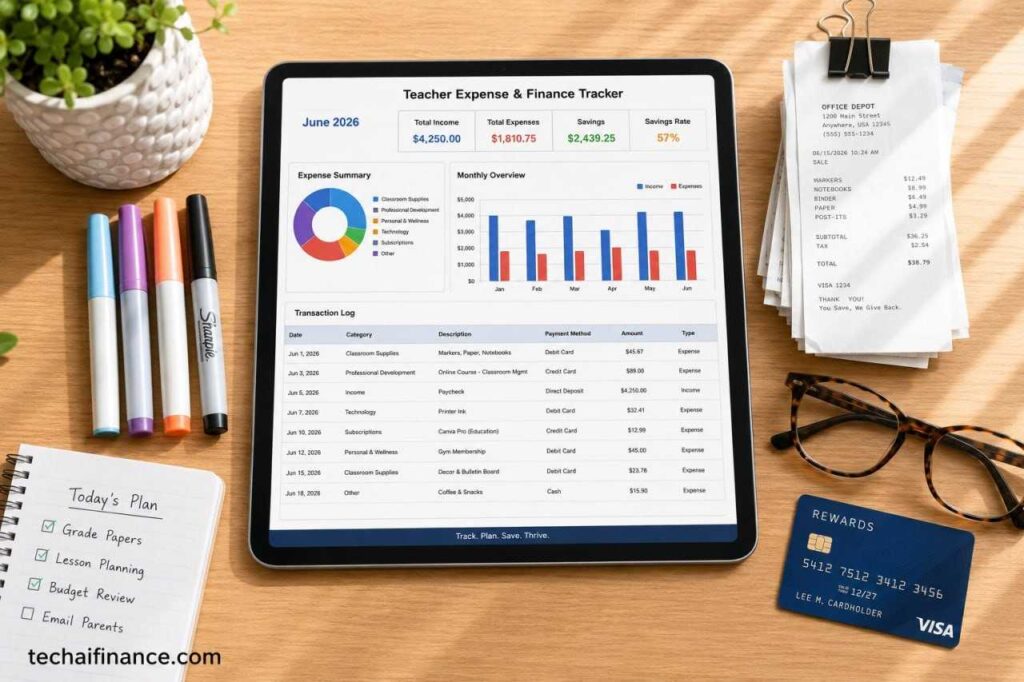
| Card C: Wells Fargo Active Cash Card Best for Simplicity, No Categories to Track Key Metrics: Flat 2% cash back on every purchase, $200 bonus after $500 spent in the first 3 months, $0 annual fee, 0% intro APR for 12 months on purchases What It Is: A flat-rate cash back card with a single earn rate on every purchase, regardless of where it happens How It Works: Every purchase, whether it is at a supermarket, a warehouse club, a craft store, or an online retailer that does not fit another card’s bonus categories, earns the same 2% rate, which removes the mental overhead of remembering which card to use where Real Numbers: The card’s regular variable APR runs from roughly 18.49% to 28.49% after the 12-month intro period, so the flat rewards rate only pays off if the balance is paid in full each month AI Tools Angle: Wells Fargo’s mobile app includes automated spending alerts and budgeting summaries built on rule-based categorization rather than a conversational AI assistant; the card itself carries no AI-specific rewards feature Honest Limitation: The flat 2% rate is lower than the Blue Cash Preferred’s 6% grocery rate or the Prime Visa’s 5% Amazon rate for teachers who spend heavily in either specific category Best For: Teachers who want one card for everything without tracking bonus categories, or who shop frequently at warehouse clubs and superstores that other cards exclude from their top rate Our Rating: 8.6 out of 10 Source: wellsfargo.com, terms verified 2026 |
| Card D: Chase Freedom Unlimited Best for Dining, Drugstores, and Everyday Flat-Rate Backup Key Metrics: 1.5% cash back on every purchase, 3% on dining and drugstores, 5% on travel booked through Chase Travel, $0 annual fee What It Is: A no-annual-fee flat-rate card from Chase that pays elevated rates on two categories many teachers hit often: restaurant takeout for a busy week and drugstore runs for classroom first-aid or cleaning supplies How It Works: Every purchase earns at least 1.5% cash back automatically, with dining and drugstore purchases bumped to 3% and no need to activate categories or track rotating quarters Real Numbers: A teacher spending $150 a month on dining and takeout plus $75 a month at drugstores earns roughly $81 a year from those two categories alone at the 3% rate, on top of 1.5% on everything else AI Tools Angle: Chase’s mobile app uses machine learning-based fraud monitoring and spending insights that flag unusual charges, but the card carries no generative AI feature the cardholder interacts with directly Honest Limitation: The 5% travel rate only applies to bookings made through the Chase Travel portal, and the 1.5% base rate on general classroom spending trails the Active Cash Card’s flat 2% Best For: Teachers who eat out or order takeout regularly during the school week and want a no-fee card that also covers drugstore runs without tracking rotating categories Our Rating: 8.4 out of 10 Source: chase.com, terms verified 2026 |
| Card E: NEA Customized Cash Rewards Credit Card Best for NEA Members Who Want a Choice Category Key Metrics: 6% cash back for the first year in one chosen category, including online shopping (then 3%), 2% at grocery stores and wholesale clubs, 1% on everything else, $0 annual fee, requires NEA membership What It Is: A Bank of America card marketed to National Education Association members that lets the cardholder pick one bonus category each month, with online shopping as a natural fit for classroom orders from Amazon and similar retailers How It Works: Cardholders choose a bonus category, such as online shopping, dining, or drugstores, and earn an elevated rate on up to $2,500 in combined bonus-category and grocery spending each quarter, then 1% after that Real Numbers: A teacher who sets the bonus category to online shopping and spends $200 a month there earns close to $144 in the first year at the combined 6% introductory rate, plus 2% on grocery store classroom purchases AI Tools Angle: Bank of America’s Erica virtual assistant can answer account questions and flag spending patterns using natural language processing, though this is a banking app feature rather than a reward tied to card spending Honest Limitation: Only NEA members and their immediate family can apply, the elevated rate drops from 6% to 3% after the first year, and bonus-category earnings are capped at $2,500 in combined quarterly spending Best For: NEA members who concentrate spending in one category, particularly online shopping for classroom supplies, and who do not mind a quarterly spending cap on bonus rewards Our Rating: 8.0 out of 10 Source: neamb.com and bankofamerica.com, terms verified 2026 |
| 💡 Pro Tip Pair a category card with a flat-rate card instead of relying on just one. Use the Blue Cash Preferred or Prime Visa for grocery and Amazon purchases, then fall back to a flat 2% card like the Active Cash for warehouse clubs, craft stores, and anything else. This two-card approach usually outperforms any single card for a teacher’s mixed spending pattern. |

Best Credit Cards for Teachers at a Glance
| Card | Best For | Key Rate | Annual Fee |
| Blue Cash Preferred (Amex) | Grocery and class party supplies | 6% U.S. supermarkets (cap $6,000/yr) | $0 intro, then $95 |
| Amazon Prime Visa | Amazon and Whole Foods orders | 5% with Prime (3% without) | $0 |
| Wells Fargo Active Cash | One flat rate, no categories | 2% on everything | $0 |
| Chase Freedom Unlimited | Dining, drugstores, and Chase Travel | 3% dining/drugstore, 1.5% other | $0 |
| NEA Customized Cash Rewards | NEA members who want a choice category | 6% first year in chosen category (then 3%) | $0 |
The Educator Expense Deduction: Reclaiming Part of What You Spend
| The Educator Expense Deduction lets eligible K-12 teachers, instructors, counselors, principals, and aides who work at least 900 hours a school year deduct unreimbursed classroom costs directly from taxable income, whether or not they itemize. For the 2025 tax year the cap is $300 per eligible educator; it rises to $350 for the 2026 tax year. |
Cash back rewards are only half the picture. The federal Educator Expense Deduction lets eligible K-12 teachers, instructors, counselors, principals, and aides deduct unreimbursed classroom expenses directly from their taxable income, and it applies whether or not you itemize. Qualified expenses include books, classroom supplies, computer equipment and related software, and professional development courses tied to your curriculum.
For the 2025 tax year, the deduction caps at $300 per eligible educator, or $600 combined if both spouses in a married filing jointly household are eligible educators. Starting with the 2026 tax year, the above-the-line cap rises to $350 per educator.
On top of that, starting in 2026 under the One Big Beautiful Bill Act (OBBBA), a new, uncapped itemized deduction becomes available for educators whose qualifying expenses exceed the $350 above-the-line amount. To claim this additional write-off, you must itemize your deductions on Schedule A instead of taking the standard deduction, so it makes the most sense if your total itemized deductions, including the extra classroom spending, exceed the standard deduction threshold.
To qualify, you need to work as a K-12 teacher, instructor, counselor, principal, or aide for at least 900 hours during the school year at a school that provides elementary or secondary education (starting in 2026, the itemized deduction also extends to interscholastic sports coaches and administrators). Keep receipts for everything you plan to claim. Combined with a rewards card that returns 5 to 6 percent on the same purchases, the deduction and the cash back work on the same spending without canceling each other out.
| 💡 Pro Tip Keep classroom purchases on one dedicated card throughout the school year. When tax season arrives, that single statement history becomes your receipt trail for the Educator Expense Deduction, which is far easier than reconstructing purchases from a mix of cash, debit, and multiple cards. |
Real-World Example: Two Teachers, Two Card Strategies
| 💡 Real-World Example Rachel Owens, 31, teaches third grade in Columbus, Ohio, and spends heavily on classroom snacks and party supplies from her local supermarket. She put her classroom spending on the Blue Cash Preferred Card and earned $340 in cash back over the school year from grocery purchases alone, enough to cover the $95 second-year annual fee more than three times over, with the rest applied as a statement credit toward her card balance. Devon Marsh, 27, teaches high school science in Tucson, Arizona, and does most of his classroom book and lab-supply ordering through Amazon. He used the Prime Visa and earned $260 in Amazon rewards over the same period, which he redeemed directly at checkout on his next classroom order rather than waiting for a statement credit. At tax time, both teachers also claimed the $350 Educator Expense Deduction on their unreimbursed purchases, reducing their taxable income in addition to the cash back already earned. These examples are illustrative. Actual results depend on individual circumstances. |
Frequently Asked Questions
What is the best credit card for teachers who buy classroom supplies?
It depends on where you shop most. The Blue Cash Preferred Card leads for supermarket purchases, while the Amazon Prime Visa leads for classroom books and supplies ordered online through Amazon.
Are there credit cards designed specifically for teachers?
The NEA Customized Cash Rewards Credit Card is marketed toward National Education Association members and offers a welcome bonus plus a rotating choice cash back category, though it is issued by Bank of America and requires NEA membership to access its full benefits.
Does the Educator Expense Deduction cover credit card interest?
No. The deduction covers unreimbursed classroom supplies, equipment, and eligible professional development, not interest charges on a credit card balance. Paying your balance in full each month keeps the rewards and the deduction working in your favor.
Can I claim the Educator Expense Deduction and still earn credit card cash back on the same purchase?
Yes. The deduction reduces your taxable income at filing time, while cash back rewards are earned separately at the point of purchase. Neither one cancels out the other.
What is the maximum Educator Expense Deduction for 2026?
For the 2026 tax year, the above-the-line deduction caps at $350 per eligible educator, up from $300 in 2025, and you can claim it even if you take the standard deduction. For expenses beyond $350, a new uncapped itemized deduction is available starting in 2026, but claiming it requires itemizing on Schedule A instead of taking the standard deduction.
Should I use a business credit card if I also tutor privately?
If you have separate tutoring or side income, a business card like the Ink Business Cash Credit Card can make sense for that specific income stream, since it offers bonus categories on office supplies and services. For personal, out-of-pocket classroom spending, a personal cash back card is usually the simpler choice.
| ⭐ Key Takeaway There is no single best credit card for every teacher, because classroom spending patterns differ by grade level, subject, and shopping habits. Match the card to where you actually spend: the Blue Cash Preferred for grocery-heavy classrooms, the Prime Visa for Amazon-heavy ordering, or the Active Cash for a simple flat rate. Then claim the Educator Expense Deduction at tax time on top of whatever cash back you earned during the year, since the two work independently of each other. |
Conclusion
Classroom spending is not going away, and no credit card eliminates it. What the right card does is return a small, real percentage of money you were going to spend anyway, and the Educator Expense Deduction returns a bit more at tax time. If out-of-pocket classroom costs are adding to a broader debt load, our guide on how to get out of debt fast on a low income walks through a step-by-step payoff plan that works alongside any of the cards above.
And if you are not sure your current spending has room for a new card payment at all, start with our guide on how to create a budget when living paycheck to paycheck before adding a rewards card on top of a budget that has not been mapped out yet.
| 📲 Share This Guide Know a teacher who is still paying out of pocket for classroom supplies without earning anything back? Share this guide so more educators can put their spending to work. |
Read Next
- How to Get Out of Debt Fast on a Low Income (7-Step Plan)
- How to Create a Budget When Living Paycheck to Paycheck in the US
- How to Fix Bad Credit in 6 Months: A Step by Step Guide for 2026
- How AI Is Changing Personal Finance Forever: What Americans Need to Know in 2026
| ✍ About the Author Written by: TechAIFinance Editorial Team Edited and Fact-Checked by: Olayinka Adejugbe Olayinka Adejugbe is not a licensed financial advisor. The content on TechAIFinance.com is produced for educational purposes only and should not be treated as personalized financial advice. Olayinka is the founder and lead editor of TechAIFinance.com. He holds a Global Certification in Artificial Intelligence and Applied Innovation and an Award of Completion in Behavioral Counseling from the World Health Organization. With a strong working knowledge of personal finance and accounting principles, Olayinka oversees the editorial review of every article on this site to ensure accuracy, currency and practical usefulness. Every article on TechAIFinance.com is produced by our research team and reviewed by Olayinka before publication. We verify statistics against named authoritative sources and update content when circumstances change. Visit our About page to learn more about our editorial process. Use our Contact page to get in touch. |
Important Disclaimer
The content published on TechAIFinance.com is for educational and informational purposes only. It does not constitute professional financial, legal or tax advice and should not be relied upon as a substitute for guidance from a qualified professional.
Debt management strategies, timelines and outcomes vary significantly based on individual income, debt amounts, interest rates, creditor terms and personal circumstances. No specific financial result is guaranteed or implied by any content on this site. Always consult a qualified financial advisor, credit counselor or attorney before making significant financial decisions. Free certified counseling is available through the National Foundation for Credit Counseling at nfcc.org.