| Important Disclosure This guide provides information about stock trading applications available to Americans in 2026. It is not financial or investment advice. Investing involves risk including the possible loss of all invested capital. Past performance does not guarantee future results. Always conduct your own research and consider consulting a qualified financial advisor before making investment decisions. Some links may be affiliate links. TechAIFinance.com may earn a commission if you open an account through our link at no additional cost to you. This did not influence which apps are reviewed or how they are rated. All fees and features were verified in April 2026. |
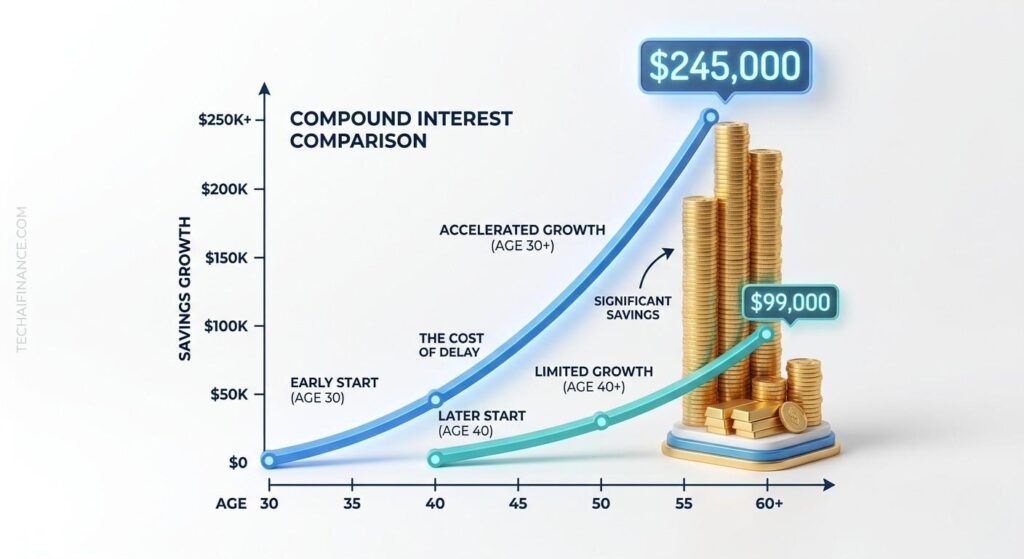
The single most consequential financial decision most Americans make is not where they invest. It is whether they start investing at all, and when. A 30-year-old who opens a brokerage account this week and puts $200 per month into a diversified index fund will have approximately $245,000 by age 60 at historical average market returns. The same person who waits until 40 to start will have approximately $99,000. That $146,000 difference was not produced by better stock picks or market timing. It was produced entirely by the decision to start earlier.
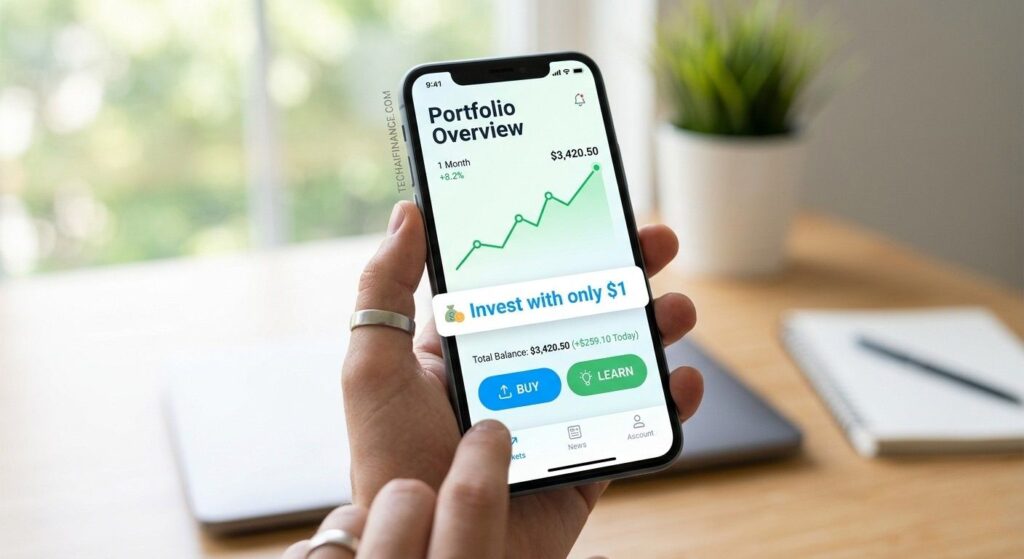
The barrier for most Americans who are not yet investing is not a lack of money, though many believe it is. At most major brokerages in 2026, you can open an account and make your first investment with $1. The real barrier is not knowing which app to start with, not understanding what fees actually cost over a lifetime of investing and not knowing the difference between apps designed to help you build long-term wealth and apps designed to encourage short-term trading that tends to produce worse outcomes for most retail investors.
This guide reviews eight stock trading apps available to Americans in 2026. The reviews are built around what a beginner investor actually needs: honest fee assessment, clear explanation of account types, real educational resources that help you understand what you are doing and an honest assessment of which apps are built for long-term wealth building versus which are built around features that sound exciting but historically work against beginner investors.
This guide was written by Olayinka Adejugbe, founder of TechAIFinance.com and holder of a Global Certification in Artificial Intelligence and Applied Innovation.
| ℹ Quick Summary Stock market investing in the US in 2026: the numbers that matter Only 58 percent of American adults own stocks either directly or through retirement accounts, per the Federal Reserve Survey of Consumer Finances 2025. The S&P 500 index has produced an average annual return of approximately 10 percent before inflation over the past 30 years, per S&P Global market data. Americans who invest in low-cost index funds consistently outperform Americans who actively pick individual stocks over 10-year periods in 92 percent of cases, per SPIVA US Scorecard 2025 published by S&P Dow Jones Indices. The average expense ratio of actively managed mutual funds in the US is 0.66 percent per year, compared to 0.06 percent for index funds, per Morningstar 2025 US Fund Fee Study. Over 30 years on a $50,000 portfolio at 8 percent annual return, that fee difference costs approximately $47,000 in foregone returns. Sources: Federal Reserve Survey of Consumer Finances 2025. S&P Global market performance data. SPIVA US Scorecard 2025. Morningstar 2025 US Fund Fee Study. |
| 📘 What This Guide Covers In this guide you will find: Full reviews of 8 stock trading apps available to American beginners in 2026 Honest fee breakdowns showing what each app actually costs over time Which account types each app offers and which account a beginner should open first The educational resources on each app that actually help new investors understand what they are doing The critical difference between apps built for long-term wealth building and apps built for active trading A step-by-step guide for making your first investment after choosing an app The 5 investing principles that matter more than which app you choose |
Table of Contents
- What Beginners Must Understand Before Choosing a Trading App
- The Critical Fee Question: What Costs Actually Matter
- App Reviews: The 8 Best Stock Trading Apps for Beginners in the US 2026
- How to Make Your First Investment: A Step-by-Step Guide
- The 5 Investing Principles That Matter More Than Your App Choice
- Which App Should You Choose: Decision Guide by Investor Type
- Full App Comparison Table
- Frequently Asked Questions
What Beginners Must Understand Before Choosing a Trading App
Choosing the right stock trading app matters, but it is secondary to understanding two foundational concepts that determine whether any app helps or hurts your financial outcomes. Most beginners choose their app first and learn the concepts later, which is why many begin investing in the wrong accounts, pay unnecessary fees or use features that actively reduce their returns.
Concept 1: Account type determines your tax outcome
Every stock trading app offers multiple account types and your choice between them has a larger impact on your long-term wealth than any stock pick you ever make. The three most important account types for American beginners are:
- Taxable brokerage account: An account with no tax advantages where investment gains are taxed as either short-term capital gains at your regular income tax rate for assets held under one year or long-term capital gains at the lower rate for assets held over one year. Interest and dividends are taxed in the year received. This account has no contribution limits and no restrictions on withdrawals.
- Roth IRA: An individual retirement account where contributions are made with after-tax dollars but all growth and qualified withdrawals in retirement are completely tax-free. Contributions are limited to $7,000 per year in 2026 or $8,000 if you are 50 or older. Income limits apply: single filers with income above $161,000 in 2026 cannot contribute directly. The Roth IRA is the most powerful wealth-building account available to most Americans under 50 with qualifying income because every dollar of growth inside it is permanently sheltered from taxation.
- Traditional IRA: Contributions may be tax-deductible depending on your income and whether you have a workplace retirement plan. Growth is tax-deferred, meaning taxes are paid when you withdraw in retirement. Required minimum distributions begin at age 73. Less flexible than the Roth IRA for most younger investors but valuable for high earners who expect to be in a lower tax bracket in retirement.
For most American beginners under 50 with earned income below the Roth IRA income limit, the recommended first account is a Roth IRA. Open it at a brokerage that offers commission-free trading and low-cost index funds. The second account to open, after maximizing the Roth IRA contribution, is a taxable brokerage account for additional investing beyond the Roth limit.
Concept 2: What you invest in matters more than when or how much
The single most important investing decision a beginner makes is not which stock to buy. It is choosing between active and passive investment strategies. Active investing means selecting individual stocks or actively managed funds in an attempt to beat the market. Passive investing means buying index funds that track a broad market index like the S&P 500, accepting market average returns rather than trying to beat them.
The research on this is definitive and has been replicated consistently for 50 years. The SPIVA US Scorecard, published semiannually by S&P Dow Jones Indices, tracks how actively managed funds perform against their benchmark index. In 2025, 92 percent of large-cap actively managed US equity funds underperformed the S&P 500 over a 15-year period. This means that a beginner investor who simply buys a low-cost S&P 500 index fund and holds it for 15 years outperforms 92 percent of professional active fund managers in the same period, without any stock research, market knowledge or trading activity.
The implication is clear: for a beginner investor, the most effective investment strategy is also the simplest. Buy a diversified, low-cost index fund. Hold it for decades. Do not sell during market downturns. Reinvest dividends automatically. Add to it consistently. The trading features, stock screeners, analysis tools and social investing features on most apps are largely irrelevant to this strategy and in many cases actively counterproductive by encouraging more frequent trading that generates worse outcomes and unnecessary tax events.
| ⚠ Watch Out The most expensive mistake beginners make with stock trading apps: Using features designed to encourage frequent trading. Options trading, cryptocurrency speculation, buying individual stocks based on social media trends and day trading all consistently produce worse outcomes for retail investors than a simple buy-and-hold index fund strategy. A 2022 study by professors at the University of California at Berkeley and Peking University found that retail investors who trade most actively underperform their least-active peers by approximately 6.5 percentage points per year on average. The best use of a stock trading app for most beginners is to set up automatic monthly contributions to a low-cost index fund and then open the app as rarely as possible. Source: Barber and Odean, Trading Is Hazardous to Your Wealth. Journal of Finance 2000, updated in subsequent research through 2025. |
The Critical Fee Question: What Costs Actually Matter
Most major stock trading apps in 2026 offer commission-free stock and ETF trading, which has eliminated the most visible fee that investors used to pay. The fee that matters most in 2026 is no longer the trading commission. It is the expense ratio of the funds you invest in, the account fee structure for retirement accounts and the hidden costs built into some apps’ business models.
Expense ratios: the fee that compounds against you
An expense ratio is the annual fee charged by a fund to cover its operating costs, expressed as a percentage of your invested amount. An index fund with a 0.03 percent expense ratio costs $3 per year per $10,000 invested. An actively managed fund with a 0.75 percent expense ratio costs $75 per year per $10,000 invested. That $72 annual difference seems small but compounds dramatically: over 30 years on a $50,000 investment at 8 percent annual growth, the 0.75 percent fund costs approximately $47,000 more in foregone returns than the 0.03 percent fund. The investment fund’s own expense ratio affects your outcome far more than which trading app you use to hold it.
Payment for order flow: the invisible cost
Several popular stock trading apps generate revenue through a practice called payment for order flow, where they receive payment from market makers in exchange for routing customer orders through those market makers rather than through the open market. This is legal and disclosed but means that your orders may receive slightly less favorable execution prices than they would through direct market access. For long-term index fund investors who make infrequent trades in large diversified positions, the impact is minimal. For frequent traders making many small trades in individual stocks, payment for order flow can meaningfully affect the effective price received.
Margin interest and premium account fees
Some apps offer margin accounts that allow you to invest borrowed money, charging interest on the borrowed amount. Margin trading amplifies both gains and losses and is inappropriate for beginner investors. Premium account tiers at several apps charge monthly subscription fees of $3 to $10 per month for access to advanced features. For beginners investing in index funds, these premium features rarely justify their cost in improved outcomes.
App Reviews: The 8 Best Stock Trading Apps for Beginners in the US 2026
Each app below was evaluated on six criteria relevant to beginner investors: account minimums and accessibility, fee structure across all account types, quality of educational resources, ease of use for someone with no prior investing experience, account type availability including Roth IRA access, and platform reliability. No app paid for placement or favorable review in this guide.
| Fidelity Investments Best Overall Stock Trading App for Long-Term Beginner Investors Minimum Deposit: $0 minimum to open | $0 minimum to invest (fractional shares) | Trading Fees: $0 for stock and ETF trades | 0.015% average expense ratio on Fidelity index funds Account Types: Taxable brokerage, Roth IRA, Traditional IRA, SEP IRA, 529 college savings, HSA | Our Rating: 9.8/10 What this app is Fidelity is the largest mutual fund company and one of the largest brokerage firms in the United States. Founded in 1946 and privately held, Fidelity manages over $12 trillion in assets under administration as of 2026 and serves over 43 million individual investors. For beginner investors specifically, Fidelity stands out for three reasons that directly affect long-term investment outcomes: its zero-expense-ratio index funds, which are the lowest-cost investment products available to American retail investors; its comprehensive financial planning tools that are genuinely useful for beginners rather than primarily entertaining; and its breadth of account types, which means a beginner can open every account they will ever need at a single institution without managing multiple platform logins. Who it is best for Americans who want to build long-term wealth through a consistent index fund investment strategy rather than active trading. Fidelity is particularly strong for beginners who want to open a Roth IRA as their first investment account, since its zero-minimum Roth IRA with fractional share investing allows starting with any dollar amount. It is also the strongest platform for Americans who will eventually want to hold multiple account types including HSAs, 529 college savings plans and business retirement accounts alongside their personal investment accounts. Key features for beginners Fidelity’s ZERO expense ratio index funds are the most important beginner feature on the platform: FZROX tracks the total US stock market at a 0.00 percent expense ratio and FZILX tracks international stocks at 0.00 percent. These funds have no management fee of any kind, making them the lowest-cost investment products available anywhere in the United States. Fidelity also offers fractional share investing starting at $1, which allows a beginner to invest in any stock or fund regardless of the current share price. The Roth IRA is available with no minimum and no annual fee. Customer service includes phone support 24 hours a day, seven days a week, and more than 200 physical investor centers across the US for in-person assistance. Educational resources Fidelity Learning Center at fidelity.com/learning-center provides one of the most comprehensive and genuinely educational libraries available at any brokerage, covering investment basics, retirement planning, tax strategy, estate planning and market analysis through articles, videos, webinars and interactive courses. The Viewpoints section publishes regular market commentary and investment education content that is written for general audiences rather than finance professionals. Fidelity’s retirement planning tools, including the myPlan tool, help beginners model how different contribution amounts and investment choices project to specific retirement outcomes. AI tools integrated: Fidelity does not offer an AI-powered investment advisor as a standalone product in the same way some newer platforms do, but it does integrate AI-powered search and research tools across its platform. Fidelity Go, the platform’s robo-advisor product, uses algorithm-based portfolio management to automatically invest contributions in a diversified portfolio based on the investor’s goal and timeline, which is functionally an AI-assisted investing approach without requiring any investment knowledge from the user. The honest limitation: Fidelity’s interface is more comprehensive than some newer apps, which can initially overwhelm beginners who encounter its full range of tools and account types. New investors who open a Fidelity account may benefit from starting with the Fidelity Go robo-advisor product for their first few months before exploring the full self-directed brokerage features. Sources: Fidelity Investments at fidelity.com. Fidelity zero expense ratio fund details at fidelity.com/mutual-funds/fidelity-funds/zero-expense-ratio-funds. FINRA brokerage registration verified at finra.org, April 2026. |
| Charles Schwab Best App for Beginners Who Want Full-Service Brokerage Without Fees Minimum Deposit: $0 minimum to open | $0 minimum to invest (fractional shares via Schwab Stock Slices) | Trading Fees: $0 for stock and ETF trades | 0.03% average on Schwab index funds Account Types: Taxable brokerage, Roth IRA, Traditional IRA, SEP IRA, SIMPLE IRA, 529, custodial | Our Rating: 9.7/10 What this app is Charles Schwab is the second-largest publicly traded brokerage in the United States after Fidelity’s assets under management and is the largest publicly traded brokerage by market capitalization. Schwab merged with TD Ameritrade in 2020, integrating TD Ameritrade’s thinkorswim trading platform and customer base while maintaining Schwab’s core identity as a full-service brokerage with a strong emphasis on investor education and long-term wealth building. For beginners, Schwab provides the same foundational advantages as Fidelity: zero account minimums, commission-free trading and low-cost index funds. Its customer service network includes over 400 physical branch locations across the US and 24-hour phone support. Who it is best for Americans who want the stability and breadth of a full-service institution with the zero-cost structure of a modern commission-free brokerage. Schwab is particularly strong for beginners who may eventually want access to more sophisticated investment options beyond basic index funds, since its platform grows with the investor rather than requiring a platform switch as needs evolve. Schwab is also the strongest platform for investors who want access to a human financial advisor as their portfolio grows, since Schwab offers both robo-advisory through Schwab Intelligent Portfolios and access to human advisors through Schwab Wealth Advisory. Key features for beginners Schwab Stock Slices allows fractional share investing in any S&P 500 company with a $5 minimum investment. The SCHD ETF from Schwab is one of the most widely respected dividend equity ETFs in the US and an excellent long-term core holding for income-focused investors. Schwab Intelligent Portfolios, the platform’s robo-advisory service, requires a $5,000 minimum but charges no advisory fee, making it one of the most cost-efficient automated investment services available for investors who reach that threshold. The Schwab mobile app is consistently rated among the highest in usability among major brokerages in annual J.D. Power and Associates satisfaction surveys. Educational resources Schwab’s education hub provides comprehensive resources across articles, videos, tutorials and podcasts. The Schwab Learning Center at schwab.com/learn covers investing basics, retirement planning, portfolio construction, tax strategies and market commentary. Schwab also offers regular online and in-person workshops for investors at all experience levels, which provide structured learning rather than on-demand reading. AI tools integrated: Schwab Intelligent Portfolios uses algorithm-driven portfolio construction and automatic rebalancing to manage a diversified portfolio based on the investor’s goals and risk tolerance. The service uses exclusively Schwab and third-party ETFs and holds a cash allocation in the portfolio. Financial advisors available through Schwab Wealth Advisory for portfolios above $500,000 provide human guidance alongside algorithmic management. The honest limitation: Schwab’s cash allocation requirement in Schwab Intelligent Portfolios, typically two to six percent of the portfolio in a cash position, has been a source of criticism because cash earns less than invested capital over the long term. Investors who use Schwab Intelligent Portfolios should understand that the cash allocation is not earning at market rates and represents a minor but real drag on returns compared to fully invested alternatives. Sources: Charles Schwab at schwab.com. J.D. Power 2025 US Self-Directed Investor Satisfaction Study. Schwab Intelligent Portfolios terms at schwab.com/intelligent-portfolios, April 2026. |
| Robinhood Simplest Interface for Beginners Who Want to Start in Minutes Minimum Deposit: $0 minimum to open | $0 minimum to invest | Trading Fees: $0 for stock and ETF trades | Robinhood Gold at $5/month Account Types: Taxable brokerage, Roth IRA (added 2023), Traditional IRA | Our Rating: 8.1/10 What this app is Robinhood is the app that made commission-free stock trading mainstream for American retail investors when it launched in 2013. Its defining feature remains its interface: clean, minimal and designed to get a new investor from download to first trade faster than any competing platform. Robinhood offers stocks, ETFs, options and cryptocurrency trading in a single app, and added Roth and Traditional IRA accounts in 2023, addressing the most significant gap in its previous offering for long-term investors. Robinhood Gold, the subscription tier at $5 per month, adds margin investing, professional research reports from Morningstar and a higher-yield cash management account. Who it is best for Americans who want the fastest and simplest path from deciding to invest to making their first trade, and who are disciplined enough to use Robinhood specifically for long-term index fund investing rather than the app’s more speculative features. The platform’s simplicity is its primary advantage for beginners who are overwhelmed by the comprehensive interfaces of Fidelity or Schwab. Its primary disadvantage for serious long-term investors is also its simplicity: the platform offers fewer research tools, less comprehensive educational resources and a business model that, through payment for order flow revenue, benefits from customer trading activity in ways that do not always align with the long-term buy-and-hold strategy that produces the best outcomes for most retail investors. Key features for beginners Robinhood’s most useful beginner features are fractional share investing starting at $1, which allows diversification with tiny initial investments; the in-app market news feed which surfaces relevant news for investments the user holds; and the cash management account which pays competitive interest on uninvested cash for Robinhood Gold subscribers. The app also offers 24-hour trading on a selection of stocks and ETFs, which is a feature that appeals to active traders but is largely irrelevant for beginner index fund investors. Educational resources Robinhood Learn at robinhood.com/learn provides basic articles on investing terminology, account types and market concepts. The educational content is beginner-accessible but less comprehensive than Fidelity’s or Schwab’s library. Robinhood does not offer webinars, workshops or advisor access. AI tools integrated: Robinhood does not prominently advertise its AI integration but uses algorithmic matching to surface relevant news and market information to users based on their holdings. Robinhood Gold subscribers receive access to Morningstar research reports, which provide professional fundamental analysis of stocks and funds that goes significantly beyond the in-app news feed. The honest limitation: Robinhood’s history includes significant regulatory issues and controversy around user interface practices that encouraged overtrading, particularly around options trading accessibility for inexperienced users. The platform has improved its practices but remains primarily revenue-driven through payment for order flow and the Robinhood Gold subscription, which creates structural incentives for trading activity. Beginners using Robinhood should use it specifically for simple index fund investing and ignore the options, margin and cryptocurrency features until they have significantly more investing experience. Sources: Robinhood at robinhood.com. FINRA Robinhood Financial LLC registration at finra.org. Robinhood IRA program terms at robinhood.com/us/en/support/articles/robinhood-retirement, April 2026. |
| Public Best App for Socially Minded Beginners Who Want to Learn From Others Minimum Deposit: $0 minimum to open | $1 minimum for fractional shares | Trading Fees: $0 for stock and ETF trades | Public Premium at $10/month Account Types: Taxable brokerage, IRA (Roth and Traditional), cryptocurrency account | Our Rating: 8.4/10 What this app is Public is a brokerage app that combines standard stock trading with a social investment community where members can share what they are investing in and why. The social layer allows beginners to see what other investors are buying, read short investment theses posted by community members and follow specific investors whose approach they find valuable. Public differentiates itself from competitors by explicitly not using payment for order flow, stating that it routes orders for best execution rather than to paying market makers. Instead of payment for order flow, Public generates revenue through its premium subscription, its order flow payment alternative called tipping and interest on uninvested cash. Public also added a high-yield bond account for non-stock investors seeking fixed income. Who it is best for American beginners who learn best from community and social context rather than from individual reading and research. The social investing layer helps beginners understand the reasoning behind investment decisions in plain language from real investors rather than only from formal educational content. Public is also appropriate for beginners who are specifically motivated by the payment for order flow distinction and want a platform that explicitly does not practice this revenue model. Key features for beginners Public’s key beginner features include its social investment feed where you can follow other investors and see their portfolio updates and investment reasoning, its alternative assets section where stock investing is integrated alongside bond and cryptocurrency options, and its high-yield bond account which in April 2026 offered competitive yields on short-term corporate and government bonds accessible with a $1 minimum. Public Premium adds real-time data, advanced charting and access to Public’s AI investing tools including Alpha, its proprietary investment research AI that analyzes individual stocks and provides fundamental analysis summaries. Educational resources Public’s educational resources are primarily delivered through its community and social feed rather than a formal library structure. The social investment commentary from other members provides informal but practical investment education in real time. Public also produces an in-app educational content series covering investing basics, portfolio construction and specific asset class explanations. AI tools integrated: Public Alpha is the platform’s AI-powered investment research tool available to Premium subscribers. Alpha analyzes individual stocks and provides plain-language summaries of a company’s financial health, competitive position, recent news and analyst sentiment, which helps beginner investors understand what they are buying beyond the stock chart and price movement. The honest limitation: Public’s social investing model creates a potential behavioral risk for beginners: following the investment decisions of other community members without understanding the underlying rationale can encourage trend-following behavior that produces poor timing decisions. The most valuable use of Public’s social layer for beginners is reading the investment theses and reasoning behind decisions rather than simply copying what popular community members buy. Sources: Public at public.com. Public payment for order flow policy at public.com/disclosures. Public Alpha AI research tool at public.com/premium, April 2026. |
| Webull Best App for Beginners Who Are Ready to Move Beyond Basic Investing Minimum Deposit: $0 minimum to open | $0 minimum to invest | Trading Fees: $0 for stock and ETF trades | Options at $0 per contract Account Types: Taxable brokerage, Roth IRA, Traditional IRA, Rollover IRA, paper trading account | Our Rating: 8.6/10 What this app is Webull is a commission-free brokerage launched in 2018 that targets investors who want more analytical tools and data than apps like Robinhood offer without paying the premium subscription fees of more established platforms. Webull provides advanced charting tools, real-time market data including Level 2 quotes, technical analysis indicators and a paper trading simulator that allows beginners to practice investing with virtual money before risking real capital. Webull is appropriate for beginners who understand the index fund principle but want to gradually develop analytical skills for evaluating individual stocks as they gain experience. Who it is best for American beginners who want a zero-cost platform with more analytical depth than Robinhood but who are not ready for the full complexity of a professional trading platform. Webull’s paper trading account is its most distinctive and genuinely valuable beginner feature: the ability to practice buying and selling stocks and ETFs with virtual money in real market conditions eliminates the financial risk of learning-by-doing mistakes that new investors in live accounts experience. Key features for beginners The paper trading account allows beginners to practice investment strategies with $1 million in virtual currency in real market conditions without risking actual money. This learning tool has no parallel at Fidelity, Schwab or Robinhood at comparable cost. Webull also offers extended hours trading from 4 AM to 8 PM Eastern time and 24-hour trading for ETFs, real-time Level 2 market data showing the depth of buy and sell orders at different price levels and customizable charting with over 50 technical indicators. The Webull IRA adds Roth and Traditional IRA accounts with the same commission-free structure as the standard account. Educational resources Webull’s educational resources include a community forum where users discuss investment strategies and share analysis, in-app video tutorials covering technical analysis basics and a financial calendar showing upcoming earnings announcements and economic data releases. The educational content is stronger on technical analysis tools than on fundamental investing concepts, which means beginners who want to understand index fund strategy rather than chart patterns may find Fidelity’s education library more relevant. AI tools integrated: Webull integrates AI-powered stock screening tools that allow investors to filter the US stock market by specific fundamental and technical criteria simultaneously. The platform’s AI pattern recognition tools identify chart patterns in stock price histories that technical traders use to evaluate potential trading opportunities, though these tools are more relevant to active traders than to long-term index fund investors. The honest limitation: Webull’s depth of analytical tools, while valuable for developing investors, can overwhelm true beginners who are still forming the foundational understanding of what stocks and index funds are. New investors who open Webull accounts without solid foundational understanding of investment basics risk getting drawn into technical analysis and active trading before establishing the long-term investing habits that produce better outcomes. Use Webull’s paper trading account first for at least 60 days before investing real money. Sources: Webull at webull.com. FINRA Webull Financial LLC registration at finra.org, April 2026. |
| Acorns Best Micro-Investing App for Beginners Who Struggle to Start Minimum Deposit: $0 minimum to open | $5 to $20 per month subscription | Trading Fees: $0 trading fees | Subscription-based: $3/month Personal, $5/month Personal Plus, $9/month Premium Account Types: Taxable brokerage, Roth IRA, Traditional IRA, SEP IRA, custodial accounts for children | Our Rating: 8.3/10 What this app is Acorns is a micro-investing app that makes investing genuinely automatic for people who struggle with the motivation to manually transfer money and make investment decisions. Its signature Round-Ups feature rounds every purchase you make to the nearest dollar and automatically invests the change. A $3.40 coffee becomes a $0.60 investment. A $47.32 grocery trip becomes a $0.68 investment. Individually these amounts are small, but accumulated across all daily spending throughout a month they add up to a meaningful automatic investment that requires zero ongoing decision-making. Acorns invests your contributions in one of five diversified ETF portfolios based on your risk tolerance, which it selects automatically after a brief questionnaire. Who it is best for Americans who have tried and failed to start investing manually and need automation to overcome the behavioral inertia of getting started. Acorns works best for beginners who want to invest but consistently find that manually transferring money to an investment account feels like an active decision that they defer. The subscription cost is the key consideration: $3 per month represents a significant fee percentage on small account balances but becomes proportionally less significant as the account grows. Key features for beginners Acorns’ Round-Ups feature automatically invests spare change from linked debit and credit cards across a portfolio of diversified ETFs from providers including iShares and Vanguard. Recurring investments can also be set as scheduled automatic transfers. The Earn section of the app offers cashback-style investments from partnered brands: when you shop at participating retailers through the Acorns app, those retailers invest a percentage of your purchase directly into your Acorns account. Acorns Later provides Roth and Traditional IRA accounts within the same subscription. Acorns Early provides custodial investment accounts for children. Educational resources Acorns Grow, the platform’s built-in educational section, covers investing basics through short articles and videos designed for people who have never invested before. The content is genuinely beginner-accessible and explains concepts like compound interest, diversification and the difference between stocks and bonds in plain language without assuming prior financial knowledge. AI tools integrated: Acorns uses algorithm-based portfolio selection and automatic rebalancing rather than AI investment advice in the traditional sense. The questionnaire-driven portfolio selection process uses data inputs to match each investor with a pre-constructed portfolio appropriate for their risk tolerance and timeline, which is functionally an AI-assisted approach to investment allocation. The honest limitation: Acorns’ subscription fee structure makes it relatively expensive for investors with small account balances. At $3 per month, an investor with $500 in their account pays 7.2 percent of their balance annually in fees, which is higher than any index fund expense ratio and significantly higher than the zero-fee alternatives at Fidelity or Schwab. Acorns becomes more cost-competitive as account balances grow. The platform is most appropriate as a starting point for investors who genuinely cannot start without automation rather than as a permanent long-term platform for building significant wealth. Sources: Acorns at acorns.com. Acorns subscription pricing at acorns.com/pricing. FINRA Acorns Securities LLC registration at finra.org, April 2026. |
| SoFi Invest Best App for Beginners Who Want Banking and Investing in One Place Minimum Deposit: $0 minimum to open | $1 minimum for fractional shares | Trading Fees: $0 for stock and ETF trades | No ongoing subscription fees Account Types: Taxable brokerage, Roth IRA, Traditional IRA, SEP IRA | Our Rating: 8.5/10 What this app is SoFi is a financial technology company that offers banking, lending, investing and insurance products integrated within a single platform. SoFi Invest is the investing component, providing commission-free stock and ETF trading alongside automated portfolio management. What makes SoFi particularly relevant for American beginners is its integration: a SoFi member can manage their checking account, high-yield savings account, student loan refinancing, personal loan, credit card and investment portfolio all through the same app and website, which simplifies the overall financial management burden that often causes new investors to procrastinate getting started. SoFi also offers access to certified financial planners through its member advisory service at no additional cost. Who it is best for Americans who want a single financial platform covering banking and investing rather than managing separate relationships with a traditional bank and a standalone brokerage. SoFi is also appropriate for beginners who want to access financial planning guidance without paying advisory fees, since SoFi members can schedule one-on-one calls with certified financial planners included in their membership at no charge. Key features for beginners SoFi’s most useful beginner features are the automated investing service through SoFi Automated Investing, which builds and manages a diversified ETF portfolio based on the investor’s goals and timeline at no advisory fee; the free certified financial planner access for all SoFi members; and the SoFi High Yield Cash Management Account, which pays competitive interest on uninvested cash within the investment platform. SoFi also offers IPO investing access for members, though this is more relevant to developing investors than absolute beginners. Educational resources SoFi Learn at sofi.com/learn provides educational articles and guides covering personal finance and investing topics. The content covers account types, investing basics, retirement planning and financial goal setting. SoFi also produces regular financial news and market commentary content through its platform. The certified financial planner access is the most distinctive educational resource: having a human expert available to answer specific questions about your own financial situation is more valuable than any static content library for investors who have questions that generic articles do not address. AI tools integrated: SoFi Automated Investing uses algorithm-driven portfolio construction and automatic rebalancing. The platform’s financial planning tools use data inputs about the member’s income, debts, goals and timeline to generate personalized recommendations about account types, contribution levels and investment allocation, which is a form of AI-assisted financial planning. The honest limitation: SoFi’s investment product selection is smaller than Fidelity’s or Schwab’s, and its index fund offerings do not include zero-expense-ratio products equivalent to Fidelity’s ZERO funds. Investors who build large portfolios on SoFi and want access to the broadest possible investment universe may eventually want to consider transferring to Fidelity or Schwab as their needs evolve. Sources: SoFi Invest at sofi.com/invest. SoFi financial planning access at sofi.com/financial-advisors. FINRA SoFi Securities LLC registration at finra.org, April 2026. |
| M1 Finance Best App for Beginners Who Want Total Portfolio Customization at Zero Cost Minimum Deposit: $100 minimum to open | $500 for retirement accounts | Trading Fees: $0 for stock and ETF trades | M1 Premium at $3/month Account Types: Taxable brokerage, Roth IRA, Traditional IRA, SEP IRA, trust accounts | Our Rating: 8.7/10 What this app is M1 Finance operates on a unique investing model called pie investing, where you build a custom portfolio by allocating percentages to specific stocks and ETFs, which M1 calls slices of your pie. When you add money to your account, M1 automatically buys each holding in proportion to its target percentage and automatically rebalances the portfolio over time to maintain your target allocations. This approach combines the customization of self-directed investing with the automation of a robo-advisor, at zero advisory fee. You decide what you want to hold and in what proportions. M1 handles the actual buying and rebalancing automatically whenever you add money. Who it is best for American beginners who want to build a specific portfolio of index funds and individual stocks in a defined proportion rather than investing in a single pre-built fund or accepting a robo-advisor’s standard portfolio. M1 Finance is ideal for investors who have read about a specific investment strategy, such as a three-fund portfolio of US total market, international market and bond index funds in specific percentages, and want to implement it automatically without manually placing trades. Key features for beginners M1’s pie interface allows investors to build a custom portfolio of up to 100 holdings with precise percentage allocations. Pre-built expert pies, created by the M1 team based on recognized investment strategies, provide starting templates that beginners can adopt directly or customize. Fractional shares allow any allocation to any stock or ETF regardless of price. Automatic reinvestment of dividends and automatic rebalancing on deposits keeps the portfolio aligned with its target without manual intervention. M1 Premium adds features including a high-yield cash account, M1 Borrow, which is a portfolio line of credit, and additional smart transfers between accounts. Educational resources M1 Finance’s educational resources include in-app explanations of the pie investing model and articles covering portfolio construction concepts, investment strategy basics and account type guidance. The expert pie library, which includes portfolios based on recognized investment strategies from sources like Vanguard’s founder John Bogle, provides educational context alongside practical implementation tools. AI tools integrated: M1 Finance does not currently offer a traditional AI investment advisor, but its automatic rebalancing and smart transfer features use algorithmic logic to maintain portfolio alignment and optimize cash movement between accounts. The pie construction interface itself functions as a portfolio planning tool that makes the allocation decision visual and concrete rather than abstract. The honest limitation: M1 Finance executes all trades once per trading day during a set trading window, which means you cannot execute trades at a specific price at a specific time as you can on Fidelity, Schwab, Robinhood or Webull. For long-term index fund investors this is completely irrelevant since timing individual trades is not part of the strategy. For investors who want to react quickly to specific market events or price levels, M1 Finance’s once-per-day trading window is a significant limitation. Sources: M1 Finance at m1.com. M1 Finance expert pies at m1.com/portfolios. FINRA M1 Finance LLC registration at finra.org, April 2026. |

How to Make Your First Investment: A Step-by-Step Guide
Once you have chosen your app, making your first investment involves the same process regardless of which platform you use. Here is the complete step-by-step guide.
- Download the app or go to the website and click Open Account. Have your Social Security number, a government-issued ID and your bank account routing and account numbers ready. Account opening typically takes 10 to 20 minutes.
- Choose your account type before funding. For most American beginners under 50, open a Roth IRA first. If you have maxed your Roth IRA contribution of $7,000 for the year or if your income exceeds the Roth IRA eligibility limit, open a taxable brokerage account.
- Link your bank account and make your first deposit. You can start with any amount at Fidelity, Schwab, Robinhood, Public or M1. Acorns requires the Round-Ups feature enabled on a linked debit or credit card. Start with whatever amount you can commit to leaving invested without touching for at least five years.
- Make your first investment. For beginners using the strategy recommended in this guide, search for one of the following in the app’s search bar: FSKAX which is Fidelity’s Total Market Index Fund at a 0.015 percent expense ratio, SWTSX which is Schwab’s Total Stock Market Index Fund at a 0.03 percent expense ratio or VTI which is Vanguard’s Total Stock Market ETF at a 0.03 percent expense ratio. Any of these provides diversified exposure to the entire US stock market in a single low-cost purchase.
- Enable automatic dividend reinvestment. This setting automatically uses dividends paid by your fund to purchase additional shares, compounding your returns without any manual action.
- Set up automatic monthly contributions. The most effective investing habit is automating a fixed monthly transfer from your bank account to your investment account. Even $50 per month, invested consistently and automatically, compounds into meaningful wealth over time.
- Turn off notifications for daily price movements. Market values fluctuate constantly. Watching daily changes in your portfolio value produces anxiety that causes many investors to sell during temporary declines, which is the most common and most costly beginner investing mistake. Check your account no more than quarterly once your investments are set up.
The 5 Investing Principles That Matter More Than Your App Choice
The research on long-term investing outcomes is clear: the variables that determine most of your investment result are not which app you use, which stock you pick or when you time the market. They are:
Principle 1: Start as early as possible
Every year you delay starting compounds against you. A 25-year-old who invests $200 per month until age 65 at 8 percent annual returns accumulates approximately $700,000. A 35-year-old with identical contributions accumulates approximately $298,000. The ten-year head start is worth $402,000. No investment choice you ever make will produce a comparable return difference.
Principle 2: Keep costs as low as possible
Choose index funds with expense ratios below 0.10 percent. Avoid actively managed funds, which consistently underperform comparable index funds after fees in the long run. Avoid frequent trading, which generates taxes and transaction friction. The money saved in fees is money that compounds in your favor instead.
Principle 3: Be consistent regardless of market conditions
Invest a fixed dollar amount on a fixed schedule regardless of whether markets are up or down. This practice, called dollar-cost averaging, automatically produces the outcome of buying more shares when prices are low and fewer shares when prices are high, without requiring you to predict market direction. Consistency over 20 to 30 years produces results that stock picking and market timing cannot match in the statistical majority of investor cases.
Principle 4: Diversify broadly
A single total market index fund provides ownership in thousands of American companies simultaneously. Adding an international fund adds exposure to thousands of companies across the rest of the world. This level of diversification is impossible to replicate through individual stock picking without significant expertise, time and capital, and a single index fund achieves it with a $1 minimum investment.
Principle 5: Do not sell during downturns
Every significant market downturn in American history has been followed by a recovery to new highs. Investors who held their positions through every major market crash of the past 50 years, including 2000, 2008 and 2020, significantly outperformed investors who sold during the decline and bought back after recovery. The most destructive action available to a long-term investor is selling when prices are low, which permanently locks in losses that the subsequent recovery would have reversed.
Which App Should You Choose: Decision Guide by Investor Type
| Choose Fidelity if: You want the lowest possible investment costs over decades and a platform you will never need to leave as your investing sophistication grows. Fidelity’s zero-expense-ratio funds are the lowest-cost investment products available to American retail investors. Also choose Fidelity if: you want the widest range of account types including HSA, 529, SEP IRA and custodial accounts under one platform. |
| Choose Schwab if: You want full-service brokerage quality with a zero-fee structure and want access to physical branch locations or human financial advisors as your portfolio grows. Schwab’s nationwide branch network and advisor access are unmatched among commission-free brokerages. Also choose Schwab if: you intend to eventually use a robo-advisor with no advisory fee, since Schwab Intelligent Portfolios is the largest zero-fee robo-advisor available. |
| Choose Robinhood if: You want the fastest and simplest setup and are committed to using it specifically for index fund investing while ignoring the speculative features. Also choose Robinhood if: you are a younger investor who responds to clean, simple interfaces and wants to avoid feeling overwhelmed by the comprehensive tools at Fidelity or Schwab. |
| Choose Acorns if: You have genuinely tried and failed to start investing manually and need full automation to overcome inertia. Acorns is not the lowest-cost option, but it is the most effective at getting genuinely stuck beginners to actually start. Plan to transition to Fidelity or Schwab when your account reaches $5,000 to reduce the proportional impact of the monthly subscription fee on your returns. |
| Choose Webull if: You have already understood the index fund basics and want to gradually develop analytical skills while using Webull’s paper trading account to practice without financial risk. Start exclusively in the paper trading account for 60 days before committing real money. This is the most important recommendation for any Webull beginner. |
Full App Comparison Table
| App | Min Deposit | Stock Fees | IRA Available | Best For | Our Rating |
| Fidelity | $0 | $0 + 0.00% index funds | Yes – all types | Long-term wealth building | 9.8/10 |
| Charles Schwab | $0 | $0 + 0.03% index funds | Yes – all types | Full-service zero-cost | 9.7/10 |
| M1 Finance | $100 | $0 advisory fee | Yes – Roth/Trad/SEP | Custom portfolio automation | 8.7/10 |
| Webull | $0 | $0 commissions | Yes – Roth/Trad | Paper trading + analytics | 8.6/10 |
| SoFi Invest | $0 | $0 commissions | Yes – Roth/Trad/SEP | Banking + investing together | 8.5/10 |
| Public | $0 | $0 commissions | Yes – Roth/Trad | Social investing community | 8.4/10 |
| Acorns | $0 | $3-$9/month sub | Yes – Roth/Trad/SEP | Automation for stuck starters | 8.3/10 |
| Robinhood | $0 | $0 commissions | Yes – Roth/Trad | Simplest interface | 8.1/10 |
| 💡 Real-World Example Consider two hypothetical American beginners who both decided to start investing in January 2026 with $1,000 and a commitment to invest $200 per month going forward. Priya is a 27-year-old teacher in Atlanta who had never invested before and felt overwhelmed by financial complexity. She chose Fidelity, opened a Roth IRA and invested her initial $1,000 in FZROX, Fidelity’s zero-expense-ratio total US market index fund. She set up automatic monthly contributions of $200 on the fifth of every month. She enabled automatic dividend reinvestment. She turned off price change notifications and checked her account at the end of each quarter. Derek is a 27-year-old in Atlanta who also had $1,000 to invest. He downloaded Robinhood, was excited by its interface and bought five individual stocks he had heard about on social media. Over six months, he traded in and out of positions 24 times, selling two positions at a loss when they declined and buying trending stocks on news events. His account balance after six months: $887, a loss of $113 from his original $1,000. Priya’s FZROX position after six months: $1,287 from regular contributions plus market growth of approximately 6 percent on invested capital. She had not checked her account since the previous quarter. Both started with the same amount, the same income, the same app ecosystem availability and the same six-month time period. The difference was strategy and behavior, not the app. This example is illustrative. Actual investment returns depend on market conditions and individual investment choices. Investing involves risk including the possible loss of principal. |
Frequently Asked Questions
How much money do I need to start investing in stocks?
At Fidelity, Schwab, Robinhood, Public, SoFi and Webull, you can open an account with $0 and make your first investment with $1 through fractional share investing. M1 Finance requires $100 for a taxable account and $500 for a retirement account. Acorns starts investing your round-up change with no minimum balance requirement. The practical answer is that you need enough to make the investment feel meaningful to you personally, which is different for every person, but the technical minimum is $1 at most platforms.
Should I open a Roth IRA or a regular brokerage account first?
For most Americans under 50 with earned income below the Roth IRA income limit of $161,000 for single filers in 2026, open the Roth IRA first. Every dollar that grows inside a Roth IRA grows tax-free forever. The same investment in a taxable brokerage account creates a tax event every year through dividends and capital gains distributions. The Roth IRA’s tax advantage is worth thousands or tens of thousands of dollars over a 30-year investing horizon. Open the taxable brokerage account after you have contributed the full $7,000 annual limit to your Roth IRA.
Is it safe to put my money in a stock trading app?
All eight apps reviewed in this guide are registered broker-dealers regulated by FINRA and covered by SIPC insurance, which protects your securities holdings up to $500,000 per account including $250,000 in cash in the event the brokerage fails. SIPC insurance does not protect against investment losses from market fluctuations: if the stocks you own decline in value, SIPC does not compensate for that decline. It only protects against losses resulting from brokerage failure. All eight platforms reviewed are well-established regulated institutions. You can verify any brokerage’s registration status at finra.org/brokercheck.
What is the difference between an ETF and a mutual fund?
An ETF, or exchange-traded fund, is a fund that holds a collection of securities and trades on a stock exchange like an individual stock throughout the trading day. A mutual fund also holds a collection of securities but is priced once per day after market close and does not trade on an exchange. Both can track an index like the S&P 500. For beginner investors, both are suitable vehicles for index fund investing. ETFs tend to have slightly lower expense ratios on average and are available at all brokerages, while some index mutual funds with very low expense ratios are only available at the brokerage that manages them. For example, Fidelity’s ZERO expense ratio mutual funds are only available within Fidelity accounts.
Can I lose all my money in stocks?
It is theoretically possible to lose all the money you invest in an individual company’s stock if that company goes bankrupt. This is one of the primary reasons this guide recommends diversified index funds rather than individual stocks for beginners: a total market index fund owns thousands of companies simultaneously, meaning no single company’s bankruptcy can destroy your investment. The value of a diversified index fund declines during market downturns but has historically always recovered to new highs over extended time periods. There is no guarantee this pattern will continue, but the historical evidence across US markets going back to the early 1900s is consistent.
| ⭐ Key Takeaway The app you choose matters far less than the decisions you make inside it. Open a Roth IRA at Fidelity or Schwab this week. Invest in a total market index fund with an expense ratio below 0.10 percent. Set up automatic monthly contributions of whatever amount you can genuinely afford to leave invested for decades. Turn off price notifications. Do not sell during market declines. Those five decisions will produce better investment outcomes for most beginners than any stock pick, any market timing strategy or any premium subscription feature on any trading app available in 2026. The best time to start was ten years ago. The second best time is today. |
Conclusion
Eight stock trading apps reviewed fully. Two, Fidelity and Schwab, stand above the rest for beginners who want to build long-term wealth at the lowest possible cost. The others serve specific needs: Webull for practice with paper trading, Acorns for automation, M1 for custom portfolio control, SoFi for banking integration, Public for social investing context and Robinhood for maximum interface simplicity.
The review that matters most, however, is not which app scores highest. It is whether you open an account and make your first investment. Every week that passes without a Roth IRA and a first index fund purchase is a week of compound growth that cannot be recovered later.
For Americans who want to understand how stock investing fits into a comprehensive personal finance strategy, our guide on how to build generational wealth in the US covers consistent long-term investing as the first of seven pillars of family wealth building. For those who want to understand passive income beyond stock investing, our guide on how to make passive income in the US 2026 covers twelve income streams from dividends to digital products.
| 📲 Share This Guide If this guide helped you choose the right stock trading app or finally gave you the push to open an account, share it with someone who has been putting off starting. Share on WhatsApp, Facebook or by text message. Thank you for reading TechAIFinance.com. |
Read Next
Continue building your financial knowledge on TechAIFinance.com:
- How to Build Generational Wealth in the US
- How to Make Passive Income in the US 2026
- Cryptocurrency and Bitcoin Basics for Americans 2026
- How to Retire Early Using the FIRE Method in the US 2026
- Best High Yield Savings Accounts in the US 2026
| ✍ About the Author Written by: TechAIFinance Editorial Team Edited and Fact-Checked by: Olayinka Adejugbe Olayinka Adejugbe is not a licensed financial advisor. The content on TechAIFinance.com is produced for educational purposes only and should not be treated as personalized financial advice. Olayinka is the founder and lead editor of TechAIFinance.com. He holds a Global Certification in Artificial Intelligence and Applied Innovation and an Award of Completion in Behavioral Counseling from the World Health Organization. With a strong working knowledge of personal finance and accounting principles, Olayinka oversees the editorial review of every article on this site to ensure accuracy, currency and practical usefulness. Every article on TechAIFinance.com is produced by our research team and reviewed by Olayinka before publication. We verify statistics against named authoritative sources and update content when circumstances change. Visit our About page to learn more about our editorial process. Use our Contact page to get in touch. |
Important Disclaimer
The content published on TechAIFinance.com is for educational and informational purposes only. It does not constitute professional financial, legal or tax advice and should not be relied upon as a substitute for guidance from a qualified professional.
Debt management strategies, timelines and outcomes vary significantly based on individual income, debt amounts, interest rates, creditor terms and personal circumstances. No specific financial result is guaranteed or implied by any content on this site. Always consult a qualified financial advisor, credit counselor or attorney before making significant financial decisions. Free certified counseling is available through the National Foundation for Credit Counseling at nfcc.org.