| Important Disclosure This guide provides information about financial independence and early retirement strategies for Americans. It is not financial, investment, tax or legal advice. All investment strategies carry risk including the possible loss of capital. The 4 percent rule and all other retirement income strategies discussed are based on historical research that may not predict future results. Always consult a qualified financial advisor, tax professional and estate planning attorney before making significant financial decisions related to retirement. Some links may be affiliate links. All figures and regulatory information were verified in April 2026. |

Retiring early is not a fantasy available only to the very rich. It is a mathematical outcome available to anyone who understands the relationship between their savings rate, their investment returns and the number of years those investments need to compound before they can sustain their lifestyle indefinitely. The wealthy do not have exclusive access to this math. They are simply more likely to know it exists.
The FIRE movement, which stands for Financial Independence, Retire Early, formalizes a set of financial principles that have always been true but were rarely discussed outside academic circles until the early 2010s. The core idea is straightforward: if you invest enough money in diversified assets and structure your spending to be supported by the income those assets generate, you no longer need to work for money. At that point, working becomes optional. What you do with that optionality is entirely your own decision.
This guide explains the FIRE method completely for Americans in 2026. It covers the mathematics behind financial independence, the four distinct FIRE approaches that suit different income levels and lifestyle preferences, the investment and account strategies that maximize efficiency, the tax tools available, the healthcare challenge unique to the American context and the honest limitations of every assumption the FIRE model rests on.
This guide was written by Olayinka Adejugbe, founder of TechAIFinance.com and holder of a Global Certification in Artificial Intelligence and Applied Innovation.
| ℹ Quick Summary FIRE and early retirement in the US in 2026: the key numbers Approximately 3.7 million Americans self-identify as pursuing financial independence as a primary financial goal, per a 2025 Charles Schwab Modern Wealth Survey. The median age at which FIRE practitioners report achieving financial independence is 43, per a 2025 survey by the personal finance platform Empower. A household saving 50 percent of after-tax income can reach financial independence in approximately 17 years regardless of income level, per mathematical analysis based on Trinity Study assumptions. The 4 percent rule is based on the 1994 Trinity Study which found that a diversified portfolio sustained 4 percent annual withdrawals for 30 years in 95 percent of historical scenarios tested. Healthcare costs are the primary challenge for American early retirees: a couple retiring at 50 can expect to pay $24,000 to $36,000 per year in health insurance premiums before Medicare at age 65, per Kaiser Family Foundation 2025 data. Sources: Charles Schwab Modern Wealth Survey 2025. Empower FIRE practitioner survey 2025. Cooley, Hubbard and Walz, Trinity Study 1994. Kaiser Family Foundation 2025. |
| 📘 What This Guide Covers In this guide you will find: The complete mathematics of financial independence including the 4 percent rule and the FIRE number formula The four FIRE types: Lean FIRE, Fat FIRE, Barista FIRE and Coast FIRE fully explained How to calculate your exact FIRE number and required savings rate The three-fund portfolio investment strategy most FIRE practitioners use How to access retirement funds before age 59 and a half without penalties The Roth conversion ladder explained step by step Tax strategy that can reduce retirement tax burden to near zero How to handle health insurance before Medicare eligibility at 65 The Social Security impact of early retirement The honest risks every FIRE plan must acknowledge A step-by-step FIRE action plan by income level |
Table of Contents
- The Mathematics of Financial Independence
- The Four Types of FIRE
- How to Calculate Your FIRE Number
- The Investment Strategy Most FIRE Practitioners Use
- Account Sequencing: Accessing Money Before 59 and a Half
- The Roth Conversion Ladder Explained
- Tax Strategy for FIRE
- Healthcare Before Medicare: The Biggest FIRE Challenge in America
- Social Security and Early Retirement
- The Honest Risks and Limitations of FIRE
- Your FIRE Action Plan by Income Level
- Frequently Asked Questions
The Mathematics of Financial Independence
Financial independence occurs at the precise moment when your invested assets generate enough return to cover your annual living expenses indefinitely. This is not a vague aspiration. It is a mathematical threshold with a specific dollar value determined by your personal spending and a specific timeline determined by your savings rate.
The 4 percent rule: the foundation of FIRE
The 4 percent rule is derived from the Trinity Study, research published in 1994 by professors Philip Cooley, Carl Hubbard and Daniel Walz at Trinity University in Texas. They found that a diversified portfolio of stocks and bonds could sustain annual withdrawals of 4 percent of the initial portfolio value, adjusted for inflation each year, for at least 30 years in 95 percent of historical 30-year periods tested.
For early retirees who may need their portfolio to last 40 to 50 years rather than the 30 years the original study modeled, many FIRE practitioners use a more conservative withdrawal rate of 3 to 3.5 percent to account for the longer required duration and increased sequence of returns risk during additional years.
The FIRE number formula
| 🔢 FIRE Calculator FIRE Number = Annual Expenses x 25 This formula comes directly from the 4 percent rule: if you withdraw 4 percent of your portfolio annually, you need a portfolio equal to 25 times your annual expenses (1 divided by 0.04 equals 25). Examples: Annual expenses of $30,000 require a FIRE number of $750,000 Annual expenses of $50,000 require a FIRE number of $1,250,000 Annual expenses of $80,000 require a FIRE number of $2,000,000 Annual expenses of $100,000 require a FIRE number of $2,500,000 For early retirees targeting a 3.5 percent withdrawal rate for added safety, the formula becomes Annual Expenses x 28.6. The most powerful lever in your FIRE plan is reducing annual expenses. Every $10,000 reduction in annual spending reduces your FIRE number by $250,000 and meaningfully shortens the timeline. |
The savings rate to retirement timeline
Your savings rate as a percentage of take-home income determines how many years until financial independence, almost entirely independent of income level. The table below shows this relationship at an assumed 7 percent real investment return starting from zero savings.
| Savings Rate | Years to FIRE | Assumed Real Return |
| 10% | ~43 years | 7% per year |
| 20% | ~32 years | 7% per year |
| 30% | ~26 years | 7% per year |
| 40% | ~21 years | 7% per year |
| 50% | ~17 years | 7% per year |
| 60% | ~13 years | 7% per year |
| 70% | ~9 years | 7% per year |
| 75% | ~7 years | 7% per year |
Source: Savings rate to financial independence timeline analysis originally published by Mr. Money Mustache at mrmoneymustache.com based on Trinity Study assumptions. Actual timeline varies based on starting portfolio value, investment returns and expense level.
The Four Types of FIRE
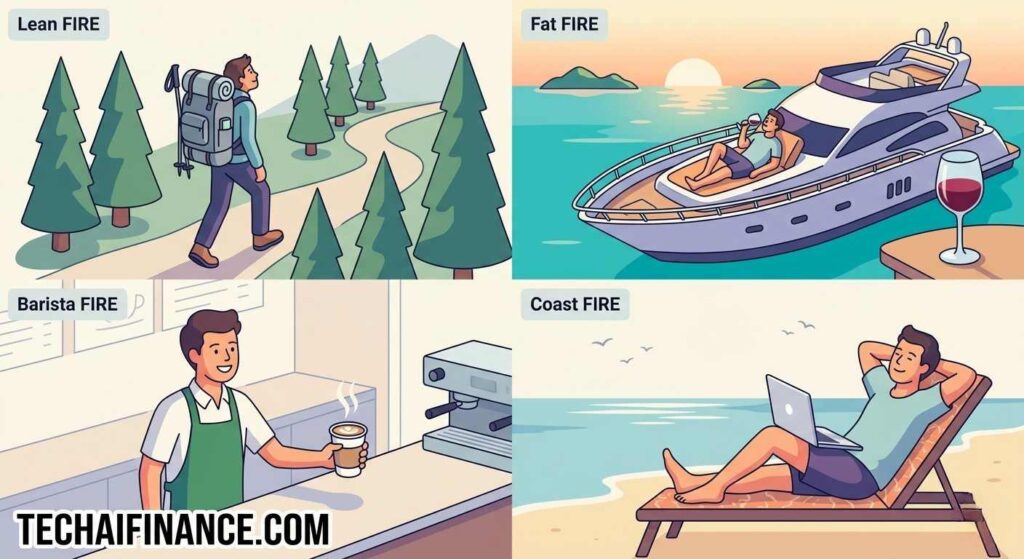
FIRE encompasses four distinct approaches that suit different income levels and lifestyle preferences. Understanding which type matches your situation is essential before setting targets or timelines.
| Lean FIRE Annual expenses: $25,000 to $40,000 per year | FIRE number: $625,000 to $1,000,000 Lean FIRE is financial independence achieved at the lowest possible expense level. Practitioners typically live in lower-cost areas, own homes outright or rent modestly, carry no debt and maintain low recurring expenses. The advantage is a dramatically smaller FIRE number and faster path to independence. The limitation is that $30,000 per year leaves almost no cushion for unexpected expenses, healthcare increases or poor early investment returns. A single major unexpected expense or a prolonged market downturn early in retirement can stress a Lean FIRE plan significantly. |
| Fat FIRE Annual expenses: $80,000 to $200,000 per year | FIRE number: $2,000,000 to $5,000,000+ Fat FIRE is financial independence at a comfortable or affluent spending level. Practitioners maintain their current lifestyle including travel, dining, quality housing and discretionary spending. The advantage is a much larger financial cushion. The limitation is the much larger FIRE number, requiring either very high income, a very long savings period or both. Fat FIRE at $100,000 per year requires a $2,500,000 portfolio, achievable but demanding significant income or sustained discipline. |
| Barista FIRE Part-time income: $15,000 to $25,000 per year | Portfolio covers remaining expenses Barista FIRE takes its name from taking a low-stress part-time job after leaving a demanding career. Rather than needing a portfolio covering 100 percent of expenses, a Barista FIRE practitioner works enjoyable part-time hours covering $15,000 to $25,000 per year, allowing a smaller portfolio to cover the rest. A household spending $55,000 per year with $20,000 covered by enjoyable part-time work needs only $35,000 from their portfolio annually, requiring $875,000 instead of $1,375,000. Barista FIRE also often resolves the healthcare challenge because employers like Starbucks offer insurance to part-time employees. |
| Coast FIRE Core concept: Invest enough early that compound growth reaches your FIRE number by traditional retirement age with no further contributions Coast FIRE is the least restrictive approach. A Coast FIRE practitioner invests aggressively in their 20s and early 30s until their portfolio is large enough to compound to their full FIRE number by age 65 without any additional contributions. At that Coast FIRE point, the pressure to save aggressively disappears. A 30-year-old who accumulates $175,000 at 8 percent real return will have approximately $1,680,000 by age 65 without contributing another dollar. At 4 percent withdrawal, that supports $67,200 annually. If their expected retirement expenses are $67,200 or less, they have achieved Coast FIRE at 30 and can work for enjoyment without financial pressure for the remaining 35 years. |
How to Calculate Your FIRE Number
Calculating your personal FIRE number requires three inputs: your current annual expenses, your target retirement annual expenses if different from current and the withdrawal rate you are comfortable with based on your target retirement age.
Step 1: Calculate your true annual expenses
Most Americans underestimate annual expenses by 15 to 25 percent because they track recurring monthly bills but overlook irregular expenses that nonetheless occur predictably over time. True annual expenses include monthly fixed costs times 12, plus car registration and maintenance, home repairs averaging 1 to 2 percent of home value annually, annual insurance premiums, irregular subscriptions paid annually, gifts and clothing, and a realistic electronics replacement budget. Use your actual bank and credit card statements from the past 12 months rather than your estimated spending.
Step 2: Adjust for retirement expenses
Your retirement expenses will differ from current expenses. Items disappearing at retirement include commuting costs, work clothing, work meals, childcare and payroll taxes on employment income. Items potentially increasing include healthcare, travel, home maintenance and hobbies that gain more time budget. Build your retirement expense estimate from adjusted categories rather than simply using your current total.
Step 3: Apply the formula and model your timeline
Multiply your estimated annual retirement expenses by 25 for the 4 percent rate or by 28.6 for the more conservative 3.5 percent rate. Then use the free compound interest calculator at investor.gov to determine how long your current savings rate will take to reach your FIRE number given your existing portfolio value and assumed investment returns.
| 💡 Pro Tip The fastest way to reduce your FIRE number is to reduce your retirement expenses. Every $1,000 reduction in annual retirement budget reduces your required FIRE number by $25,000 and meaningfully shortens your timeline. The most common categories where FIRE practitioners find the largest room are housing costs, vehicle costs and food spending. Relocating to a lower-cost area at retirement can reduce annual housing costs by $10,000 to $30,000, reducing the FIRE number by $250,000 to $750,000. |
The Investment Strategy Most FIRE Practitioners Use
The investment strategy used by the majority of FIRE practitioners is deliberate in its simplicity. Most follow a variation of the three-fund portfolio approach advocated by Vanguard founder John Bogle and formalized by the Bogleheads community at bogleheads.org.
The three-fund portfolio for FIRE
- Total US stock market index fund: Provides ownership in thousands of American companies in a single purchase. Examples: FSKAX from Fidelity at 0.015 percent expense ratio, SWTSX from Schwab at 0.03 percent, VTI from Vanguard at 0.03 percent.
- International stock market index fund: Diversifies beyond the US economy. Examples: FZILX from Fidelity at 0.00 percent, VXUS from Vanguard at 0.07 percent.
- US bond index fund: Provides stability during stock market downturns. Examples: FXNAX from Fidelity at 0.025 percent, BND from Vanguard at 0.03 percent.
Asset allocation and sequence of returns risk
During accumulation, most FIRE practitioners hold an aggressive stock-heavy allocation: 90 percent stocks and 10 percent bonds, or even 100 percent stocks for those with very high risk tolerance and long timelines. At retirement, most add a cash buffer of one to two years of annual expenses to cover living costs during market downturns without selling stocks at depressed prices. This addresses sequence of returns risk, the danger of experiencing poor investment returns early in retirement when withdrawals are just beginning. A market decline of 40 percent in the first year of retirement combined with ongoing withdrawals can permanently impair the portfolio’s recovery capacity. A cash buffer eliminates the need to sell during that first decline.
Account Sequencing: Accessing Money Before 59 and a Half
One of the most frequently asked FIRE questions is how to access retirement savings before age 59 and a half without the 10 percent early withdrawal penalty on traditional IRA and 401k distributions. Four strategies, used in sequence, solve this.
Strategy 1: Taxable brokerage account first
Money in a taxable brokerage account can be withdrawn anytime without penalty. Long-term capital gains on assets held more than one year are taxed at 0 percent for taxpayers in the 10 to 12 percent income bracket, 15 percent for most Americans and 20 percent for high earners. Early retirees structuring withdrawals as realized long-term capital gains often pay very low effective tax rates. Most FIRE practitioners build both a taxable account and tax-advantaged accounts during accumulation, using the taxable account for early retirement spending while tax-advantaged accounts continue compounding.

Strategy 2: Roth contribution withdrawals
Roth IRA contributions, not earnings, can be withdrawn at any age without tax or penalty. If you contributed $80,000 to a Roth IRA and it has grown to $140,000, you can withdraw the $80,000 in contributions anytime with no consequence, leaving the $60,000 in earnings to continue growing. This makes the Roth IRA a valuable penalty-free withdrawal source during early retirement before the conversion ladder becomes available.
Strategy 3: Rule 72t substantially equal periodic payments
IRS Rule 72t allows early IRA withdrawals without the 10 percent penalty if taken as a series of substantially equal periodic payments calculated using one of three IRS-approved methods. Payments must continue for five years or until age 59 and a half, whichever is longer. This provides access to traditional IRA funds in early retirement but locks in a fixed payment stream that cannot be changed without triggering back-penalties.
Strategy 4: The Roth conversion ladder
The Roth conversion ladder is the most widely used early retirement account access strategy. It involves converting traditional IRA or 401k funds to a Roth IRA each year in amounts calibrated to stay within low income tax brackets. After five years from each conversion, the converted amount becomes available for withdrawal without tax or penalty. By beginning conversions at retirement and living on taxable account assets during the five-year seasoning period, a FIRE retiree systematically makes all traditional retirement account funds accessible before 59 and a half without triggering early withdrawal penalties.
The Roth Conversion Ladder Explained
The Roth conversion ladder is the primary mechanism making early retirement financially efficient for Americans with significant traditional 401k and IRA balances.
How the ladder works step by step
- In working years, maximize 401k and traditional IRA contributions to reduce taxable income during high-earning years.
- At retirement, roll your 401k balance into a traditional IRA if not already done.
- Each year in early retirement, convert a portion of your traditional IRA to a Roth IRA. The converted amount is added to your taxable income that year. Calibrate conversions to stay within your target tax bracket, often the 12 percent federal bracket in early retirement with minimal other income. Converting $40,000 to $50,000 per year typically falls within the 12 percent bracket.
- Pay the income tax on the converted amount using funds from your taxable brokerage account.
- After exactly five years from each conversion, that converted amount becomes available for withdrawal from the Roth IRA without any tax or penalty.
- By year six of retirement, the first year’s conversion is available. By year seven, the second year’s. This creates a rolling pipeline of traditional IRA funds becoming accessible annually without penalties.
| Roth Conversion Ladder: Simplified Year-by-Year Example Assume retirement at age 42 with $800,000 in a traditional IRA, $200,000 in a Roth IRA and $150,000 in a taxable brokerage. Annual expenses: $50,000. Years 1 to 5 (ages 42 to 47): Live on taxable brokerage funds. Convert $50,000 per year from traditional IRA to Roth IRA. Pay income tax on each conversion from taxable account. Each conversion begins its 5-year clock. Year 6 (age 48): The $50,000 converted in Year 1 is now available penalty-free. Withdraw $50,000 to cover annual expenses. Year 7 and beyond: Each subsequent year’s conversion from 5 years prior becomes available. The rolling ladder provides penalty-free withdrawals indefinitely. This is a simplified illustration. Actual Roth conversion ladder design should be developed with a CPA who understands your specific tax situation. |
Tax Strategy for FIRE
Tax optimization is among the highest-leverage activities in a FIRE plan because the tax rate you pay in early retirement is largely within your control.
The 0 percent capital gains tax bracket
Federal income tax on long-term capital gains is 0 percent for taxpayers with total taxable income below $94,050 for married filing jointly in 2026, or $47,025 for single filers. A FIRE retiree who manages annual income through a combination of Roth conversions, capital gains realizations and other sources can often pay zero federal tax on their investment withdrawals. A couple with $80,000 in expenses covered by long-term capital gains from a taxable account, keeping total income below the 0 percent threshold, owes no federal capital gains tax.
ACA premium tax credits
The Affordable Care Act’s premium tax credits are available to Americans purchasing marketplace insurance whose household income falls within specific thresholds relative to the federal poverty level. FIRE retirees who calibrate annual income through Roth withdrawals that do not count as income combined with modest taxable income can maximize premium tax credit eligibility and reduce health insurance premiums by thousands of dollars per year during the pre-Medicare period. The income range for a couple that optimizes premium tax credits in 2026 is approximately $25,000 to $93,200.
Standard deduction advantage
The federal standard deduction for married filing jointly in 2026 is $30,000. The first $30,000 of ordinary income including Roth conversion income is effectively tax-free for a married couple. A married FIRE couple converting $30,000 per year from a traditional IRA to Roth pays zero federal income tax if they have no other taxable income, making the early retirement years particularly valuable for Roth conversions before Social Security and required minimum distributions at age 73 push conversions into higher brackets.
Healthcare Before Medicare: The Biggest FIRE Challenge in America
The single greatest practical challenge for American early retirees that does not exist in most other developed countries is healthcare coverage. Employer-based insurance ends when employment ends. Medicare begins at 65. An American who retires at 45 faces up to 20 years of self-funded health insurance at costs that represent the largest single budget uncertainty in their retirement plan.
What health insurance actually costs before 65
The average unsubsidized monthly premium for a mid-tier marketplace health insurance plan for a 50-year-old American was approximately $678 per month in 2026 per Kaiser Family Foundation data. For a couple both aged 50, the combined unsubsidized premium averaged approximately $1,356 per month or $16,272 per year. This figure increases with age: by 55, the same couple might pay $19,000 to $22,000 per year in unsubsidized premiums before accounting for deductibles, copayments or out-of-pocket costs for actual healthcare services.
Strategies for managing pre-Medicare healthcare costs
ACA marketplace plans with premium tax credits
Carefully managing annual income to qualify for premium tax credits on the ACA marketplace at healthcare.gov is the most powerful tool available. A couple with household income between 100 and 400 percent of the federal poverty level qualifies for credits that can reduce effective monthly premiums to $0 to $200 rather than full market rates. Run your expected retirement income through the premium tax credit estimator at healthcare.gov before setting your retirement date.
Barista FIRE for healthcare
Many FIRE practitioners choose the Barista FIRE approach specifically to maintain employer-sponsored health insurance. Starbucks offers insurance to employees working at least 20 hours per week. Costco and several other major retailers offer similar coverage for qualifying part-time employees. For a couple paying $500 to $600 per month for their share of an employer plan, this approach reduces healthcare spending by $10,000 to $15,000 per year compared to self-funded marketplace coverage at the cost of working 20 pleasant hours per week.
Health sharing ministries
Health sharing ministries are member organizations where participants share each other’s medical costs. They are not insurance and do not provide the same legal protections as ACA-compliant plans, but often cost significantly less than marketplace premiums. Examples include Sedera at sedera.com and Liberty HealthShare at libertyhealthshare.org. Research eligibility requirements thoroughly before relying on a health sharing ministry as a primary healthcare strategy.
| ⚠ Watch Out Healthcare is the variable that derails more FIRE plans than any investment or savings mistake. A 45-year-old who retires without adequately planning for healthcare will face $300,000 to $500,000 in cumulative healthcare expenses between early retirement and Medicare at 65, before accounting for any significant health events. Before setting a retirement date, model your healthcare costs specifically: run your expected retirement income through the premium tax credit estimator at healthcare.gov, research actual plan costs for your age and location in your state’s marketplace and include healthcare as a specific line item in your retirement expense calculation. Source: Kaiser Family Foundation Health Insurance Premium Calculator 2025 at kff.org. |
Social Security and Early Retirement
Early retirement affects Social Security benefits in ways that most FIRE planners underestimate.
How early retirement reduces Social Security benefits
Social Security retirement benefits are calculated from your 35 highest-earning years of work. If you retire at 45 with only 20 years of earnings, the remaining 15 slots in your calculation are filled with zeros, significantly reducing your projected monthly benefit. A person who works 35 years at $80,000 per year might project approximately $2,800 per month at full retirement age. The same person working only 20 years at the same salary and retiring early would project approximately $1,800 per month, a difference of $12,000 per year for life.
The delayed benefit strategy for early retirees
Most FIRE practitioners plan to begin Social Security benefits at age 70 rather than the earliest eligible age of 62, because delaying from 62 to 70 increases the monthly benefit by approximately 77 percent. An $1,800 per month benefit at 62 becomes approximately $3,186 per month at 70. The break-even age is approximately 82: if you live past 82, the higher delayed benefit produces more total lifetime income. Given that early retirees tend to have lower health stress than those who continue demanding careers, the delayed benefit strategy makes particular sense. Create a free account at ssa.gov/myaccount to view your earnings record and model benefit projections under early retirement scenarios.
The Honest Risks and Limitations of FIRE
FIRE content tends toward optimism. The following limitations deserve honest acknowledgment.
The 4 percent rule may not hold for 50-year retirements
The original Trinity Study modeled 30-year retirements. A 40-year-old who retires and lives to 90 needs 50 years of portfolio sustainability. Subsequent research shows the 4 percent rule has a meaningfully lower success rate over 50-year periods, particularly in low-return economic environments. Using a 3 to 3.5 percent withdrawal rate reduces but does not eliminate this risk.
Lifestyle inflation in retirement
Many early retirees find retirement spending higher than anticipated. More time at home, more travel, more dining and greater participation in hobbies all contribute to spending above the frugal model used during accumulation. Build a realistic retirement lifestyle budget rather than projecting current spending forward, and include a discretionary category that reflects the life you actually intend to live.
Sequence of returns risk in the first decade
The most dangerous period for a FIRE portfolio is the first ten years when withdrawals are beginning but the portfolio lacks the cushion that later-year retirees enjoy from decades of compounding. A prolonged market downturn in the first five years of retirement combined with ongoing withdrawals can permanently impair the portfolio’s recovery trajectory. Maintaining a one to two year cash buffer and being willing to temporarily reduce discretionary spending during severe downturns directly addresses this risk.
The identity and purpose challenge
Financial planning guides rarely address the non-financial challenges of early retirement. Research on early retirees consistently shows that the transition away from career identity, professional community and the structure of working life is more difficult for many people than the financial planning. Early retirees who retire toward a life with meaningful structure, purpose and community consistently report greater satisfaction than those who retire away from employment without a clear vision of what they are retiring to.
Your FIRE Action Plan by Income Level
| Household income under $75,000: Coast FIRE is your most realistic first target 1. Maximize your employer 401k match: this is a 50 to 100 percent immediate return. 2. Open a Roth IRA at Fidelity or Schwab and contribute the maximum $7,000 per year. 3. Calculate your Coast FIRE number using the compound interest calculator at investor.gov. 4. Track actual annual expenses precisely for three months to establish a reliable baseline. 5. Build a six-month emergency fund in a high yield savings account before increasing investment contributions above the 401k match and Roth IRA maximum. |
| Household income $75,000 to $150,000: Barista FIRE or standard FIRE within reach 1. Maximize all available tax-advantaged accounts: 401k, Roth IRA, HSA if eligible. 2. Calculate your FIRE number from actual annual expenses. Build a retirement budget that accounts for healthcare costs specifically. 3. Target a 40 to 50 percent savings rate. Review your three largest expense categories for the highest-impact reductions. 4. Build a taxable brokerage account after maxing tax-advantaged accounts to create the early withdrawal access layer. 5. Learn the Roth conversion ladder and model how it would work for your specific account mix at your anticipated retirement date. |
| Household income above $150,000: Fat FIRE achievable within 15 to 20 years 1. Maximize all tax-advantaged accounts including backdoor Roth IRA if income exceeds direct Roth limits, HSA and mega-backdoor Roth options. 2. Invest heavily in taxable brokerage accounts to build the accessible asset layer for early retirement spending. 3. Define your Fat FIRE number specifically: what annual expenses do you actually need for your desired retirement lifestyle? 4. Work with a fee-only financial advisor and CPA to design a tax-efficient withdrawal and Roth conversion strategy for your specific account mix. 5. Model the healthcare cost gap specifically for your anticipated retirement age and expected income level in the pre-Medicare years. |
| 💡 Real-World Example Consider a hypothetical married couple in Memphis, Tennessee: Marcus earns $78,000 as a civil engineer. Diana earns $64,000 as a high school teacher. Combined income: $142,000. Current annual expenses: $58,000. Current savings rate: 22 percent. January 2026: They calculate their FIRE situation for the first time. FIRE number at current expenses: $58,000 times 25 equals $1,450,000. At 22 percent savings rate with 7 percent real returns, financial independence arrives in approximately 26 years, around age 58. They want 50, not 58. They calculate what it takes: a 42 percent savings rate reaches FIRE in approximately 17 years. They make four decisions. First, move from a $2,400 per month apartment to a $1,600 per month townhouse, saving $9,600 per year. Second, eliminate one car payment, saving $6,200 per year. Third, reduce dining out from $800 to $300 per month, saving $6,000 per year. Fourth, both maximize their workplace retirement accounts at $23,500 each and open Roth IRAs contributing $7,000 each. New savings rate: 51 percent of net income. New projected FIRE timeline: 16 to 17 years. Target FIRE age: 47 to 48. The expense reduction of $21,800 per year reduced their required FIRE number by $545,000 and cut approximately 9 years from their timeline. This example is illustrative. Actual timelines depend on investment returns, income changes, expense discipline and economic conditions. |
Frequently Asked Questions
Is the 4 percent rule still valid in 2026?
The 4 percent rule remains the most widely cited withdrawal rate guideline in retirement planning. It is not a guarantee: it is a historical probability based on specific market conditions. Research since 1994 has generally supported withdrawal rates in the 3.5 to 4.5 percent range depending on asset allocation, retirement duration and willingness to make spending adjustments during severe market downturns. For early retirees with 40 to 50 year retirement periods, using 3 to 3.5 percent as a planning rate provides additional safety margin at the cost of requiring a larger initial portfolio.
What happens to my 401k and IRA if I retire early?
Your accounts remain yours and continue growing tax-deferred. The challenge is accessing funds before age 59 and a half without the 10 percent early withdrawal penalty. The strategies in this guide, including the Roth conversion ladder, Rule 72t and maintaining a taxable brokerage account, address this access challenge. The Roth conversion ladder is the most flexible and widely used approach because it provides penalty-free access without locking you into a fixed payment stream.
How do I handle a stock market crash in early retirement?
Preparation before the crash is more effective than reaction during it. Maintain a cash or short-term bond buffer of one to two years of annual expenses used for living costs during significant downturns without selling stocks. Be willing to temporarily reduce discretionary spending during severe downturns. Have a flexible spending plan distinguishing essential from discretionary expenses so you know exactly what you can cut if needed. Avoid making irreversible financial decisions during market panic, which is the most damaging action available to an early retiree.
Can I achieve FIRE on an average American income?
FIRE is achievable across a wide range of incomes but the type and timeline vary. On a median US household income of approximately $74,000 in 2026, standard FIRE at average spending is achievable in 20 to 30 years with consistent effort. Lean FIRE with significant spending reduction is achievable faster. Coast FIRE, requiring only reaching a specific investment milestone, is achievable in 10 to 15 years on a median income with a high early savings rate. The income required for FIRE depends entirely on what annual expenses you sustain in retirement.
Where can I learn more about the FIRE method?
- Mr. Money Mustache: the blog that popularized FIRE for American audiences. Extensive archives on FIRE lifestyle and financial strategy.
- Bogleheads Wiki: the definitive resource for low-cost index fund investing, retirement account sequencing and the Roth conversion ladder.
- ChooseFI: podcast and community resource for financial independence at all income levels.
- Empower Personal Dashboard: free tool for tracking net worth, investment allocation and retirement projections.
- SSA My Account: view your Social Security earnings record and project benefits under early retirement scenarios.
| ⭐ Key Takeaway Financial independence is not about the number. It is about the freedom the number represents. Every American who understands the FIRE math and takes consistent action toward it, regardless of current income or starting point, moves toward a life where work is a choice rather than a requirement. The FIRE number is the milestone. The life you design on the other side of it is the point. Start with one concrete action today: open the Roth IRA, increase the 401k contribution by 1 percent, or calculate your true annual expenses for the first time. One action. Today. |
Conclusion
The FIRE method is not a shortcut to wealth. It is a framework for understanding the relationship between income, expenses, savings rate and the timeline to financial independence. Applied consistently over years and decades, it produces outcomes that most Americans who never learn it will never experience: the freedom to choose how you spend your time without the requirement of trading that time for money.
The mathematics are clear. The account types are accessible. The investment strategy is simple. The tax tools are available to any American willing to learn them. The healthcare challenge is real and requires specific planning. The Social Security impact is manageable with the right strategy. The risks are genuine and worth understanding before committing.
For Americans who want to start the investment foundation that makes FIRE achievable, our guide on best stock trading apps for beginners in the US 2026 covers the eight best brokerage platforms for opening your Roth IRA today. For the complete picture of generational wealth building, our guide on how to build generational wealth in the US covers all seven pillars that build lasting family financial security together.
| 📲 Share This Guide If this guide helped you understand FIRE for the first time or clarified your own path to financial independence, share it with someone who needs to hear that retiring early is not just for the very rich. Share on WhatsApp, Facebook or by text message. Thank you for reading TechAIFinance.com. |
Read Next
Complete your financial education on TechAIFinance.com:
- Best Stock Trading Apps for Beginners in the US 2026
- How to Build Generational Wealth in the US
- How to Make Passive Income in the US 2026
- Best High Yield Savings Accounts in the US 2026
- Cryptocurrency and Bitcoin Basics for Americans 2026
| ✍ About the Author Written by: TechAIFinance Editorial Team Edited and Fact-Checked by: Olayinka Adejugbe Olayinka Adejugbe is not a licensed financial advisor. The content on TechAIFinance.com is produced for educational purposes only and should not be treated as personalized financial advice. Olayinka is the founder and lead editor of TechAIFinance.com. He holds a Global Certification in Artificial Intelligence and Applied Innovation and an Award of Completion in Behavioral Counseling from the World Health Organization. With a strong working knowledge of personal finance and accounting principles, Olayinka oversees the editorial review of every article on this site to ensure accuracy, currency and practical usefulness. Every article on TechAIFinance.com is produced by our research team and reviewed by Olayinka before publication. We verify statistics against named authoritative sources and update content when circumstances change. Visit our About page to learn more about our editorial process. Use our Contact page to get in touch. |
Important Disclaimer
The content published on TechAIFinance.com is for educational and informational purposes only. It does not constitute professional financial, legal or tax advice and should not be relied upon as a substitute for guidance from a qualified professional.
Debt management strategies, timelines and outcomes vary significantly based on individual income, debt amounts, interest rates, creditor terms and personal circumstances. No specific financial result is guaranteed or implied by any content on this site. Always consult a qualified financial advisor, credit counselor or attorney before making significant financial decisions. Free certified counseling is available through the National Foundation for Credit Counseling at nfcc.org.