Your credit score is not just a number. It is the price tag on every dollar you borrow. Two Americans applying for the same $350,000 mortgage on the same day with different credit scores can end up paying more than $130,000 different amounts in total interest over 30 years. Not because of their income. Not because of their down payment. Because of three digits on a credit report.
Most Americans know their credit score falls somewhere between 300 and 850. Far fewer understand what each range actually unlocks or costs. The difference between a 619 and a 621 is two points on a scale, but in practice it is the difference between qualifying for a conventional mortgage and being limited to FHA financing. The difference between a 739 and a 741 is two points, but it is the line between a good rate and a very good rate on most auto loans. The ranges have real dollar consequences that most consumers never calculate.
This guide explains every FICO and VantageScore credit score range available to American consumers in 2026, what each one means for mortgages, car loans, credit cards and apartment applications, and what moves your score from one range to the next most efficiently.
| ℹ Quick Summary The average FICO credit score in the US was 714 in 2026, sitting in the Good range of 670 to 739, per the FICO Credit Insights Report Spring 2026. Approximately 71 percent of Americans have a FICO score of 670 or above, placing them in the Good, Very Good or Exceptional range, per Experian State of Credit Report 2025. About 24 percent of Americans have an Exceptional credit score of 800 or above, while 16.3 percent have a Very Poor score below 600, per FICO Credit Insights Report 2026. On a $350,000 30-year fixed mortgage, the interest rate difference between an Exceptional score of 760 or above and a Fair score near 620 results in approximately $372 more in monthly payments and over $133,000 more in total interest paid over the life of the loan, per Experian and Curinos rate data April 2026. Americans with Fair credit scores pay an average of $183,000 more in total interest over their lifetime across mortgages, auto loans, credit cards and personal loans compared to those with Exceptional credit, per a LendingTree lifetime interest analysis 2025. |
| 📘 What This Guide Covers The five official FICO credit score ranges and what each one means in practice How VantageScore ranges differ from FICO ranges and which one lenders actually use The real lender cutoffs hiding inside the official ranges that matter more than the labels What each credit score tier costs on a mortgage, car loan, credit card and apartment The five factors that determine your credit score and how much each one weighs The highest-impact moves for each starting range to reach the next tier faster How long negative items stay on your report and when they stop affecting your score A real-world example of two Americans in different credit score ranges |
Table of Contents
- The Five FICO Credit Score Ranges Explained
- FICO vs VantageScore: Which One Matters More
- The Real Lender Cutoffs Inside Each Range
- What Each Credit Score Range Actually Costs You
- Poor Credit (300 to 579): What It Means and How to Get Out
- Fair Credit (580 to 669): The Most Actionable Range for Americans
- Good Credit (670 to 739): Where Most Americans Live
- Very Good Credit (740 to 799): Competitive Rate Territory
- Exceptional Credit (800 to 850): The Top Tier
- The Five Factors Behind Your Credit Score
- How to Move From One Range to the Next
- How Long Negative Items Stay on Your Report
- Frequently Asked Questions
The Five FICO Credit Score Ranges Explained
What are the five FICO credit score ranges?
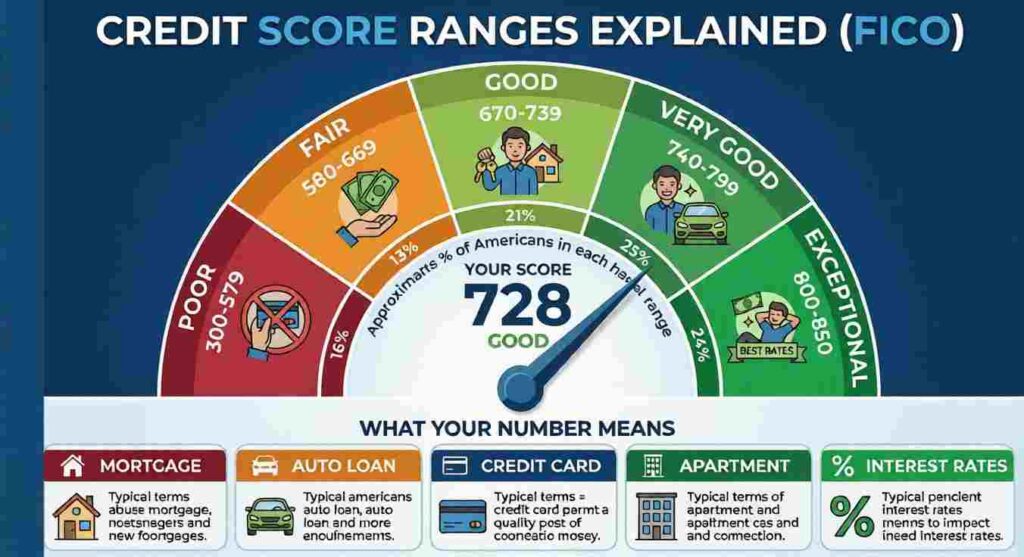
| FICO divides the 300 to 850 credit score scale into five ranges: Poor from 300 to 579, Fair from 580 to 669, Good from 670 to 739, Very Good from 740 to 799 and Exceptional from 800 to 850. These ranges are used by 90 percent of top US lenders to assess credit risk, per FICO. Moving up one range typically results in meaningfully lower interest rates on every credit product you use. |
The five FICO credit score ranges have the same names regardless of which FICO scoring model version a lender uses, whether that is FICO 8, FICO 9 or FICO 10. The ranges are published on myFICO.com and are the official categorization used by the major credit bureaus Equifax, Experian and TransUnion when describing consumer credit health.
| FICO Range | Score | % of Americans | What It Signals to Lenders |
| Exceptional | 800 to 850 | 24% | Elite credit health. Best rates available on all products. |
| Very Good | 740 to 799 | 25% | Strong credit. Competitive rates. Lenders compete for your business. |
| Good | 670 to 739 | 21% | Average American range. Most products accessible at reasonable rates. |
| Fair | 580 to 669 | 17% | Subprime territory. Higher rates, more restrictions, fewer options. |
| Poor | 300 to 579 | 13% | Most traditional lenders decline. Secured cards and credit-builder loans only. |
Source: FICO Credit Insights Report 2026 and Experian State of Credit Report 2025. Percentages are approximate and vary slightly by data source and measurement period.
FICO vs VantageScore: Which One Matters More
| FICO scores are used in over 90 percent of US lending decisions, making them the primary credit score for mortgage, auto loan and credit card applications. VantageScore is used by many free credit monitoring services including Credit Karma and Capital One CreditWise, so Americans often see their VantageScore displayed as their current credit score even though most lenders are checking their FICO score. The two models use the same 300 to 850 scale but have different cutoffs for each rating category. | |||
| Rating | FICO Score Range | VantageScore 3.0 and 4.0 Range | Key Difference |
| Exceptional / Excellent | 800 to 850 | 781 to 850 | VantageScore Excellent starts 19 points lower |
| Very Good / Prime | 740 to 799 | 661 to 780 | VantageScore Prime is a much broader band |
| Good | 670 to 739 | 601 to 660 | Different thresholds can create confusion |
| Fair / Near Prime | 580 to 669 | 500 to 600 | VantageScore starts Fair lower |
| Poor / Subprime | 300 to 579 | 300 to 499 | Similar floor |
The practical takeaway is that a 680 VantageScore shown by a free credit monitoring app puts you in the Good range on VantageScore but still in the Good range on FICO as well. However a 720 VantageScore shown as Prime does not mean you are in the same position on FICO. When preparing for a mortgage or major loan application, pull your actual FICO scores from myFICO.com to see the specific score versions your lender will check.
The Real Lender Cutoffs Inside Each Range
What credit score thresholds do lenders actually use?
| While FICO’s five official ranges provide useful labels, the thresholds lenders actually use for approval and rate decisions sit at specific numbers within those ranges. The most important practical cutoffs in 2026 are: 580 for FHA mortgage eligibility, 620 for conventional mortgages and most auto lenders, 670 for mainstream unsecured credit cards, 720 for competitive auto loan rates and 740 for the best available mortgage rates. Knowing which side of these thresholds you are on matters more than knowing your range label. |
The official range labels are useful shorthand but the actual decisions lenders make are based on specific score thresholds that do not always align neatly with the range boundaries. Two consumers in the same Good range can have very different lending outcomes if one is at 672 and the other is at 738.
| The Practical Lender Thresholds in 2026 580: Minimum for FHA mortgage with 3.5 percent down payment. Below 580 requires 10 percent down. Per HUD guidelines 2026. 620: Minimum for most conventional mortgages and most auto lenders. Below this most mainstream lenders decline. Per Fannie Mae and Freddie Mac guidelines 2026. 670: Minimum for most mainstream unsecured credit cards at reasonable rates. Below this most major issuers offer secured cards only. 720: Threshold for competitive auto loan rates at most banks and credit unions. Above this rate offers improve noticeably. 740: Threshold for the best available mortgage rates at most lenders. Above 740 additional score improvement rarely produces further rate improvement. |
What Each Credit Score Range Actually Costs You
How much does your credit score affect your interest rate?
| Your credit score directly determines the interest rate on every credit product you use. On a $350,000 30-year mortgage, a borrower with an Exceptional score above 760 pays approximately 6.15 percent APR while a borrower with a Fair score near 620 pays approximately 7.72 percent APR. That difference amounts to $372 more per month and over $133,000 more in total interest over the life of the loan, per Experian and Curinos rate data April 2026. |
Mortgage cost by credit score range
| Credit Score | Approx APR (30yr Fixed) | Monthly Payment ($350k loan) | Total Interest Over 30 Years |
| 760 and above (Exceptional) | 6.15% | $2,133 | $417,880 |
| 700 to 759 (Very Good) | 6.63% | $2,240 | $456,400 |
| 660 to 699 (Good) | 7.10% | $2,350 | $496,000 |
| 620 to 659 (Fair) | 7.72% | $2,505 | $551,800 |
| Below 620 (Poor) | FHA required or declined | Varies significantly | Significantly higher |
Source: Experian and Curinos national average rate data, April 2026. Rates are illustrative averages. Actual rates vary by lender, down payment, loan type and market conditions at time of application.
Auto loan cost by credit score range
| Credit Score Range | Avg New Car APR | Monthly Payment ($35k car, 60mo) | Total Interest Paid |
| 781 and above | 4.8% | $658 | $4,480 |
| 661 to 780 | 6.9% | $692 | $6,520 |
| 601 to 660 | 10.8% | $753 | $10,180 |
| 500 to 600 | 14.5% | $831 | $14,860 |
| Below 500 | Over 20% or declined | $940 and above | $21,400 and above |
Source: Experian State of the Automotive Finance Market Q1 2026. Rates are national averages and vary significantly by lender, vehicle age and market conditions.
What can you do with a Poor credit score?
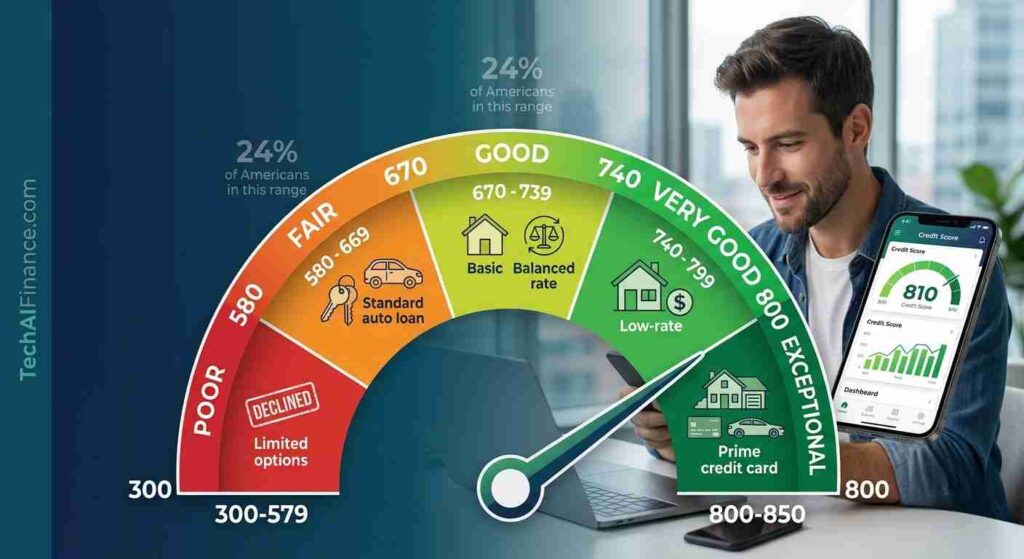
| With a Poor credit score between 300 and 579, most traditional lenders will decline standard applications for unsecured credit cards, personal loans and auto loans. FHA mortgages require a minimum 580 FICO score with 3.5 percent down or 500 with 10 percent down. The fastest path from Poor to Fair is a secured credit card used correctly, meaning low balances and on-time payments, combined with disputing any inaccurate items on your credit report at annualcreditreport.com. |
About 13 percent of Americans are in the Poor range, per FICO Credit Insights Report 2026. A Poor score is most commonly the result of missed payments, accounts in collections, a bankruptcy, a foreclosure or a very thin credit file with little positive history. Moving from Poor to Fair is the highest-impact transition on the entire credit scale because it unlocks access to products that are simply unavailable below 580.
What is available with Poor credit
- Secured credit cards: You deposit $200 to $500 as collateral and receive a credit card with that amount as your limit. Using it for small purchases and paying the full balance monthly builds positive payment history without the risk of adding debt.
- Credit-builder loans: Offered by credit unions and some online lenders. You make payments into a locked savings account. When the loan is paid off you receive the funds. The on-time payments are reported to all three bureaus.
- Becoming an authorized user: If a family member or trusted friend adds you as an authorized user on their credit card account with a long history and low utilization, their positive history can appear on your credit report.
| ⚠ Watch Out Predatory lenders target consumers with Poor credit scores. Payday loans, rent-to-own financing and some buy-here-pay-here auto dealerships charge effective APRs of 200 to 400 percent and rarely help build your credit score even when payments are made on time since many do not report to the major bureaus. A secured card from a major bank or credit union is a better starting point. Discover it Secured, Capital One Quicksilver Secured and Chime Credit Builder are among the most credit-builder friendly options in 2026 that report to all three bureaus. Source: CFPB Payday Lending Research 2025 at consumerfinance.gov. |
Fair Credit (580 to 669): The Most Actionable Range for Americans
What can you qualify for with a Fair credit score?
| With a Fair credit score between 580 and 669, you can qualify for FHA mortgages starting at 580, many auto loans at elevated rates, some unsecured credit cards at high APRs and most apartment rentals with a larger security deposit. The Fair range is the most actionable range for credit improvement because the moves that work here, reducing utilization and adding on-time payments, produce faster score increases than at any other starting point. Many Americans in this range can reach Good credit within 6 to 12 months. |
About 17 percent of Americans are in the Fair range, per FICO Credit Insights Report 2026. This range often results from a combination of a few missed payments, higher credit card utilization or a relatively short credit history. The good news is that Fair credit is the range where focused, consistent action produces the fastest visible results.
The fastest moves from Fair to Good
- Reduce credit card utilization below 30 percent: Utilization above 30 percent significantly depresses your score. Paying down balances to below 30 percent of each card’s limit is often the single highest-impact action available in this range.
- Never miss a payment: Payment history accounts for 35 percent of your FICO score. Set up autopay for at least the minimum on every account.
- Dispute inaccurate items: The Consumer Financial Protection Bureau found that approximately 1 in 5 Americans has an error on at least one credit report, per CFPB 2025 data. Disputing errors at annualcreditreport.com is free and can produce meaningful score improvements within 30 to 60 days if the error is removed.
- Do not close old accounts: Closing a credit card reduces your total available credit, which raises your utilization ratio. Old accounts with no balance are better left open.
- Avoid new hard inquiries: Each credit application triggers a hard inquiry that temporarily lowers your score by 5 to 10 points. In the Fair range, cluster any new credit applications within a 14-day window so they count as a single inquiry.
Good Credit (670 to 739): Where Most Americans Live
| A Good FICO score between 670 and 739 is enough to qualify for most credit products including conventional mortgages, standard auto loans and most credit cards, but it does not qualify you for the best available rates. The best mortgage and auto loan rates become available at 740 and above. Good credit is where the average American sits and where small score improvements produce meaningful rate savings on larger purchases. |
About 21 percent of Americans are in the Good range, per FICO Credit Insights Report 2026, and the national average FICO score of 714 sits comfortably in this range. Good credit means approval for most financial products at reasonable but not optimal rates. The value of moving from 720 to 740 is often underestimated: that 20-point increase can improve your mortgage rate by 0.25 to 0.5 percent, which on a $350,000 loan translates to $60 to $120 less per month for 30 years.
| 💡 Pro Tip If you are in the Good range and planning a mortgage application within the next 6 to 12 months, focus exclusively on reducing utilization. Utilization is the most quickly adjustable factor in your score. Paying down a credit card balance from 40 percent utilization to 10 percent utilization can add 20 to 30 points to your score within a single billing cycle after the new balance is reported to the bureaus. One billing cycle improvement of 20 to 30 points could move you from 720 to 740 and into the best rate tier on your mortgage. |
Very Good Credit (740 to 799): Competitive Rate Territory
| A Very Good FICO score between 740 and 799 qualifies you for the best available mortgage rates, competitive auto loan rates and premium credit cards with the highest rewards and lowest APRs. At 740, lenders compete for your business. Approval rates are very high across almost all credit products. The difference between Very Good and Exceptional credit in practical lending terms is minimal since most lenders offer their best pricing to any borrower at 740 or above. |
About 25 percent of Americans are in the Very Good range, per FICO Credit Insights Report 2026. Consumers here typically have consistent on-time payment histories, moderate to low utilization and a healthy mix of account types. The real question at this range is not how to improve your score but how to use your strong credit profile most effectively for major financial goals.
What Very Good credit unlocks
- Best mortgage rates: 740 and above is the threshold where most lenders offer their best pricing. A $350,000 mortgage in this range costs approximately $2,133 to $2,240 per month compared to $2,350 to $2,505 for Good range borrowers, per Experian and Curinos April 2026.
- Premium credit card approvals: The top travel rewards cards, cash back cards and cards with the highest sign-on bonuses require Very Good or Exceptional credit for consistent approval.
- Best auto loan rates: Credit unions and banks compete for borrowers at 740 and above. Pre-qualification without a hard inquiry from multiple lenders is worth doing before any auto purchase.
- Apartment applications: Very Good credit eliminates additional security deposits and co-signer requirements at virtually all residential rental properties.
Exceptional Credit (800 to 850): The Top Tier
What are the benefits of an Exceptional credit score?
| An Exceptional FICO score between 800 and 850 qualifies you for the absolute lowest available interest rates on every credit product, premium credit card approvals with the highest rewards tiers and zero friction on apartment applications and other credit-based screenings. About 24 percent of Americans have an Exceptional score, per FICO Credit Insights Report 2026. There is no meaningful practical difference between an 800 and an 850. Both qualify for the best rates available. |
Exceptional credit is achieved through years of consistent behavior rather than any single action. Consumers in this range typically have long credit histories with no recent late payments, very low utilization across multiple accounts, a healthy mix of credit types and few recent hard inquiries. The credit profile here is the result of sustained habits rather than optimization tactics.
One important note: chasing an 850 score after crossing 800 produces no additional financial benefit. Every lender that has best-rate pricing based on credit score applies it to all borrowers at or above 740 to 760. An 800 and an 850 pay the same mortgage rate. The goal is not a perfect score but a score in the range that qualifies you for the best available terms on the products you actually use.
The Five Factors Behind Your Credit Score
What factors determine your credit score?
| Five factors determine your FICO credit score. Payment history accounts for 35 percent and is the single most important factor. Amounts owed, meaning your credit utilization ratio, accounts for 30 percent. Length of credit history accounts for 15 percent. Credit mix across different account types accounts for 10 percent. New credit from recent applications and inquiries accounts for 10 percent. Payment history and utilization together control 65 percent of your score and are the only two factors you can actively improve within a single billing cycle. | ||||
| Factor | FICO Weight | What It Measures | What Helps Most | |
| Payment history | 35% | On-time vs late payments across all accounts | Never miss a payment. Set up autopay. | |
| Amounts owed (utilization) | 30% | Credit used vs total available credit | Keep utilization below 30%, ideally below 10% | |
| Length of credit history | 15% | Age of oldest, newest and average account | Keep old accounts open. Start early. | |
| Credit mix | 10% | Variety of account types: cards, loans, mortgage | Having both revolving and installment accounts helps | |
| New credit | 10% | Recent hard inquiries and new accounts | Limit new applications. Space them out. | |
How to Move From One Range to the Next
The most effective actions depend on your starting range. The moves that produce 50-point improvements in the Poor to Fair transition are different from the moves that produce 20-point improvements in the Good to Very Good transition.
Poor to Fair (targeting 580)
- Open a secured credit card and use it for one small recurring purchase per month. Pay the full balance before the due date every month. This builds payment history and keeps utilization very low.
- Dispute any inaccurate items on all three credit reports at annualcreditreport.com. Incorrect collections, wrong account information or errors in personal information can all suppress your score.
- Ask a trusted family member to add you as an authorized user on a card with a long history and low utilization.
Fair to Good (targeting 670)
- Pay down credit card balances to below 30 percent utilization on each card, not just overall.
- Set up autopay for at least the minimum payment on every account to eliminate any future missed payments.
- Wait for negative items to age. Late payments lose most of their score impact after 2 years even though they remain on the report for 7 years.
Good to Very Good (targeting 740)
- Reduce utilization further, to below 10 percent on each card. This single action is often worth 20 to 40 points from the Good range.
- Avoid any new credit applications in the 6 to 12 months before a major credit event like a mortgage application.
- Allow existing positive accounts to age. Time in the Good range with no negative events is the most reliable path to Very Good.
Very Good to Exceptional (targeting 800)
- Maintain all existing positive habits. Exceptional credit is built by time without negative events more than by any specific action.
- Keep at least one credit card with a balance below 5 percent utilization reported to the bureaus each month.
- Allow your oldest accounts to remain open even if you rarely use them.

How Long Negative Items Stay on Your Report
How long does bad credit stay on your report?
| Most negative items stay on your credit report for seven years from the date of the first delinquency. Chapter 7 bankruptcy stays for 10 years. Hard inquiries stay for two years but typically only affect your score for 12 months. However, negative items lose most of their impact on your score long before they fall off. A late payment from 4 years ago has significantly less weight than one from 6 months ago even though both appear on the report. | ||
| Negative Item | Time on Report | When It Loses Most Impact |
| Late payments | 7 years | After 2 years impact reduces significantly |
| Collections | 7 years from first delinquency | After 2 to 3 years for paid collections |
| Chapter 7 bankruptcy | 10 years | After 4 to 5 years for score impact |
| Chapter 13 bankruptcy | 7 years | After 3 to 4 years for score impact |
| Hard inquiries | 2 years | After 12 months no longer affects score |
| Foreclosure | 7 years | After 3 to 4 years impact reduces |
| Repossession | 7 years | After 2 to 3 years impact reduces |
Source: Fair Credit Reporting Act (FCRA) statutory timelines. Federal law governs how long consumer reporting agencies may retain negative information.
| 💡 Real-World Example Consider two hypothetical Americans who both set a goal of buying a home in three years. Keisha is 32 and lives in Atlanta, Georgia. Her FICO score when she set the goal was 624, sitting in the Fair range. She had two late payments from three years ago and credit card balances representing 48 percent of her total available credit. Over the next 18 months she paid her balances down to 9 percent utilization, set up autopay on all accounts and opened no new credit. Eighteen months later her score had risen to 698, firmly in the Good range. By the time she applied for a mortgage three years after setting the goal her score was 734, just six points below the Very Good threshold but well above the conventional mortgage minimum. She qualified for a 6.78 percent rate on a $320,000 mortgage, paying $2,083 per month. Marcus is 35 and lives in Phoenix, Arizona. His FICO score was 622 when he set the same three-year homebuying goal. He did not change his credit habits. He continued using 52 percent of his available credit, missed one more payment in year two and opened a new credit card for a retail discount in year one. Three years later his score was 601. He qualified for an FHA loan at 7.95 percent on the same $320,000 mortgage, paying $2,335 per month. Over 30 years, Marcus will pay $90,720 more in interest than Keisha. Same starting score. Same goal. Same timeline. The difference was whether credit habits changed in the three years between setting the goal and reaching it. These examples are illustrative. Actual results depend on individual credit profiles, lender policies and market conditions at time of application. |
Frequently Asked Questions
What is considered a good credit score in the US in 2026?
A FICO score of 670 or above is officially considered Good in 2026. However, the more useful threshold for most Americans is 740, where the best available mortgage and auto loan rates become accessible. The national average FICO score is 714, per the FICO Credit Insights Report Spring 2026, which sits in the middle of the Good range and is sufficient for most credit products at reasonable but not optimal rates.
How do I check my credit score for free?
Pull your official credit reports from all three bureaus for free at annualcreditreport.com, which is the only federally authorized free credit report site. This shows your full report but not your score. For free score monitoring, Credit Karma at creditkarma.com shows your TransUnion and Equifax VantageScore updated daily. Experian’s free tier at experian.com shows your Experian FICO Score 8 monthly. Capital One CreditWise shows your TransUnion VantageScore and includes free dark web monitoring at no cost to anyone regardless of whether you bank with Capital One.
Why is my credit score different on different apps?
Your credit score differs across apps because different apps use different scoring models and different bureau data. Credit Karma shows VantageScore from TransUnion and Equifax. Experian shows FICO Score 8 from Experian. A mortgage lender checks FICO Score 2 from Equifax, FICO Score 5 from Experian and FICO Score 4 from TransUnion, which are different from all of the above. None of these scores is wrong. They are all legitimate calculations from the same underlying credit data using different mathematical models.
How quickly can I improve my credit score?
Utilization improvements can produce visible score changes within a single billing cycle after your creditor reports the new lower balance to the bureaus, typically 30 to 45 days. Disputing and removing an inaccurate negative item can produce changes within 30 to 60 days after the dispute is resolved. Payment history improvements take longer because each on-time payment adds to a positive pattern rather than producing an immediate jump. Most Americans who take focused action see meaningful score improvement within 3 to 6 months. Moving a full range, such as from Fair to Good, typically takes 6 to 18 months of consistent positive behavior.
Does checking my own credit score hurt it?
No. Checking your own credit score through any monitoring service, free app or the federally mandated annualcreditreport.com produces a soft inquiry that does not affect your score at all. Only hard inquiries, which occur when a lender checks your credit as part of a new credit application, affect your score. You can check your own score as many times as you want without any negative impact.
What is the fastest way to raise my credit score?
The fastest way to raise a credit score for most Americans is reducing credit card utilization. If your cards are at 40 to 70 percent utilization, paying them down to below 30 percent and ideally below 10 percent can produce significant score improvement within one billing cycle. For Americans with accurate reports and low utilization, there is no fast fix because the remaining factors such as payment history length and credit age build over time rather than in response to a single action.
| ⭐ Key Takeaway Your credit score range determines the price of every dollar you borrow. The difference between the Good range and the Very Good range on a $350,000 mortgage is over $100,000 in total interest. The two factors you can actually move quickly are payment history and utilization. They control 65 percent of your score. Set up autopay today and pay down your highest utilization card first. Do not chase an 850. Chase 740. At 740 you qualify for the best rates most lenders offer. Every point above that is a milestone, not a financial benefit. |
Conclusion
A credit score range is not a permanent condition. It is a snapshot of your credit behavior up to this moment, and every billing cycle is an opportunity to improve it. The Americans who move from Fair to Good credit within 18 months are not doing anything complicated. They are paying on time, keeping utilization low and letting their positive history build. The ones who move from Good to Very Good are doing the same things more consistently for longer.
For Americans who are working on improving their credit score alongside managing existing debt, our guide on how to fix bad credit in 6 months covers the specific dispute and habit steps that produce the fastest verified improvement. For those monitoring their score during the improvement process, our guide on best credit monitoring apps for Americans 2026 covers the free and paid tools that alert you as your score moves between ranges.Read Next
Continue building your financial knowledge on TechAIFinance.com:
- How to Fix Bad Credit in 6 Months: Step-by-Step Guide for 2026
- Best Credit Monitoring Apps for Americans 2026
- How to Get Out of Debt Fast on a Low Income: 7-Step Plan
- How to Build Wealth on a Single Income in the US 2026
- How to Create a Budget When Living Paycheck to Paycheck
| ✍ About the Author Written by: TechAIFinance Editorial Team Edited and Fact-Checked by: Olayinka Adejugbe Olayinka Adejugbe is not a licensed financial advisor. The content on TechAIFinance.com is produced for educational purposes only and should not be treated as personalized financial advice. Olayinka is the founder and lead editor of TechAIFinance.com. He holds a Global Certification in Artificial Intelligence and Applied Innovation and an Award of Completion in Behavioral Counseling from the World Health Organization. With a strong working knowledge of personal finance and accounting principles, Olayinka oversees the editorial review of every article on this site to ensure accuracy, currency and practical usefulness. Every article on TechAIFinance.com is produced by our research team and reviewed by Olayinka before publication. We verify statistics against named authoritative sources and update content when circumstances change. Visit our About page to learn more about our editorial process. Use our Contact page to get in touch. |
Disclaimer & Content Note
The information provided on TechAIFinance.com—including content on personal finance, side hustles, AI tools, and tech reviews is for educational and informational purposes only and does not constitute professional financial, legal, tax, or technical advice. Financial outcomes, business earnings, and tech performance vary based on individual circumstances and market conditions. TechAIFinance.com makes no guarantees regarding results or tool performance. Always consult a qualified professional before making major financial, business, or tech purchasing decisions. Free certified credit counseling is available through the National Foundation for Credit Counseling at nfcc.org.