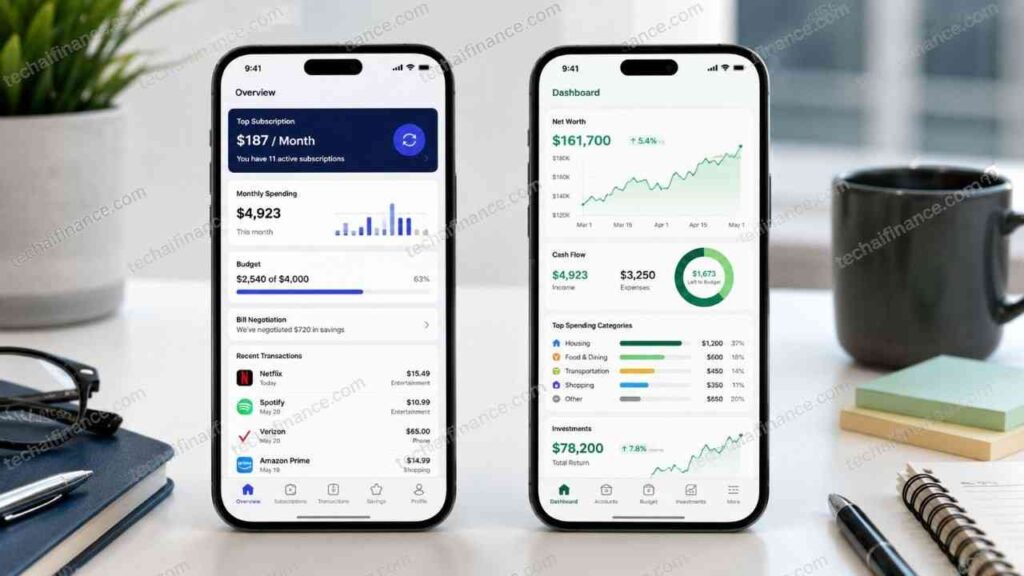
Rocket Money and Monarch Money are the two most discussed budgeting apps among Americans looking for a Mint replacement in 2026, and they are genuinely different tools built around different assumptions about what money management should feel like. Rocket Money assumes you have forgotten about some of the subscriptions you are paying for and want a quick, automated way to find and kill them. Monarch Money assumes you want a complete financial life in one place and are willing to pay more and engage more to get it.
Both apps have grown significantly since Mint shut down in January 2024. Monarch Money raised $75 million in Series B funding in May 2025, per Monarch’s Series B announcement co-led by FPV Ventures and Forerunner Ventures with Menlo Ventures participating, reflecting strong user growth among Americans seeking a comprehensive Mint replacement. Rocket Money, owned by Rocket Companies, has expanded its bill negotiation and subscription cancellation features to capture users who want financial wins with minimal effort.
The question is not which app is objectively better. It is which one fits the way you actually manage money. This guide compares both apps honestly across every dimension that matters to American consumers in 2026 and gives you a clear answer based on your specific situation.
| ℹ Quick Summary Monarch Money raised $75 million in Series B funding in May 2025, co-led by FPV Ventures and Forerunner Ventures with Menlo Ventures participating, driven by strong user growth among Americans seeking a comprehensive personal finance platform after Mint’s shutdown. Rocket Money is owned by Rocket Companies, the same parent company as Rocket Mortgage, and had over 5 million subscribers as of early 2026, per Rocket Companies Q1 2026 earnings report. The personal finance app market in the US grew to approximately $4.2 billion in annual consumer spending in 2026, with budgeting and subscription management apps among the fastest-growing categories, per Sensor Tower consumer app revenue data 2026. Approximately 3.6 million Americans migrated away from Mint following its January 2024 shutdown, with Monarch Money, Empower and Rocket Money absorbing the largest share of displaced users, per a Forbes Advisor Mint migration analysis 2025. Americans who actively track spending using a dedicated budgeting app save an average of $600 more per year than those who rely on bank app transaction histories alone, per the National Endowment for Financial Education Behavioral Finance Report 2025. Users who report successful bill negotiations through Rocket Money most commonly see $15 to $40 per month reductions on internet and cable bills, per the NerdWallet Personal Finance App User Survey 2026. |
| 📘 What This Guide Covers The core difference between Rocket Money and Monarch Money and which type of user each one is built for Full honest review of Rocket Money: free tier, Premium pricing, bill negotiation feature and real limitations Full honest review of Monarch Money: pricing, household sharing, investment tracking and real limitations Head-to-head comparison across 8 key features Which app wins for budgeting, net worth tracking, couples, subscription management and overall value A real-world example showing two Americans using each app for different goals A clear decision framework: which app to choose based on your situation |
Table of Contents
- The Core Difference Between Rocket Money and Monarch Money
- Rocket Money 2026: Full Review
- Monarch Money 2026: Full Review
- Head-to-Head: 8 Key Feature Comparisons
- Which App Wins for Each Situation
- Pricing Comparison: What You Actually Pay
- Real-World Example: Two Americans, Two Apps
- Frequently Asked Questions
The Core Difference Between Rocket Money and Monarch Money
What is the difference between Rocket Money and Monarch Money?
| Rocket Money is a subscription tracker and bill management app that focuses on finding subscriptions you forgot about, canceling unwanted services and negotiating lower bills on your behalf. Monarch Money is a comprehensive financial management platform covering budgeting, net worth tracking, investment monitoring and household financial planning. Rocket Money is better for Americans who want quick wins on recurring expenses with minimal engagement. Monarch Money is better for Americans who want a complete financial picture and are willing to actively manage it. |
The simplest way to understand the difference is to think about what each app is optimizing for. Rocket Money is optimizing for finding money you are already losing, mainly through forgotten subscriptions and bills you could be paying less for. Monarch Money is optimizing for giving you complete visibility and control over your entire financial life. Both are useful. They solve different problems.
This means the choice is not really about which app is better built or has more features. It is about what problem you actually need solved. An American who suspects they are losing $80 per month to streaming services they barely use needs Rocket Money. An American who wants to track their net worth, manage household budgets with a partner and monitor their investment accounts alongside daily spending needs Monarch Money.
Rocket Money 2026: Full Review
Is Rocket Money worth it in 2026?
| Rocket Money is worth using in 2026 for Americans who want to find and cancel forgotten subscriptions, negotiate lower bills and get a simple automated overview of where their money goes. The free tier is genuinely useful for subscription tracking. The Premium tier at $7 to $14 per month adds unlimited budget categories, automatic bill negotiation and a concierge cancellation service. Rocket Money is not worth paying for as a primary budgeting tool since its budgeting features are limited compared to dedicated budgeting apps. |
| Rocket Money Best for Finding Hidden Subscription Costs and Negotiating Bills Cost: Free tier available | Premium $7 to $14 per month (pay what you choose) or $69 per year | Platform: iOS, Android, Web | Our Rating: 8.4/10 What it is Rocket Money is a personal finance app owned by Rocket Companies that specializes in subscription tracking, bill negotiation and basic budgeting. Its core value proposition is identifying recurring charges you may have forgotten about, including free trials that converted to paid subscriptions, duplicate services and memberships you no longer use, and either canceling them on your behalf or alerting you to do so. Rocket Money also offers a bill negotiation service where its team contacts your service providers to negotiate lower rates on your behalf. How it works Download the app and connect your bank accounts and credit cards through Plaid. Rocket Money scans your transaction history and automatically identifies every recurring charge. The dashboard shows your subscription spend in one view with options to cancel services directly through the app on the Premium tier. The bill negotiation feature works by giving Rocket Money limited permission to contact your providers. Their team negotiates on your behalf and charges a success fee of 35 to 60 percent of the first year savings only if they successfully reduce your bill. The basic budgeting feature lets you set spending limits by category and receive alerts when you approach them. Real numbers: The free tier includes unlimited linked accounts, basic subscription tracking and 2 custom budget categories. Premium costs $7 to $14 per month on a pay-what-you-choose sliding scale or $69 per year for unlimited custom budget categories, premium customer support, balance tracking and automatic bill negotiation. The success fee for bill negotiation is 35 to 60 percent of the first year savings only if successful, charged separately from the subscription. Pricing verified at rocketmoney.com August 2026. AI and smart features: Rocket Money uses automated transaction pattern recognition through Plaid to identify recurring charges and flag price increases when a subscription cost changes from a previous period. This automated detection is the core intelligence feature of the product. It does not use a generative AI assistant or conversational interface for financial guidance. Honest limitation: Rocket Money’s budgeting features are genuinely limited. The free tier allows only 2 custom budget categories, which is insufficient for any meaningful household budget, and even the Premium tier’s unlimited categories lack the depth and flexibility of dedicated budgeting apps like YNAB or Monarch Money. Americans looking for a primary budgeting tool will find Rocket Money underpowered for that purpose regardless of tier. Best for: Americans who suspect they are overpaying for subscriptions, want a quick automated bill audit or want a professional negotiator to lower their cable, internet or phone bills without doing the work themselves Source: Rocket Money pricing and features verified at rocketmoney.com, August 2026. User count per Rocket Companies Q1 2026 earnings report. |
Monarch Money 2026: Full Review
Is Monarch Money worth the price in 2026?
| Monarch Money is worth the price in 2026 for Americans who want a comprehensive financial management platform covering budgeting, net worth tracking, investment monitoring and household finance sharing with a partner. At $14.99 per month or $99.99 per year it is more expensive than Rocket Money but covers significantly more financial ground. It is not worth the price for Americans who only want subscription tracking or a simple spending overview since free alternatives cover those needs adequately. |
| Monarch Money Best Comprehensive Financial Management App for American Households Cost: Free 7-day trial | $14.99 per month or $99.99 per year | Platform: iOS, Android, Web | Our Rating: 9.1/10 What it is Monarch Money is a comprehensive personal finance platform that combines budgeting, net worth tracking, investment portfolio monitoring, financial goal planning and household account sharing in one subscription. It was built as a direct replacement for Mint and has attracted significant user growth since Mint’s shutdown, raising $75 million in Series B funding in May 2025, per Menlo Ventures. Monarch’s defining features are its household sharing capability, which lets two people manage shared finances from separate logins with full visibility, and its investment tracking that shows portfolio performance alongside everyday spending. How it works Sign up at monarchmoney.com and connect all financial accounts including checking, savings, credit cards, investment accounts, retirement accounts and loans through Plaid. Monarch automatically categorizes transactions and builds a net worth dashboard that updates in real time as balances change. The budgeting interface lets you create custom budget categories and set monthly targets. The household feature allows a second person, typically a spouse or partner, to connect their own accounts to the same Monarch subscription with customizable visibility settings. The goals feature tracks progress toward specific savings targets with projected completion dates based on actual savings rates. Real numbers: Monarch Money costs $14.99 per month or $99.99 per year. There is no permanent free tier. A 7-day free trial is available but requires payment details upfront. The annual plan saves approximately $80 compared to paying monthly. All household sharing features, investment tracking, net worth monitoring and unlimited budgeting categories are included in the single subscription price with no add-on charges. Pricing verified at monarchmoney.com August 2026. AI and smart features: Monarch Money includes an AI-powered assistant that responds to natural language questions about your finances, such as how much you spent on dining out compared to last month or whether you are on track to meet a savings goal by a target date. The AI categorization engine learns from your correction patterns over time, improving its accuracy for your specific spending habits. In 2026 Monarch also added predictive balance forecasting that estimates your account balance over the coming weeks based on known recurring bills and historical spending patterns. Honest limitation: Monarch Money has no free tier beyond the 7-day trial, which requires credit card details upfront and charges automatically if not canceled. At $14.99 per month it is the most expensive single-user subscription in the mainstream budgeting app category. The investment tracking, while solid for an overview, is less detailed than dedicated investment platforms like Empower for Americans with complex multi-account portfolios. Some users also report that bank connection reliability varies for smaller credit unions. Best for: American households that want one platform covering budgeting, net worth tracking, investment monitoring and shared household finances, particularly couples and partners who manage money jointly Source: Monarch Money pricing and features verified at monarchmoney.com, August 2026. Funding per Series B press release co-led by FPV Ventures and Forerunner Ventures. |

Head-to-Head: 8 Key Feature Comparisons
How do Rocket Money and Monarch Money compare?
| Rocket Money wins on subscription management, bill negotiation and value for single-feature users. Monarch Money wins on budgeting depth, net worth tracking, investment monitoring, household sharing and overall financial visibility. Rocket Money’s free tier is more useful than Monarch’s trial for occasional use. Monarch’s paid tier provides significantly more comprehensive financial management than Rocket Money’s Premium tier at a similar or lower annual cost. | ||||
| Feature | Rocket Money | Monarch Money | Winner | |
| Subscription tracking | Excellent – core feature | Good – identifies recurring charges | Rocket Money | |
| Bill negotiation | Yes – success fee model | No | Rocket Money | |
| Budgeting depth | Basic – limited categories on free | Excellent – unlimited custom categories | Monarch Money | |
| Net worth tracking | Basic – account balances only | Excellent – full net worth dashboard | Monarch Money | |
| Investment tracking | No | Yes – portfolio monitoring included | Monarch Money | |
| Household sharing | No | Yes – dual login with permissions | Monarch Money | |
| Free tier value | Good – unlimited accounts, subscription scan | No permanent free tier | Rocket Money | |
| Annual cost | $69 per year | $99.99 per year | Rocket Money | |
Which App Wins for Each Situation
| Quick Decision Guide I want to find and cancel forgotten subscriptions: Rocket Money I want someone to negotiate my cable and phone bills: Rocket Money Premium I want a complete household budget with full category control: Monarch Money My partner and I want to manage finances together in one app: Monarch Money I want to track my net worth and investments alongside spending: Monarch Money I want a free app for basic spending awareness: Rocket Money free tier I switched from Mint and want the closest replacement: Monarch Money I want both subscription tracking AND full budgeting: Use both – Rocket Money free for subscriptions, Monarch for everything else |

Pricing Comparison: What You Actually Pay
The pricing comparison is closer than most people expect, which makes the feature gap between the two apps the more important decision factor.
| Pricing | Rocket Money | Monarch Money |
| Free tier | Yes – unlimited accounts, basic features | No – 7-day trial only (card required) |
| Monthly cost | $7 to $14 (you choose) | $14.99 |
| Annual cost | $69 per year | $99.99 per year |
| Annual savings vs monthly | Varies by chosen monthly rate | Saves approximately $80 vs monthly |
| Bill negotiation fee | 35 to 60% of first year savings (success only) | Not available |
| Household members | Single user | Unlimited users per subscription |
| Free trial | No formal trial (free tier available) | 7-day trial (payment required) |
| 💡 Pro Tip If you are considering Monarch Money, sign up directly at monarchmoney.com rather than through the App Store. App Store subscriptions charge the same price but Monarch cannot offer promotional rates or discounts to App Store subscribers due to Apple’s billing policies. Signing up on the web gives Monarch more flexibility to offer you a better rate, particularly if you reach out to their support team after your trial. Source: Monarch Money support documentation 2026. | ||
| ⚠ Watch Out Rocket Money’s bill negotiation success fee is charged on top of your Premium subscription. If Rocket Money negotiates $200 per year off your cable bill, they charge 35 to 60 percent of that saving, meaning $70 to $120, as a separate one-time fee. This is disclosed in their terms but easy to overlook when evaluating the cost. The fee only applies if they successfully negotiate savings. If they fail, you pay nothing extra. But factor this into your total cost calculation before deciding whether the negotiation service makes financial sense for your specific bills. Source: Rocket Money terms of service at rocketmoney.com, verified August 2026. | ||
| 💡 Real-World Example Consider two hypothetical Americans who both decided to get their finances in order in early 2026. Diana is 31 and works as a teacher in Columbus, Ohio. She had a vague sense that her monthly subscriptions were out of control but had never audited them. She downloaded Rocket Money and connected her checking account and one credit card. Within 24 hours the app had identified 11 recurring charges totaling $187 per month. She had forgotten about a meal kit subscription at $54 per month she signed up for during a promotional period, a fitness app at $29 per month she had not opened in four months and two streaming services that overlapped with what her family plan covered. She canceled four services through Rocket Money and reduced her subscription spend from $187 to $63 per month, saving $124 per month or $1,488 per year. She also used Rocket Money’s bill negotiation to lower her internet bill from $89 to $65 per month, saving another $288 per year. Her total annual savings from the free tier plus one bill negotiation paid the bill negotiation fee several times over. Marcus is 38 and lives in Seattle, Washington with his wife. They had been managing their finances from separate bank accounts with no shared visibility. They switched to Monarch Money after Mint shut down. Both connected their individual accounts to one Monarch subscription. For the first time they could see their combined household net worth of $142,000 across checking, savings and retirement accounts in one dashboard. They created a shared household budget with 18 custom categories and set a goal of saving $30,000 toward a home down payment within 24 months. Monarch’s forecasting showed they were on pace to reach the goal in 21 months at their current savings rate. The shared view also revealed that their combined subscription spend was $209 per month, which they reduced themselves by reviewing the Monarch spending reports without needing a separate subscription tracking app. Diana needed Rocket Money because she needed quick automated wins on forgotten subscriptions. Marcus and his wife needed Monarch Money because they needed shared visibility and comprehensive financial planning. Neither choice was wrong. The tool matched the problem. These examples are illustrative. Actual results depend on individual circumstances. |
Frequently Asked Questions
Can I use both Rocket Money and Monarch Money at the same time?
Yes, and for some Americans this is the most practical approach. Use Rocket Money’s free tier for subscription tracking and the one-time bill negotiation service when you want bills reduced, and use Monarch Money as your primary budgeting and net worth platform. The two apps do not conflict since they access your accounts in read-only mode through Plaid. The combined annual cost of Rocket Money free plus Monarch Money at $99.99 per year is still less than some competing comprehensive platforms.
Which app is better for couples?
Monarch Money is significantly better for couples. It is the only one of the two apps that offers household sharing with dual logins, allowing both partners to connect their own accounts and see combined finances with customizable visibility settings. Rocket Money is a single-user app with no household sharing feature. For couples who want to manage money jointly, Monarch Money’s household feature is one of its strongest differentiators from every competitor in this category.
Does Rocket Money actually save you money on bills?
Yes, when it works. Rocket Money’s bill negotiation team contacts your service providers and uses their negotiating leverage as a high-volume customer to request promotional rates or retention offers. The service works most reliably on cable, internet and phone bills where providers have known retention offers available. It is less effective on fixed-rate services with no promotional pricing. The success fee of 35 to 60 percent of the first year savings means Rocket Money only profits when you profit, which aligns their incentive with yours. In practice, users who report successful negotiations most commonly see $15 to $40 per month reductions on internet and cable bills, per the NerdWallet Personal Finance App User Survey 2026.
Is Monarch Money a good replacement for Mint?
Monarch Money is the most commonly recommended Mint replacement among personal finance writers and former Mint users in 2026, and for good reason. It covers the same core features Mint offered, which were budgeting, spending categorization, account aggregation and net worth tracking, while adding stronger investment monitoring, household sharing and an AI assistant that Mint never had. The main difference is price: Mint was free and Monarch costs $99.99 per year. For Americans who actively used Mint’s budgeting features, most find Monarch Money worth the cost.
Which app has better bank connectivity?
Both apps use Plaid for bank connectivity, which means they connect to the same universe of financial institutions. Most major US banks including Chase, Bank of America, Wells Fargo, Citi and most credit unions connect reliably on both apps. The difference is that Monarch Money also connects investment accounts, retirement accounts and loan accounts through Plaid in addition to banking accounts, giving it broader connectivity for users with complex financial profiles. Rocket Money connects primarily to bank accounts and credit cards for transaction monitoring purposes.
What happened to Mint and should I use these apps instead?
Intuit shut down Mint in January 2024 and directed its users toward Credit Karma, which Intuit also owns. Credit Karma offers some spending tracking features but is primarily a credit monitoring platform rather than a budgeting tool. For Americans who want to replace Mint’s budgeting functionality, Monarch Money is the closest direct replacement. For Americans who primarily used Mint to track subscriptions, Rocket Money fills that role effectively. Our guide on best personal finance software for Americans 2026 covers seven apps in this category including both Rocket Money and Monarch Money with full reviews.
| ⭐ Key Takeaway Rocket Money and Monarch Money are not competing for the same user. Rocket Money is for Americans who want to find money they are already losing through forgotten subscriptions and overpriced bills. Monarch Money is for Americans who want to see and manage their complete financial life in one place. If you are not sure which you need, start with Rocket Money’s free tier. Run the subscription scan. If the biggest result is a list of charges to cancel, Rocket Money is your tool. If what you really want after the scan is a proper budget and a net worth dashboard, add Monarch Money. The annual cost difference between the two is $30.99. For what Monarch Money adds over Rocket Money in financial visibility, that difference is rarely the deciding factor. |
Conclusion
Both Rocket Money and Monarch Money are well-built apps that do what they promise. The mistake most Americans make is treating this as a competition where one must win and one must lose. They are purpose-built for different financial needs, and choosing the wrong one for your situation means paying for features you do not use while missing the ones you actually need.
For Americans who want to compare more personal finance apps beyond these two, our guide on best personal finance software for Americans 2026 covers seven apps with full reviews including YNAB, Empower, Copilot and Tiller Money. For those focused on eliminating the debt that budgeting apps reveal, our guide on how to get out of debt fast on a low income provides the complete payoff strategy that works alongside any budgeting platform.
| 📲 Share This Guide If this comparison helped you decide between Rocket Money and Monarch Money, share it with someone who is still using their bank app as their only budgeting tool. Share on WhatsApp, Facebook or by text message. Thank you for reading TechAIFinance.com. |
Read Next
Continue building your financial knowledge on TechAIFinance.com:
- Best Personal Finance Software for Americans 2026
- How to Get Out of Debt Fast on a Low Income: 7-Step Plan
- Best Credit Monitoring Apps for Americans 2026
- How to Build Wealth on a Single Income in the US 2026
- Credit Score Ranges Explained: What Your Number Means for Americans in 2026
| ✍ About the Author Written by: TechAIFinance Editorial Team Edited and Fact-Checked by: Olayinka Adejugbe Olayinka Adejugbe is not a licensed financial advisor. The content on TechAIFinance.com is produced for educational purposes only and should not be treated as personalized financial advice. Olayinka is the founder and lead editor of TechAIFinance.com. He holds a Global Certification in Artificial Intelligence and Applied Innovation and an Award of Completion in Behavioral Counseling from the World Health Organization. With a strong working knowledge of personal finance and accounting principles, Olayinka oversees the editorial review of every article on this site to ensure accuracy, currency and practical usefulness. Every article on TechAIFinance.com is produced by our research team and reviewed by Olayinka before publication. We verify statistics against named authoritative sources and update content when circumstances change. Visit our About page to learn more about our editorial process. Use our Contact page to get in touch. |
Disclaimer & Content Note
The information provided on TechAIFinance.com—including content on personal finance, side hustles, AI tools, and tech reviews is for educational and informational purposes only and does not constitute professional financial, legal, tax, or technical advice. Financial outcomes, business earnings, and tech performance vary based on individual circumstances and market conditions. TechAIFinance.com makes no guarantees regarding results or tool performance. Always consult a qualified professional before making major financial, business, or tech purchasing decisions. Free certified credit counseling is available through the National Foundation for Credit Counseling at nfcc.org.