| Content Note This guide provides general information about the home buying process in the United States. It is not financial, legal or real estate advice. Real estate transactions involve complex legal and financial obligations that vary significantly by state. Always consult a licensed real estate agent, mortgage lender and real estate attorney before purchasing property. All figures reflect national averages and 2026 data verified in May 2026. Local market conditions vary significantly. |
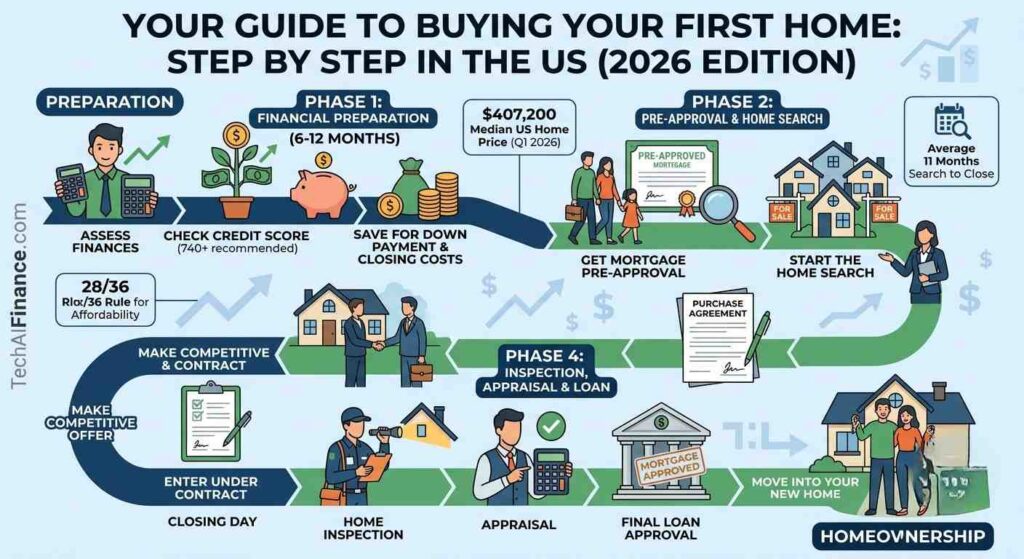
Buying your first home is the largest financial transaction most Americans will ever complete. It is also one of the most emotionally charged, most administratively complex and most consequential decisions in a financial lifetime. The average American homeowner has a net worth nearly 40 times higher than the average renter, per the Federal Reserve Survey of Consumer Finances 2025, and the primary reason is the equity that accumulates in a home over years of ownership and appreciation.
The challenge is that most first-time buyers approach homeownership with a general sense of the process but without a clear understanding of the specific steps, the true upfront costs beyond the down payment, the difference between loan types that significantly affects monthly payments and qualification requirements, or the sequence of decisions that determines whether the process moves smoothly or stalls at an avoidable obstacle. The knowledge gap between understanding that you want to buy a home and knowing exactly how to buy one efficiently and correctly is where most first-time buyers lose time, money and confidence.
This guide walks through every step of the first-time homebuying process in the US from the financial preparation that should begin 6 to 12 months before you start searching to the actions that happen on and after closing day. Every step is specific. Every cost is quantified. Every decision point includes the criteria for making the right choice for your situation.
This guide was written by Olayinka Adejugbe, founder of TechAIFinance.com and holder of a Global Certification in Artificial Intelligence and Applied Innovation.
| ℹ Quick Summary First-time homebuying in the US in 2026: the numbers that frame the decision First-time buyers represented 32 percent of all home purchases in the US in 2025, the lowest share in 42 years of tracking by the National Association of Realtors, reflecting affordability constraints driven by elevated home prices and mortgage rates. The median home price in the US was $407,200 in Q1 2026, per the National Association of Realtors. A 20 percent down payment on the median home requires $81,440 plus an estimated $12,000 to $20,000 in closing costs and reserves. The average American first-time buyer takes 11 months from beginning their serious home search to closing, per NAR 2025 Profile of Home Buyers and Sellers. Approximately 80 percent of first-time buyers use a mortgage to finance their purchase. The average down payment for first-time buyers in 2025 was 8 percent of the purchase price, per NAR data. Americans who check their credit score and address issues before applying for a mortgage save an average of $14,500 over the life of a 30-year loan compared to those who apply without preparation, per a 2025 analysis by LendingTree. Sources: National Association of Realtors Profile of Home Buyers and Sellers 2025. Federal Reserve Survey of Consumer Finances 2025. LendingTree mortgage analysis 2025. |
| 📘 What This Guide Covers In this guide you will find: Phase 1: Financial preparation – what to do 6 to 12 months before you start looking How much house you can actually afford using the 28/36 rule The true upfront cost of buying a home beyond just the down payment The four main loan types: Conventional, FHA, VA and USDA explained and compared First-time homebuyer programs that reduce down payment and closing cost requirements Phase 2: Getting pre-approved and starting the search Phase 3: Making an offer, negotiating and going under contract Phase 4: The inspection, appraisal and mortgage process Phase 5: Closing day and what happens after The most common first-time buyer mistakes and exactly how to avoid them |
Table of Contents
- Phase 1: Financial Preparation (6 to 12 Months Before)
- How Much Home You Can Actually Afford
- The True Upfront Cost of Buying: Beyond the Down Payment
- Mortgage Loan Types: Conventional, FHA, VA and USDA
- First-Time Homebuyer Programs and Down Payment Assistance
- Phase 2: Pre-Approval and the Home Search
- Phase 3: Making an Offer and Going Under Contract
- Phase 4: Inspection, Appraisal and Final Mortgage Approval
- Phase 5: Closing Day and What Happens After
- The Most Common First-Time Buyer Mistakes
- Frequently Asked Questions
Phase 1: Financial Preparation (6 to 12 Months Before)
The most common mistake first-time buyers make is starting the home search before completing the financial preparation. Searching for homes before your credit is optimized, your down payment is saved and your debt-to-income ratio is under control leads to either disappointment when financing falls short of what the desired homes require or making a financially compromised purchase because the search process created emotional attachment before the financial picture was complete.
Step 1: Pull your credit reports and scores
Get your credit reports from all three bureaus at annualcreditreport.com, which is the official free source mandated by federal law. Review each report for errors, inaccuracies and negative items. Dispute any errors directly with the relevant bureau: errors on credit reports are more common than most people realize and can suppress your score by 20 to 100 points. Address negative items where possible: pay down high credit card balances to below 30 percent of each card’s limit, resolve any collection accounts and avoid opening new credit accounts in the 12 months before applying for a mortgage.
Your credit score determines both your mortgage interest rate and which loan programs you qualify for. The difference between a 620 credit score and a 740 credit score on a $350,000 30-year mortgage can be 0.5 to 1.0 percentage points in interest rate, which translates to $30,000 to $60,000 more in total interest paid over the loan’s life. Investing time in credit optimization before applying for a mortgage produces a guaranteed return that no investment can match with equivalent certainty.
Step 2: Calculate your debt-to-income ratio
Lenders evaluate your debt-to-income ratio as the primary measure of your ability to carry a mortgage payment alongside your existing obligations. The front-end DTI ratio is your proposed monthly housing payment divided by your gross monthly income. The back-end DTI ratio is your total monthly debt payments including the proposed mortgage divided by your gross monthly income. Most conventional loan programs require a back-end DTI below 43 percent, though some programs allow up to 50 percent with compensating factors. FHA loans generally allow higher DTI ratios up to 50 percent with compensating factors. The lower your DTI, the better your loan terms and qualification confidence.
| DTI Calculation Example Gross monthly income: $6,500 Existing monthly debt payments: Car payment $380 + Student loan $220 = $600 Proposed monthly mortgage payment (PITI): $1,750 Front-end DTI: $1,750 / $6,500 = 26.9% (under the 28% guideline – acceptable) Back-end DTI: ($1,750 + $600) / $6,500 = 36.2% (under the 36% conservative guideline – good) PITI = Principal, Interest, Taxes and Insurance – all four components count toward your monthly housing payment in lender calculations. |
Step 3: Save your full homebuying budget
Your savings goal is not just the down payment. It is the down payment plus closing costs plus a cash reserve after closing. Calculate all three components before setting your savings target.
How Much Home You Can Actually Afford
The question of affordability has two different answers: what a lender will approve you for and what you can comfortably manage without financial stress. Lenders approve based on qualifying ratios and credit profiles. Comfortable affordability depends on your full financial picture including retirement savings goals, emergency fund maintenance and the lifestyle you want to maintain.
The 28/36 rule
The most widely used affordability guideline in American personal finance is the 28/36 rule. Your monthly housing costs including mortgage principal, interest, property taxes and homeowner’s insurance should not exceed 28 percent of your gross monthly income. Your total monthly debt payments including the housing payment should not exceed 36 percent of your gross monthly income. A household with $8,000 per month in gross income should target a maximum housing payment of $2,240 and total monthly debt obligations below $2,880.
The real affordability test
The 28/36 rule is a guideline, not a prescription. Many financial advisors suggest a more conservative approach: calculate what monthly payment leaves you comfortable saving 15 to 20 percent of your income for retirement, maintaining a six-month emergency fund and covering your non-housing discretionary spending without chronic financial stress. A household that qualifies for a $2,240 monthly payment on paper but has $800 per month in student loan payments, high childcare costs and significant retirement catch-up needs may find that $1,600 to $1,800 per month is the genuinely comfortable ceiling.
The impact of interest rates on purchasing power
At a 7 percent interest rate, a $1,800 monthly principal and interest payment supports a loan of approximately $270,000. At a 6 percent rate, the same $1,800 payment supports a loan of approximately $300,000. At a 5 percent rate, it supports approximately $335,000. Interest rate changes of even half a percentage point significantly affect how much house a given payment can support. Use a mortgage calculator to model your payment at current prevailing rates rather than assuming a specific purchase price will produce a given monthly payment.
| ⚠ Watch Out The most dangerous affordability mistake first-time buyers make: Buying at the maximum loan amount the lender will approve without evaluating whether that payment is comfortable given your full financial picture. Lenders approve based on qualifying ratios that do not account for your retirement savings goals, your children’s future education costs, your desire to travel, your income stability risk or any other financial priority beyond existing debt obligations. A lender who approves you for a $450,000 purchase is not telling you that a $450,000 purchase is financially wise for your situation. They are telling you that you meet the minimum qualifications for that loan amount. The payment that is comfortable for your specific life is a different calculation. |
The True Upfront Cost of Buying: Beyond the Down Payment
The down payment is the cost most first-time buyers think about. It is not the only upfront cost and in many cases it is not even the largest one relative to what buyers have saved. Understanding all upfront costs before beginning your search prevents the heartbreak of going under contract on a home you cannot actually close on because the total cash required exceeds what you have available.
| Cost Item | Typical Amount | Notes |
| Down Payment | 3.5% to 20% of purchase price | Minimum varies by loan type. 20% avoids PMI on conventional loans. |
| Closing Costs | 2% to 5% of loan amount | Covers lender fees, title insurance, attorney fees, recording fees, etc. |
| Home Inspection | $300 to $550 | Paid before closing. Not optional for an informed purchase. |
| Appraisal Fee | $400 to $700 | Required by lender. Usually paid with application or before closing. |
| Earnest Money Deposit | 1% to 2% of purchase price | Paid with offer. Applied to down payment or closing costs at closing. |
| Moving Costs | $800 to $5,000 | Varies by distance, volume and whether professional movers are used. |
| Immediate Repairs / Updates | $0 to $10,000+ | Budget for repairs identified in inspection or cosmetic updates. |
| Cash Reserve After Closing | 2% to 3% of home value | Recommended post-closing emergency fund. Lenders may verify this. |
| Homeowner’s Insurance (upfront) | $800 to $2,000 | First year premium often paid at closing or shortly before. |
| Property Tax Prepaid | 2 to 3 months | Lender typically collects prepaid taxes for escrow at closing. |
| 💡 Pro Tip The cash needed to close is almost always more than the down payment alone. A first-time buyer purchasing a $350,000 home with a 5 percent down payment needs: Down payment: $17,500 Closing costs (3%): $10,500 Inspection and appraisal: $1,000 Moving costs: $1,500 Post-closing reserve (2%): $7,000 Total cash needed: approximately $37,500 A buyer who has saved exactly $17,500 for the down payment will not be able to close on this home. Always calculate total cash needed, not just the down payment. | ||
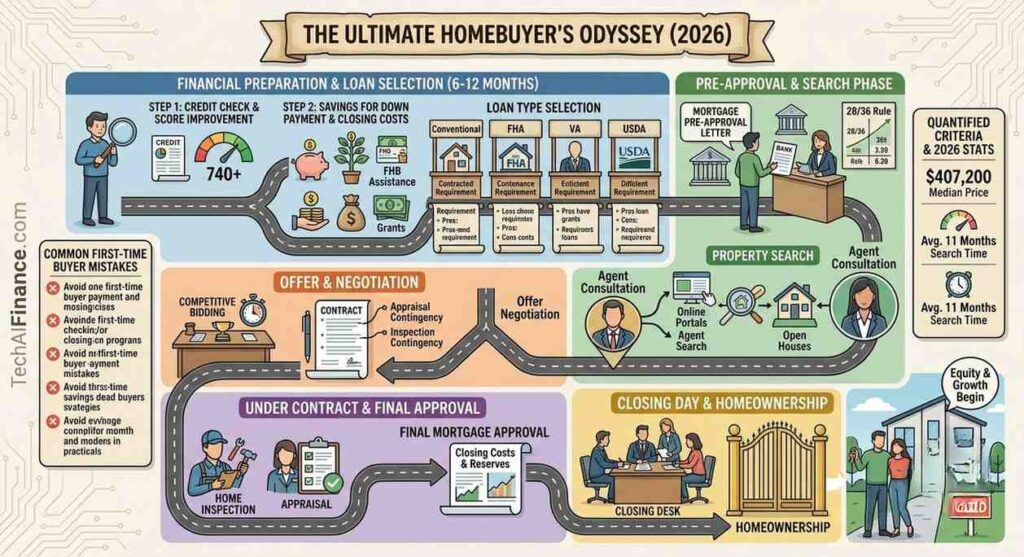
Mortgage Loan Types: Conventional, FHA, VA and USDA
The loan type you choose determines your minimum down payment, your credit score requirement, your mortgage insurance obligations and your total loan cost over time. Understanding all four primary options before applying allows you to choose the loan that produces the best terms for your specific financial situation.
| Conventional Loan Best Loan for Buyers With Strong Credit and a 5% to 20% Down Payment Minimum Down Payment: 3% to 20% (below 20% requires PMI) | Minimum Credit Score: 620 minimum, 740+ for best rates What this loan is A conventional loan is a mortgage not backed by a federal government agency, instead conforming to guidelines set by Fannie Mae and Freddie Mac. Conventional loans are the most common mortgage type in the US, offering more flexibility in property type eligibility and loan structuring than government-backed programs. They come in two forms: conforming loans that fall within the Federal Housing Finance Agency’s loan limits, which in 2026 are $832,750 for single-family homes in most US markets and higher in designated high-cost areas up to a ceiling of $1,249,125, per the FHFA November 2025 announcement, and jumbo loans that exceed those limits and require stronger credit and reserves. How it works You apply through a bank, credit union or mortgage lender. The lender evaluates your credit score, income, employment history, assets and debt-to-income ratio against Fannie Mae and Freddie Mac guidelines. If your down payment is below 20 percent, the lender requires private mortgage insurance, commonly called PMI, which protects the lender if you default. PMI typically costs 0.5 to 1.5 percent of the loan amount annually and is added to your monthly payment. Once your equity reaches 20 percent through principal paydown or appreciation, you can request PMI cancellation, and lenders are legally required to cancel PMI automatically when your loan balance reaches 78 percent of the original purchase price. Key costs to know PMI cost on a $300,000 loan at 1 percent: $3,000 per year or $250 per month until removed. Origination fees typically 0.5 to 1 percent of loan amount. Conventional loans do not charge an upfront mortgage insurance premium like FHA loans, which means the total cost comparison depends on how long PMI remains on the loan. Advantages: No upfront mortgage insurance premium, PMI removable as equity builds, no loan limits for jumbo products, flexible property types, competitive rates for strong credit profiles. Honest limitation: Requires stronger credit and a meaningful down payment to achieve the best rates. PMI on a 3 to 5 percent down payment can cost more in the first several years than FHA’s mortgage insurance structure for some buyers. Best for: Buyers with credit scores above 720 and at least 5% down who want to avoid FHA mortgage insurance premiums and eventually eliminate PMI as equity builds |
| FHA Loan Best Loan for First-Time Buyers With Lower Credit or Limited Down Payment Minimum Down Payment: 3.5% with 580+ credit score | 10% with 500-579 credit score | Minimum Credit Score: 500 minimum (580+ for 3.5% down) What this loan is An FHA loan is a mortgage insured by the Federal Housing Administration, a division of the US Department of Housing and Urban Development. The FHA does not lend money directly but insures lenders against losses if FHA-approved borrowers default. This insurance allows FHA-approved lenders to offer more accessible terms to borrowers who do not qualify for conventional loans, including lower credit score minimums and higher allowable debt-to-income ratios. FHA loans are particularly valuable for first-time buyers because the 3.5 percent minimum down payment is significantly lower than what most conventional lenders require for borrowers without strong credit profiles. How it works You apply with any FHA-approved lender, which includes most banks, credit unions and mortgage companies. The FHA insures the loan and requires two forms of mortgage insurance: an upfront mortgage insurance premium of 1.75 percent of the loan amount, typically added to the loan balance, and an annual mortgage insurance premium of 0.55 to 1.05 percent of the remaining loan balance depending on the loan term and original down payment. For most FHA loans made after 2013 with a down payment below 10 percent, the annual MIP remains for the life of the loan and cannot be removed as equity builds. This is the primary financial trade-off compared to conventional PMI, which can be removed when equity reaches 20 percent. Key costs to know Upfront MIP of 1.75 percent of loan amount: on a $300,000 loan this is $5,250, typically added to the loan balance. Annual MIP of approximately 0.55 percent on a 30-year loan with 3.5 percent down: $1,650 per year or $137.50 per month, permanent for most loans. FHA loans also require the property to meet minimum property standards, which can eliminate some distressed or fixer-upper properties from eligibility. Advantages: Accessible to buyers with credit scores as low as 580, allows higher DTI ratios than conventional loans, smaller down payment requirement, competitive interest rates because of government backing. Honest limitation: Annual MIP is permanent on most FHA loans made after 2013 with less than 10 percent down, which means the only way to eliminate it is to refinance into a conventional loan when your equity exceeds 20 percent. This refinance adds transaction costs. The upfront MIP also increases the effective loan balance from day one. Best for: First-time buyers with credit scores between 580 and 679, buyers with limited savings who can only make the minimum down payment, and buyers whose debt-to-income ratio is too high for conventional loan approval |
| VA Loan Best Loan in the US for Eligible Veterans, Active Duty and Surviving Spouses Minimum Down Payment: 0% down payment required | Minimum Credit Score: No VA minimum, most lenders require 580 to 620 What this loan is A VA loan is a mortgage guaranteed by the US Department of Veterans Affairs available to eligible military borrowers. The VA guarantee allows lenders to offer terms that are unavailable elsewhere in the mortgage market: zero down payment with no private mortgage insurance, competitive interest rates that are typically 0.25 to 0.5 percent below conventional rates, no prepayment penalty and the ability to finance the funding fee into the loan balance. For eligible borrowers, the VA loan is almost universally the most financially advantageous mortgage available, and many veterans and service members do not realize they have this benefit or do not understand the full scope of its value. How it works Verify your eligibility and request a Certificate of Eligibility from the VA at va.gov or through a VA-approved lender who can obtain the COE on your behalf. With your COE, you apply with a VA-approved lender following the standard mortgage application process. The lender submits the loan for VA guarantee. VA loans require a funding fee that varies by down payment amount and whether it is your first VA loan use: first use with no down payment carries a funding fee of 2.15 percent of the loan amount, which can be financed into the loan or paid at closing. The funding fee is waived entirely for veterans with a service-connected disability rating of 10 percent or higher. Key costs to know VA funding fee: 2.15 percent for first use with zero down, 1.25 percent with 10 percent or more down, 3.3 percent for subsequent use with zero down. No PMI regardless of down payment amount. No minimum down payment. VA appraisals are required and assess both value and minimum property requirements. Some sellers are reluctant to accept VA loan offers due to appraisal requirements, which can be addressed by providing a seller concession or offering a strong overall offer. Advantages: Zero down payment, no PMI, competitive interest rates below conventional, no prepayment penalty, funding fee waived for disabled veterans, assumable by future buyers which is a significant advantage when rates rise. Honest limitation: Only available to eligible military borrowers. VA appraisals have minimum property requirements that can limit eligible properties. Some sellers in competitive markets have historically been reluctant to accept VA offers, though this has improved significantly as seller and agent education has increased. Best for: Eligible veterans, active duty service members, National Guard and Reserve members with qualifying service and surviving spouses of service members who died in the line of duty or from a service-connected disability |
| USDA Loan Best Zero Down Payment Option for Buyers in Eligible Rural and Suburban Areas Minimum Down Payment: 0% down payment required | Minimum Credit Score: 640 minimum for most USDA-approved lenders What this loan is A USDA loan is a mortgage guaranteed by the US Department of Agriculture’s Rural Development program for buyers in eligible rural and certain suburban areas. Despite the USDA name, eligible areas include many suburbs of major metropolitan areas: approximately 97 percent of US land area is USDA-eligible, covering areas where approximately 109 million Americans live. USDA loans offer zero down payment with no private mortgage insurance, making them one of the most accessible homeownership paths for moderate-income buyers in eligible geographic areas. How it works Verify the property address is in a USDA-eligible area at the USDA eligibility map at eligibility.sc.egov.usda.gov. Confirm your household income does not exceed the program’s income limits for your area, which vary by county and household size and are set at approximately 115 percent of the area’s median income. Apply with a USDA-approved lender following standard mortgage application procedures. USDA loans carry an upfront guarantee fee of 1 percent of the loan amount and an annual fee of 0.35 percent of the remaining loan balance, which is lower than FHA’s MIP and can be financed into the loan. Key costs to know Upfront guarantee fee: 1 percent of loan amount, typically financed into the loan. Annual fee: 0.35 percent of remaining loan balance: on a $250,000 loan this is $875 per year or $72.92 per month. The annual fee remains for the life of the loan but is lower than FHA MIP for most loan sizes. No PMI. Advantages: Zero down payment, lower ongoing fees than FHA in most cases, no PMI, competitive rates because of government backing, available in more geographic areas than most buyers realize. Honest limitation: Property must be in a USDA-eligible area and buyer’s household income must fall below program limits. Not available for investment properties or vacation homes. The USDA approval process can take slightly longer than conventional or FHA processes due to additional review steps. Best for: Buyers purchasing in eligible rural and suburban areas with moderate income who do not qualify for or prefer not to use a VA loan, and who want zero down payment without the funding fee structure of VA loans |
First-Time Homebuyer Programs and Down Payment Assistance
Beyond the four federal loan types, most states and many counties and municipalities offer first-time homebuyer programs that provide down payment assistance, closing cost assistance, reduced interest rates or combinations of these benefits specifically for buyers who have not owned a home in the past three years. These programs represent potentially thousands of dollars in assistance that most first-time buyers never discover.
How to find first-time homebuyer programs in your state
The US Department of Housing and Urban Development maintains a directory of state housing finance agencies at hud.gov/buying/localbuying. Every state has a housing finance agency that administers first-time buyer programs. In addition, many counties, cities and nonprofit housing organizations run their own programs. The Down Payment Resource at downpaymentresource.com is a free search tool that identifies all programs you may qualify for based on your location, income and purchase price.
Common program types
- Down payment assistance grants: Grants of $2,500 to $25,000 that do not need to be repaid. Usually income-limited and tied to completing a homebuyer education course.
- Deferred second mortgages: Loans for down payment assistance that are deferred with zero or low interest until you sell, refinance or reach the end of the loan term. No monthly payment required.
- Matched savings programs: Programs where a nonprofit or government agency matches your savings dollar for dollar up to a cap, effectively doubling your down payment savings.
- Below-market interest rate programs: State housing finance agencies often offer mortgage interest rates 0.25 to 0.75 percent below prevailing market rates to qualifying first-time buyers, which saves thousands over the loan term.
- HUD-approved homebuyer education: Most assistance programs require completing a HUD-approved homebuyer education course, available free or at low cost online through organizations like eHome America or Framework at frameworkhomeownership.org. This education requirement is genuinely valuable and is worth completing even if you do not ultimately use an assistance program.
Phase 2: Pre-Approval and the Home Search
Getting pre-approved: the essential first step before searching
A mortgage pre-approval is a lender’s conditional commitment to lend you a specific amount based on a verified review of your credit, income, assets and employment. It is different from pre-qualification, which is a preliminary estimate based on self-reported information without verification. In most US real estate markets in 2026, sellers require a pre-approval letter before accepting an offer. Without one, your offer will not be considered.
To get pre-approved, you submit a full mortgage application to a lender with supporting documentation: two years of tax returns and W-2 forms, 30 days of recent pay stubs, two to three months of bank and investment account statements, government-issued ID and any other income documentation relevant to your situation. The lender pulls your credit, verifies your documents and issues a pre-approval letter stating the maximum loan amount you qualify for.
Apply with two or three lenders simultaneously rather than one, since multiple mortgage inquiries within a 14 to 45-day window are treated as a single inquiry on your credit report under the credit scoring models used for mortgages. Comparing pre-approval terms from multiple lenders gives you leverage to negotiate the best rate and identifies any lender-specific differences in qualifying criteria that might make one lender a better fit for your financial profile.
Choosing a real estate agent
A buyer’s agent represents your interests in the home purchase transaction and is typically compensated through the seller’s proceeds rather than directly by the buyer, though the 2024 NAR settlement changes introduced new buyer agency agreement requirements that vary by state. When choosing a buyer’s agent, evaluate their experience with first-time buyers, their knowledge of your target neighborhoods, their communication responsiveness and whether they have a genuine track record of successful transactions in your price range and market.
The buyer’s agent helps you search the MLS for properties matching your criteria, schedules showings, advises on offer strategy and pricing, reviews inspection reports, manages the transaction timeline and coordinates with the title company and your lender. A skilled buyer’s agent in a competitive market can mean the difference between winning or losing a home you want through strategic offer construction and relationship with the listing agent.
The home search
Define your must-haves and your nice-to-haves before beginning the search, and be honest about the difference. Must-haves are requirements you genuinely will not compromise on: a minimum number of bedrooms, a specific school district, a maximum commute to a specific location, no HOA. Nice-to-haves are preferences you would like but can live without. The buyers who search most efficiently and most happily are those who have made these distinctions clearly rather than discovering them one rejected home at a time.
Phase 3: Making an Offer and Going Under Contract
How to price your offer
Your buyer’s agent will provide a comparative market analysis showing recent sale prices for comparable homes in the same neighborhood, which is the factual foundation for your offer price. In a seller’s market with low inventory, offers at or above asking price with minimal contingencies are typically necessary to compete. In a buyer’s market with ample inventory, offers below asking price are often accepted. The CMA tells you the market value range. Your offer strategy depends on market conditions, your competitive position relative to other buyers and your ability to waive or retain contingencies.
Key contract terms beyond the price
- Earnest money deposit: Typically 1 to 2 percent of the purchase price, submitted within two to three days of accepted offer. Shows serious intent and is at risk if you breach the contract.
- Contingencies: Conditions that must be met for the sale to proceed. The three most common are the inspection contingency, the financing contingency and the appraisal contingency. Each protects your earnest money if the specified condition is not met.
- Closing date: Typically 30 to 45 days from contract acceptance for buyers using financing. Cash buyers can close faster.
- Seller concessions: You may negotiate for the seller to contribute toward your closing costs, which reduces the cash you need at closing. Common in buyer’s markets and for VA loan buyers.
- Inclusions and exclusions: Specify which appliances, fixtures and features are included in the sale. Items that are unclear should be explicitly addressed in the contract.
After your offer is accepted
Once your offer is accepted and signed by both parties, you are under contract. Immediately submit your earnest money deposit as specified in the contract and notify your lender to begin the formal mortgage process. Schedule your home inspection within the contingency window specified in your contract, typically five to ten business days from contract acceptance. Missing the inspection contingency deadline waives your right to withdraw based on inspection findings.
Phase 4: Inspection, Appraisal and Final Mortgage Approval
The home inspection
The home inspection is one of the most important steps in the buying process and one of the most financially consequential $400 you will ever spend. A licensed home inspector examines the structural components, mechanical systems, electrical systems, plumbing, roofing, foundation and exterior of the home and provides a written report documenting every deficiency observed. The inspection report gives you the information needed to decide whether to proceed, renegotiate or withdraw.
After receiving the inspection report, you have three options: proceed as contracted, request that the seller make specific repairs before closing, request a credit toward your closing costs in lieu of repairs, or withdraw from the contract under the inspection contingency. Major structural issues, safety hazards, undisclosed water damage and significant mechanical system failures are legitimate grounds for requesting repairs or credits. Cosmetic issues are typically not negotiating points. Your agent will advise on which findings are negotiation-worthy and how to frame your repair request professionally.
The appraisal
Your lender orders a professional appraisal to verify that the property value supports the loan amount. An appraiser licensed in your state visits the property and compares it to recent comparable sales to determine its market value. If the appraisal comes in at or above the purchase price, the loan proceeds as planned. If the appraisal comes in below the purchase price, you have several options under the appraisal contingency: renegotiate the purchase price down to the appraised value, pay the difference between the appraised value and the contract price in cash, challenge the appraisal with documented comparable sales your agent identifies, or withdraw from the contract under the appraisal contingency.
Final mortgage approval (clear to close)
After the inspection and appraisal are complete, your lender submits the loan file to underwriting for final approval. The underwriter reviews every document in your file to confirm it meets program guidelines. During underwriting, do not make any major financial changes: do not change jobs, do not open new credit accounts, do not make large purchases on credit and do not move significant cash between accounts without documenting the source. Any of these actions can trigger additional underwriting conditions or, in extreme cases, invalidate your approval. When underwriting is complete and all conditions are satisfied, the lender issues a clear to close, which authorizes the loan to proceed to closing.
Phase 5: Closing Day and What Happens After
The closing disclosure
At least three business days before closing, your lender is required to provide a Closing Disclosure that details every cost associated with the loan and transaction. Review this document carefully against the Loan Estimate you received at application: compare the interest rate, loan terms, all fees and the total cash required at closing. If any material changes appear that were not previously discussed, contact your lender immediately before closing day.
What to bring to closing
- Government-issued photo ID
- Cashier’s check or wire transfer confirmation for the amount due at closing. Personal checks are not accepted. Wire transfer amounts should be confirmed with the title company by phone to a verified number before sending, since wire fraud targeting homebuyers is a documented and growing crime.
- Your checkbook for any small last-minute adjustments
- Proof of homeowner’s insurance if not already submitted to the lender
What happens at the closing table
At closing you sign the promissory note committing you to repay the loan, the deed of trust or mortgage giving the lender a lien on the property, the closing disclosure and multiple other legally required documents. The title company or closing attorney manages the process, verifies that all conditions are met and distributes funds to the appropriate parties. After all documents are signed and funds are disbursed, the deed is recorded with the county and you receive the keys. You are a homeowner.
The first 90 days as a homeowner
- Set up mortgage auto-pay: Late mortgage payments are reported to credit bureaus after 30 days and can significantly damage your credit score.
- Update your address everywhere: IRS, voter registration, employer, bank accounts, subscriptions and every other institution that has your address on file.
- File for homestead exemption: Most states offer a property tax reduction for primary residence owners called a homestead exemption. File within the deadline specified by your county, typically in the first year of ownership.
- Document all capital improvements: Keep records of every significant home improvement from day one. These records increase your cost basis and reduce taxable gain when you eventually sell.
- Build a home maintenance reserve: Save 1 to 2 percent of your home’s value annually for maintenance and repairs. A $350,000 home needs $3,500 to $7,000 per year in a dedicated maintenance fund.
The Most Common First-Time Buyer Mistakes
| Mistake | Why It Happens | How to Avoid It |
| Starting the search before financial prep | Excitement overrides process | Complete credit review, savings target and DTI calculation first |
| Not comparing multiple lenders | Applying to one lender feels faster | Apply to 3 lenders in the same 14-day window to trigger one credit inquiry |
| Buying at the maximum approval amount | Lender approval feels like a recommendation | Use the 28/36 rule and the personal comfort test independently |
| Skipping the home inspection | Trying to make offer more competitive | Never waive inspection in practice, even in hot markets |
| Ignoring first-time buyer programs | Not aware they exist | Check downpaymentresource.com and your state housing finance agency |
| Making financial changes during underwriting | Not realizing the risk | Freeze all financial activity from pre-approval through clear to close |
| Underestimating total cash needed | Focusing only on down payment | Add closing costs, inspection, reserves and moving costs to savings target |
| Not getting pre-approved before searching | Wanting to look before committing | Pre-approval takes 1 to 3 days and protects you in competitive situations |
| Wiring closing funds without phone verification | Urgency creates fraud vulnerability | Always call the title company at a verified number before wiring any funds |
| Forgetting to file homestead exemption | Post-closing overwhelm | Set a calendar reminder for the first week after closing |
| 💡 Real-World Example Consider two hypothetical first-time buyers in Nashville, Tennessee, both with household incomes of $92,000 per year. Vanessa is 29 and started seriously planning to buy 14 months before her closing date. She pulled her credit reports and found an error from a medical collection account that had already been resolved but not updated. She disputed it, it was corrected and her credit score rose from 694 to 731. She paid down her credit card balances from 68 percent utilization to 24 percent, raising her score further to 751. She calculated her total cash need: for a $340,000 home with a 5 percent down payment she needed $17,000 down, $10,200 in closing costs, $800 for inspection and appraisal, $1,500 for moving and $6,800 in post-closing reserves, totaling $36,300. She set a savings plan and reached that target in 11 months. She applied to three lenders simultaneously before beginning her search, received pre-approvals from all three, compared their rate quotes and chose the lender offering the best rate. She discovered Tennessee’s Great Choice Home Loan program through downpaymentresource.com and qualified for $6,000 in down payment assistance, reducing her required cash by that amount. With a 751 credit score, she qualified for a conventional loan at a competitive rate, avoiding FHA’s permanent mortgage insurance. Closing outcome: Vanessa purchased a $342,000 home in Nashville with a 5 percent down payment and a conventional loan. Her monthly payment is $1,987 including taxes and insurance. Her credit preparation saved her an estimated $18,000 over the life of the loan compared to the rate she would have received with her original 694 score. Marcus is 31 and decided to buy after attending a friend’s housewarming. He started searching homes online the same week, fell in love with a $365,000 home, called a single lender and was told he qualified. He had not checked his credit reports, had not calculated his total cash need and had not verified his savings were sufficient for all costs. His credit score was 682. He had $22,000 saved, which he believed covered a 5 percent down payment of $18,250. When he applied formally, closing costs of $10,900 plus reserves brought his actual cash need to $38,000. He was $16,000 short and could not close. He lost the $1,500 in earnest money he had paid and spent three additional months saving before he was able to buy a different home for $348,000. Same income, same market, different outcomes entirely based on whether financial preparation preceded the search. These examples are illustrative. Actual outcomes depend on individual circumstances, credit profiles and market conditions. |
Frequently Asked Questions
What credit score do I need to buy a home in the US?
The minimum credit score required depends on the loan type. FHA loans allow scores as low as 500 with a 10 percent down payment and 580 with a 3.5 percent down payment. VA and USDA loans have no official minimum but most lenders require 580 to 640 for these programs. Conventional loans require a minimum of 620 but offer significantly better rates starting around 720 to 740. The practical implication is that buying with a score below 700 is possible through FHA, VA or USDA programs but costs more over the loan’s life than buying after improving your score to 720 or above.
How long does the homebuying process take from start to finish?
From beginning financial preparation to closing day, the typical timeline for a first-time buyer is 9 to 14 months: 6 to 12 months of financial preparation and savings, 1 to 3 months of active home searching, and 30 to 45 days from accepted offer to closing. Buyers who begin the process already financially prepared with strong credit, adequate savings and a stable employment history can move from search to close in 60 to 90 days. The variable most within your control is how early you begin the financial preparation phase.
Should I buy now or wait for interest rates to fall?
Timing the mortgage market is as uncertain as timing any other financial market. Buyers who waited for rates to decline in 2023 and 2024 faced persistent elevated rates while home prices in many markets continued rising, resulting in both higher prices and comparable rates. The decision to buy should be driven by your personal financial readiness, including a stable income, adequate savings, manageable debt and a realistic timeline to stay in the home, rather than interest rate speculation. If rates do decline after you purchase, refinancing is always available to capture the lower rate, often at a cost of $3,000 to $5,000 which is recovered quickly through the lower monthly payment.
What is private mortgage insurance and is it bad?
PMI is a monthly insurance premium you pay when your down payment on a conventional loan is below 20 percent. It protects the lender, not you, against default risk. PMI typically costs 0.5 to 1.5 percent of the loan amount annually and can be removed when your equity reaches 20 percent. PMI is not bad in itself: it is the cost of purchasing sooner with less money down, which in markets where home values appreciate meaningfully can be a sound financial trade-off. The math question is whether the equity you build through earlier homeownership and appreciation exceeds the PMI cost over the period it applies. In many markets, it does.
Can I buy a home if I have student loan debt?
Yes, provided your debt-to-income ratio meets lender guidelines after including both your student loan payments and your proposed mortgage payment. Federal student loans in income-driven repayment plans count toward your DTI at the lower income-driven payment amount. Under conventional loan guidelines, if your federal student loans show a zero-dollar monthly payment on an IDR plan, lenders use 0.5 to 1 percent of the outstanding balance as the payment for DTI calculation. Managing your student loan repayment plan to produce a low monthly payment before applying for a mortgage can meaningfully improve your qualifying DTI.
| ⭐ Key Takeaway Buying your first home is a process, not an event. The outcome on closing day is determined almost entirely by decisions made in the 6 to 12 months before you look at a single listing. Pull your credit reports today. Calculate your true cash need for the purchase price range you are targeting. Identify the loan type that fits your profile. Find your state’s first-time buyer programs. Get pre-approved before searching. The buyers who close on the homes they want are the buyers who completed these steps before they fell in love with a specific house. The buyers who face disappointment are the ones who started searching before they were ready. Preparation is the competitive advantage in homebuying. Start it today. |
Conclusion
Buying your first home in the United States is the largest financial transaction most people complete and one of the most wealth-building decisions available to Americans. The homeowners who build lasting equity and financial stability through real estate are not the ones who happened to buy in the right market at the right time. They are the ones who prepared their credit, saved the full cash requirement, chose the right loan type for their situation, found the right home at a price supported by comparable sales and executed the transaction correctly from pre-approval to closing.
Every step in this guide is within the control of any buyer who begins the preparation process early enough. The credit improvement, the savings accumulation, the loan program selection and the offer strategy are all learnable skills that produce materially better outcomes in the largest transaction of your financial life.
For the investment strategy that builds wealth alongside homeownership, our guide on how to build generational wealth in the US covers homeownership as one of seven interconnected wealth-building pillars. For Americans planning the retirement that homeownership equity supports, our guide on how to retire early using the FIRE method in the US 2026 covers how owned real estate fits into a complete early retirement plan including the equity access strategies available to paid-off homeowners.
| 📲 Share This Guide If this guide helped you understand the homebuying process more clearly than any realtor or bank pamphlet ever has, share it with a friend who is thinking about buying their first home. Share on WhatsApp, Facebook or by text message. Thank you for reading TechAIFinance.com. |
Read Next
Continue building your financial knowledge on TechAIFinance.com:
- How to Build Generational Wealth in the US
- How to Retire Early Using the FIRE Method in the US 2026
- Best High Yield Savings Accounts in the US 2026
- How to Make Money From Real Estate Without Buying Property
- How to Build Generational Wealth in the US
| ✍ About the Author Written by: TechAIFinance Editorial Team Edited and Fact-Checked by: Olayinka Adejugbe Olayinka Adejugbe is not a licensed financial advisor. The content on TechAIFinance.com is produced for educational purposes only and should not be treated as personalized financial advice. Olayinka is the founder and lead editor of TechAIFinance.com. He holds a Global Certification in Artificial Intelligence and Applied Innovation and an Award of Completion in Behavioral Counseling from the World Health Organization. With a strong working knowledge of personal finance and accounting principles, Olayinka oversees the editorial review of every article on this site to ensure accuracy, currency and practical usefulness. Every article on TechAIFinance.com is produced by our research team and reviewed by Olayinka before publication. We verify statistics against named authoritative sources and update content when circumstances change. Visit our About page to learn more about our editorial process. Use our Contact page to get in touch. |
Important Disclaimer
The content published on TechAIFinance.com is for educational and informational purposes only. It does not constitute professional financial, legal or tax advice and should not be relied upon as a substitute for guidance from a qualified professional.
Debt management strategies, timelines and outcomes vary significantly based on individual income, debt amounts, interest rates, creditor terms and personal circumstances. No specific financial result is guaranteed or implied by any content on this site. Always consult a qualified financial advisor, credit counselor or attorney before making significant financial decisions. Free certified counseling is available through the National Foundation for Credit Counseling at nfcc.org.