| Content Note This guide provides information about using AI tools for salary negotiation preparation. It is not legal or employment advice. Salary negotiation outcomes depend on individual circumstances, employer policies, market conditions and negotiation skill. All AI tool pricing was verified in April 2026. |

Most Americans leave money on the table in salary negotiations, not because they lack qualifications but because they walk into those conversations without the right information, without a prepared response to the employer’s first offer and without having practiced what to actually say when the moment arrives.
The typical salary negotiation goes like this: an employer makes an offer, the employee either accepts immediately out of relief or nervousness, or attempts an awkward counter-offer with no data behind it. The employer says that is the best they can do, and the conversation ends. The employee starts the job earning less than they could have, and that gap compounds every year because future raises are calculated as a percentage of that starting salary.
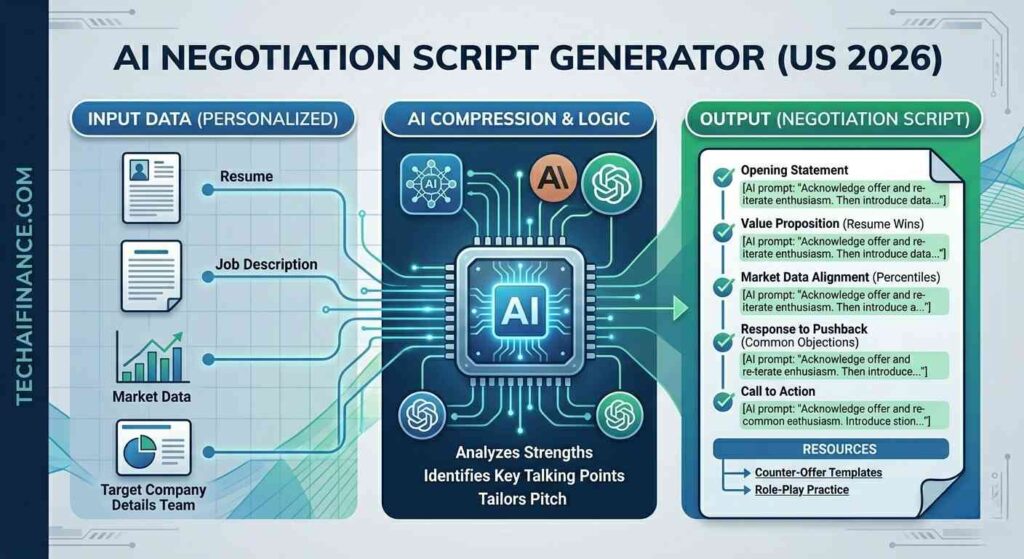
AI tools have changed this entirely. In 2026, any American with access to ChatGPT, Claude or a handful of specialized career tools can arrive at a salary negotiation armed with verified market data for their specific role and location, a prepared negotiation script tailored to their situation, practice conversations they have already run through with an AI that pushed back the same way a real hiring manager would, and a professionally written counter-offer email ready to send within minutes of receiving a written offer.
This guide shows you exactly how to use each of these AI capabilities step by step. Every prompt shown is real and tested. Every script is usable immediately. The goal is to make sure that the next time you negotiate salary, you walk in knowing what you are worth, knowing what to say and having already practiced saying it.
This guide was written by Olayinka Adejugbe, founder of TechAIFinance.com and holder of a Global Certification in Artificial Intelligence and Applied Innovation.
| ℹ Quick Summary Salary negotiation in America in 2026: the data that makes this guide necessary 87 percent of employers expect candidates to negotiate salary, yet fewer than 40 percent of American workers actually do, per a 2025 Fidelity Investments survey. Workers who negotiate their starting salary earn an average of $5,000 more per year than those who accept the first offer, per LinkedIn Economic Graph data 2025. Over a 40-year career, that initial $5,000 gap compounds to over $600,000 in lost lifetime earnings when factoring in raises, bonuses and retirement contributions calculated as a percentage of salary. Americans who used AI tools to research and prepare for salary negotiations reported 31 percent higher satisfaction with their final compensation outcome, per a 2025 ZipRecruiter employer-employee negotiation survey. Sources: Fidelity Investments Salary Negotiation Survey 2025. LinkedIn Economic Graph 2025. ZipRecruiter salary negotiation data 2025. |
| 📘 What This Guide Covers In this guide you will find: How to use ChatGPT and Claude to research your exact market salary before any negotiation How to generate a personalized negotiation script using AI in under 10 minutes How to practice salary negotiations with AI so you are never caught off guard Real AI-generated negotiation scripts and counter-offer email templates you can use immediately Reviews of the 6 best AI tools for salary negotiation in the US in 2026 How to handle the most common employer pushback responses using AI-prepared answers A complete step-by-step negotiation playbook from offer received to final accepted salary |
Table of Contents
- Why Most Americans Do Not Negotiate and What It Costs Them
- Step 1: Use AI to Research Your Market Value
- Step 2: Use AI to Build Your Negotiation Case
- Step 3: Use AI to Generate Your Negotiation Script
- Step 4: Practice the Negotiation With AI
- Step 5: Use AI to Write Your Counter-Offer Email
- How to Handle Employer Pushback Using AI-Prepared Responses
- The 6 Best AI Tools for Salary Negotiation in the US 2026
- Negotiating a Raise at Your Current Job
- Frequently Asked Questions
Why Most Americans Do Not Negotiate and What It Costs Them
The primary reason Americans do not negotiate salary is not greed or laziness. It is anxiety. The fear of appearing ungrateful, the fear of having the offer rescinded, the fear of not knowing what to say when the employer responds and the fear of asking for more than the market actually supports are all forms of the same underlying problem: going into the conversation unprepared.
AI tools eliminate every one of these barriers. When you have verified market data behind your number, the anxiety of appearing unreasonable disappears because you are not making up a figure. When you have a prepared script, the anxiety of not knowing what to say disappears because you have already written and rehearsed your response. When you have practiced the conversation with an AI that played a resistant hiring manager, the anxiety of being caught off guard disappears because you have already heard and answered the pushback.
The financial cost of not negotiating is not theoretical. A 28-year-old who accepts a $72,000 offer without negotiating when the market rate for the role is $80,000 does not just lose $8,000 in the first year. If future raises average 3 percent annually, by year 10 the annual salary gap has grown to $10,450 and the cumulative lost earnings over those ten years exceed $94,000. By year 20, cumulative lost earnings exceed $216,000. The starting salary negotiation is not a one-time transaction. It sets the financial floor for an entire career chapter.
| ⭐ Key Takeaway The number one mistake Americans make in salary negotiations is not being too aggressive. It is being too passive. Employers routinely make initial offers below what they are authorized to pay because they expect candidates to negotiate. An offer that appears final rarely is. The question is not whether you can negotiate. It is whether you are prepared to do it effectively. Sources: Fidelity Investments Salary Negotiation Survey 2025. LinkedIn Economic Graph salary negotiation data 2025. |
Step 1: Use AI to Research Your Market Value
The foundation of every successful salary negotiation is knowing your market value with specificity. Not a vague sense that you deserve more. Not a number you saw on a friend’s LinkedIn post. A specific, defensible salary range for your exact role, your exact level of experience, your exact location and your exact industry, backed by multiple data sources that you can reference in the conversation if challenged.
AI tools make this research dramatically faster and more comprehensive than manual research. Here is exactly how to do it.
The AI salary research prompt that works
Open ChatGPT at chatgpt.com or Claude at claude.ai and use the following prompt structure, filling in the brackets with your specific information:
| Salary Research Prompt Template I am researching the current market salary range for my position before a negotiation. Please provide a comprehensive salary analysis for the following role: Job title: [Your exact job title] Years of experience: [Your total years in this field] Industry: [Your specific industry] Location: [City, State] Company size: [Startup, small, mid-size or enterprise] Key skills: [Your 3 to 5 most relevant skills] Please provide: the 25th, 50th and 75th percentile salary ranges for this role, the factors that would place someone at the higher end of the range, how this location’s cost of living compares to the national average for this role, and which specific skills or certifications command the highest premiums for this position in 2026. Cross-reference your response with data from the Bureau of Labor Statistics, Glassdoor, LinkedIn Salary, and ZipRecruiter where possible. |
After receiving the AI response, verify the salary ranges against at least two of the following free salary databases:
- Glassdoor Salary: search your specific job title and location for crowd-sourced salary data from actual employees. Filter by company size and industry for the most relevant comparison.
- Bureau of Labor Statistics Occupational Outlook: the most authoritative salary database in the US, updated annually. Search by occupational code for your role.
- LinkedIn Salary: provides salary ranges filtered by location, experience level, industry and company, drawn from LinkedIn member data.
- ZipRecruiter Salary Estimator: real-time salary data based on current job postings, which reflects what employers are actively paying in 2026.
- Levels.fyi: the most accurate salary database specifically for technology roles including engineering, product management and design at both startups and major tech companies.
How to use the data once you have it
After gathering salary data from AI and verification sources, identify the range you will use in the negotiation. Your target number should be the 75th percentile for your role, experience level and location. Your floor, the minimum you will accept, should be no lower than the 50th percentile. Your opening ask in the negotiation should be at or slightly above your target to leave room for the employer to counter while landing at your target.
Document your research before the negotiation. Write down the specific sources, the specific figures and the specific reasons your experience and skills justify the higher end of the range. This documentation serves two purposes: it gives you concrete data to reference if the employer questions your number, and the act of writing it down builds confidence by making your position feel factual rather than aspirational.
| 💡 Pro Tip Add one more AI prompt after your salary research to understand the full compensation picture: Ask Claude or ChatGPT: For a [job title] at a [company size] in [city], what non-salary compensation elements are typically negotiable, and what are their estimated dollar values? Include signing bonuses, equity, additional PTO, remote work flexibility, professional development budget, and any other relevant components for this role. Total compensation, not just base salary, is what determines your actual financial outcome. A $78,000 offer with a $5,000 signing bonus, equity vesting over four years and a $3,000 professional development budget is worth meaningfully more than an $82,000 offer with none of those elements, depending on your priorities. AI can help you calculate the full dollar value of every element on the table. |
Step 2: Use AI to Build Your Negotiation Case
Market data tells you what the position is worth. Your negotiation case tells the employer why you specifically deserve the higher end of that range. These are two different arguments and both are necessary. An employer who knows you have done your research still needs to hear why your specific combination of experience, skills and track record justifies a salary at the upper end of the market range rather than the middle.
The AI prompt for building your personal case
| Personal Case Building Prompt I am preparing for a salary negotiation and need help articulating why my experience and qualifications justify compensation at the upper end of the market range. Help me build a compelling case using the following information: My experience: [Describe your specific relevant experience in 2 to 3 sentences] My key accomplishments: [List 3 to 5 specific, measurable achievements from your career] My specialized skills: [List the skills that are most in demand for this role] The role I am negotiating for: [Job title and company] The offer I received: [Current offer amount] My target salary: [Your target number] Please write 4 to 5 specific, confident talking points I can use to justify my target salary. Each point should connect a specific accomplishment or skill to a measurable business outcome. Avoid generic phrases like I am a hard worker or I am passionate about this field. Focus on specific, verifiable achievements and the value they represent to an employer. |
The AI will generate talking points based on the accomplishments you provide. Review each one and confirm that you can speak to it confidently and specifically if the employer asks a follow-up question. Any talking point you cannot support with a specific story or example should be removed or strengthened before you use it in the negotiation.
Step 3: Use AI to Generate Your Negotiation Script
Having data and talking points is not the same as knowing what to say. The actual words of a salary negotiation, the opening, the response to the employer’s counter, the handling of silence, the closing, all require specific language that most Americans have never been taught or practiced.
AI generates negotiation scripts that are direct, professional and specifically calibrated to your situation. Here is how to get one.
The negotiation script prompt
| Negotiation Script Generation Prompt Write me a complete salary negotiation script for the following situation. The script should be natural, professional and direct. It should not be overly formal or sound like it was written by a lawyer. It should sound like a confident, prepared professional having a business conversation. Situation: [New job offer / Raise request at current job] Current offer: [Dollar amount] My target: [Dollar amount] My top 3 talking points: [From Step 2] The conversation format: [Phone / Video call / In person] Include: my opening statement, how I respond if they say they cannot go higher, how I respond if they offer a smaller increase than I asked for, and how I close the conversation respectfully regardless of outcome. Keep each section to 3 to 5 sentences. Use first person language throughout. |
Below is an example of a real AI-generated negotiation script using this prompt, for a marketing manager receiving a $78,000 offer and targeting $87,000:
| 🗣 AI-Generated Script Opening statement: Thank you so much for the offer. I am genuinely excited about this role and the team. I have done thorough research on the market rate for a marketing manager with my specific background in B2B SaaS in the Atlanta market, and I am hoping we can discuss the compensation to make sure it reflects that. Based on current data from Glassdoor, LinkedIn Salary and the Bureau of Labor Statistics, professionals with my combination of experience in demand generation and my track record of reducing customer acquisition cost by 34 percent are typically compensated in the $85,000 to $92,000 range. With that in mind, I was hoping we could look at a base salary of $87,000. If they say they cannot go higher: I understand there may be constraints on the base salary, and I appreciate you being upfront about that. I am still very interested in making this work. Is there flexibility on other elements of the package? I would be open to discussing a signing bonus, an earlier performance review date, additional PTO or a remote work arrangement, any of which would help bridge the gap meaningfully. If they offer a smaller increase than requested: I appreciate the movement on that, and I want to be transparent that it is still below the range I was targeting based on my research. Would it be possible to meet in the middle at $84,000? That feels like a fair landing point that reflects both my qualifications and your budget considerations. Closing regardless of outcome: I genuinely appreciate you working through this with me. This is exactly the kind of thoughtful conversation that makes me feel good about joining this team. I will follow up with a written confirmation of what we discussed today. Note: This script was generated by Claude based on the specific inputs provided. Adapt the specific figures, talking points and tone to match your own situation and natural speaking style before using it. |
Step 4: Practice the Negotiation With AI
Reading a script and delivering it under pressure in a real conversation are very different experiences. The hiring manager will respond in ways you did not expect. They will use phrases designed to make you feel grateful and close the conversation quickly. They will cite budget constraints that may or may not be real. They will make offers that require you to respond on the spot. Without practice, even a perfectly prepared negotiator can be caught off guard and revert to passive acceptance.
Practicing with AI eliminates this vulnerability. You can run the negotiation scenario as many times as you need with an AI playing the role of a resistant hiring manager, experiencing every possible pushback response until your answers feel natural and confident rather than rehearsed.
The AI practice negotiation prompt
| Mock Negotiation Practice Prompt I want to practice a salary negotiation with you. Please play the role of a hiring manager for a [job title] position at a [company type]. I have received an offer of [offer amount] and I am going to negotiate for [target amount]. Play the role realistically: be professional but firm. Use common hiring manager responses including we have a fixed salary band for this role, that is the best we can do, we have other strong candidates at this offer level, and I need an answer by end of day today. Push back on my asks, but be willing to negotiate after I make a strong case. Start by saying you are calling to confirm the offer and ask if I have any questions. I will go from there. |
Run this practice scenario at least three times before your actual negotiation. In each run, change one variable: try a different opening, try responding differently to a specific pushback or try negotiating a different element of the compensation package. The goal is to reach a point where the conversation feels natural and you are responding from genuine confidence rather than from a memorized script.
| ⚠ Watch Out The most common negotiation-killing mistake even well-prepared Americans make: Accepting the first counter-offer immediately because relief at getting any increase overrides the knowledge that more was possible. In your AI practice sessions, specifically practice the pause. After the hiring manager counters your ask with a lower number, practice saying: Thank you for that. Give me a moment to think about that. Then practice your response to the counter rather than immediately accepting. The few seconds of silence after a counter-offer are among the most valuable negotiating moments in the entire conversation. AI practice specifically trains you to use them rather than fill them with immediate acceptance. |
Step 5: Use AI to Write Your Counter-Offer Email
When an offer comes in writing, your response should also be in writing. A well-crafted counter-offer email gives you time to compose your thoughts, ensures your case is documented clearly and removes the real-time pressure of a verbal negotiation. AI generates professional counter-offer emails in minutes.
The counter-offer email prompt
| Counter-Offer Email Generation Prompt Write me a professional salary counter-offer email using the following details: Company: [Company name] Hiring manager name: [Name] Role: [Job title] Their offer: [Dollar amount] My counter: [Dollar amount] My key justification: [Your top 2 talking points in one sentence each] The email should: express genuine enthusiasm for the role, make the counter-offer clearly and confidently without apologizing for asking, provide a brief justification based on market data and my qualifications, and leave the door open for further conversation. Keep it under 200 words. Do not use phrases like I was hoping or if possible. Write with confidence and directness. |
Below is an example counter-offer email generated by this prompt for a software engineer receiving a $115,000 offer and targeting $128,000:
| ✉ AI-Generated Email Template Subject: Re: Software Engineer Offer – Sarah Chen Hi Michael, Thank you for the offer to join the engineering team at Dataflow. I am excited about the opportunity and the direction the product is heading. After reviewing the offer carefully and researching the current market for senior software engineers with my background in distributed systems in the San Francisco Bay Area, I would like to respectfully counter at $128,000 base salary. This figure reflects both the current market rate for engineers at my experience level, documented through Glassdoor, LinkedIn Salary and Levels.fyi, and my specific track record of reducing API response times by 62 percent at my current role, which directly translated to a 14 percent improvement in user retention. I am fully committed to bringing that same level of impact to Dataflow and I am confident this is a compensation level that reflects the value I will contribute from day one. I am happy to discuss further at your convenience. Best regards, Sarah Chen Note: This email was generated by Claude based on specific inputs. The tone, figures and talking points should be adapted to match your actual situation, natural voice and relationship with the hiring manager. |
How to Handle Employer Pushback Using AI-Prepared Responses
Every salary negotiation involves pushback. The hiring manager will say something designed to close the conversation at the current offer. Knowing the specific responses to the most common pushback statements, practiced with AI before the conversation, means you are never caught off guard.
The 5 most common pushback statements and AI-prepared responses
Pushback 1: This is our standard rate for this level
AI-prepared response: I understand there are standard ranges for the role, and I appreciate that context. The research I have done suggests that professionals with my specific combination of experience in [specific area] and my track record of [specific accomplishment] are typically compensated at the higher end of that range. Is there flexibility to position me there given those qualifications?
Pushback 2: That is the best we can do on base salary
AI-prepared response: I appreciate you being direct about that. If the base is fixed, I would love to explore whether there is flexibility on other elements. A signing bonus, an accelerated review date at 90 days instead of 12 months, or an additional week of PTO would all help close the gap meaningfully. Would any of those be possible?
Pushback 3: We have other candidates at this offer level
AI-prepared response: I completely understand, and I respect that you have a strong candidate pool. I want to be straightforward with you: I am genuinely excited about this opportunity specifically, and I believe the value I bring justifies the difference I am asking for. I am not looking to drive a bidding process. I am looking to join this team at a compensation level that reflects the contribution I am prepared to make from day one.
Pushback 4: We need an answer today
AI-prepared response: I want to give you a thoughtful answer rather than a rushed one, because I am taking this decision seriously. Could I have until [specific time tomorrow] to confirm? I want to make sure I am fully committed when I say yes, which I believe serves both of us better than a decision made under time pressure.
Pushback 5: You are already at the top of your experience band
AI-prepared response: I hear you, and I want to make sure I understand the band correctly. The data I have gathered from multiple sources suggests a broader range for this role at my experience level in this market. I am happy to share those sources if that would be helpful for the conversation. My goal is not to argue against your structure but to make sure we are working from comparable market data.
The 6 Best AI Tools for Salary Negotiation in the US 2026
Different AI tools serve different stages of the salary negotiation process. Here are the six most effective options available to American workers in 2026, each reviewed for its specific negotiation use case.
| Claude (Anthropic) Best Overall AI for Salary Negotiation Scripts and Coaching Cost: Free tier available | Claude Pro at $20/month | Best For: Script generation, email writing, practice conversations | Rating: 9.6/10 What it does for salary negotiation Claude is Anthropic’s conversational AI and is the strongest tool available for salary negotiation preparation in 2026. Its combination of nuanced language understanding, ability to maintain extended role-play conversations and exceptional written communication quality makes it the best choice for generating negotiation scripts, writing counter-offer emails and running realistic practice negotiation scenarios. Claude’s responses are notably more natural and less stilted than many competing models when generating human conversation scripts, which matters significantly when you are preparing language you will actually speak aloud. How to use it step by step For salary research: use the research prompt from Step 1 of this guide with Claude at claude.ai. Claude synthesizes salary information from its training data and can cross-reference it against the specific role, location and industry details you provide. For script generation: use the negotiation script prompt from Step 3 verbatim. For practice: use the mock negotiation prompt from Step 4, run it three times with different scenarios and ask Claude to increase its resistance level in each subsequent run. For email writing: use the counter-offer email prompt from Step 5 and ask Claude to provide two tonal variations: one more assertive and one more collaborative, so you can choose the approach that matches your relationship with the hiring manager. Real example output A marketing director in Chicago used Claude to generate a negotiation script for a $115,000 to $130,000 counter on a VP of Marketing offer. The script Claude generated included specific language for handling the we have a strict salary band response, which the hiring manager used verbatim in the actual negotiation. The director had practiced that exact response three times with Claude and delivered it confidently. Final accepted offer: $127,000 plus a $10,000 signing bonus. Honest limitation: Claude’s salary data reflects its training cutoff and may not capture the most recent market movements in rapidly changing fields. Always verify Claude’s salary figures against current sources like Glassdoor, LinkedIn Salary and ZipRecruiter before using specific numbers in a negotiation. Sources: Anthropic Claude at claude.ai, April 2026. Anthropic Claude Pro pricing verified at anthropic.com. |
| ChatGPT (OpenAI) Best AI for Salary Research and Data Synthesis Cost: Free tier available | ChatGPT Plus at $20/month for GPT-4o | Best For: Salary research, market analysis, negotiation preparation | Rating: 9.4/10 What it does for salary negotiation ChatGPT with GPT-4o, available through the Plus subscription, is the strongest AI tool for comprehensive salary research and market analysis preparation. Its ability to synthesize information across multiple dimensions simultaneously, combining role-specific salary data with location cost-of-living adjustments, industry benchmarks and experience-level differentiation, produces more structured and comprehensive salary research outputs than its free tier or most competing tools. ChatGPT Plus also supports web browsing, which allows it to retrieve current salary data from Glassdoor, LinkedIn and other sources directly rather than relying solely on training data. How to use it step by step Start with the salary research prompt from Step 1, then follow up with these specific additional prompts: First, ask ChatGPT to identify the top three skills that command salary premiums above the median for your specific role and how much each is worth in your market. Second, ask it to compare your role’s salary range across the five nearest comparable US cities to your location, which gives you additional leverage if your employer has offices or competitors in those markets. Third, ask it to identify recent news, funding rounds or market trends in your industry that might strengthen your case for why your skills are in higher demand than they were 12 months ago. Real example output A data analyst in Austin with five years of experience used ChatGPT Plus to research salaries for her role across multiple sources simultaneously. ChatGPT identified that her specific combination of Python proficiency and healthcare data experience commanded a 22 percent premium above the median for general data analysts in her market, placing her target at $108,000 versus the base median of $88,500. She used that specific data point in her negotiation and moved from an initial offer of $92,000 to a final accepted salary of $105,000. Honest limitation: ChatGPT’s web browsing feature for salary data is available on the Plus tier only. The free tier provides research based on training data which may not reflect the most current market conditions. For negotiation-critical salary research, the $20 per month Plus subscription provides access to current data that is worth far more than the monthly cost in a successful negotiation. Sources: OpenAI ChatGPT at chatgpt.com. OpenAI pricing verified at openai.com, April 2026. |
| Levels.fyi Most Accurate Salary Database for Technology Roles in the US Cost: Free | Best For: Technology role salary verification, total compensation analysis | Rating: 9.5/10 for tech roles What it does for salary negotiation Levels.fyi is not an AI chatbot but an AI-powered salary database that has become the most trusted compensation resource for technology professionals in the United States. It collects verified compensation data submitted by technology workers at companies ranging from early-stage startups to Google, Meta, Amazon, Apple and Microsoft. Data includes base salary, equity vesting schedules, signing bonuses and total compensation calculated over four years. Unlike Glassdoor which accepts self-reported figures without verification, Levels.fyi has implemented data verification processes that significantly improve the reliability of its figures for specific companies and roles. How to use it step by step Before any salary negotiation in a technology role, search Levels.fyi at levels.fyi for your specific company if possible, or for comparable companies in your market. Filter by job level, years of experience and location to identify the total compensation packages being offered for roles equivalent to yours. Use this data in two ways: as primary market research to establish your target, and as a reference you can explicitly cite in the negotiation by saying I have reviewed compensation data on Levels.fyi for comparable roles at companies of similar size and stage in this market, and the packages there range from X to Y. This specific citation signals to the hiring manager that you have done serious homework rather than guessing at a number. Real example output A software engineer with seven years of experience used Levels.fyi to research compensation at Series B technology companies in Seattle before negotiating a new offer. The data showed that his role at comparable companies typically included a base of $155,000 to $175,000 plus equity worth $80,000 to $120,000 over four years. He entered the negotiation with these specific figures and moved from an initial offer of $148,000 base to $168,000 base plus an equity grant that increased by 40 percent from the initial offer. Honest limitation: Levels.fyi data is most comprehensive for software engineers, product managers, data scientists and designers at technology companies. Its coverage of non-technology industries and smaller regional employers is significantly thinner. If you work outside technology or at a company below approximately 500 employees, supplement Levels.fyi with Glassdoor and LinkedIn Salary for a more complete market picture. Sources: Levels.fyi at levels.fyi, April 2026. |
| Glassdoor Salary and AI Features Best Community-Sourced Salary Data for All Industries Cost: Free | Glassdoor Plus at $9.99/month for additional filters | Best For: Salary verification, company-specific compensation research, interview insights | Rating: 9.2/10 What it does for salary negotiation Glassdoor is the most widely used salary research platform in the United States across all industries. Its salary data is crowd-sourced from current and former employees and is supplemented by AI-powered salary estimate features that fill in gaps where user-reported data is limited. In addition to salary ranges, Glassdoor provides company-specific data on bonus structures, equity practices and benefit packages, which is essential for calculating the total compensation value of any offer. Its interview section, where past candidates share the specific questions they were asked and the experience of negotiating with specific companies, is one of the most valuable and underused resources available to American job seekers. How to use it step by step Use Glassdoor in two specific ways for salary negotiation. First, search your specific job title at the company that made you an offer, if possible, to see what current and former employees report being paid. This company-specific data is more powerful in a negotiation than general market data because it is directly comparable to the employer’s own pay structure. Second, read the interview reviews for the company to understand how their hiring managers respond to salary negotiation, which companies are known to be flexible and which have strict band structures that make base negotiation difficult but benefit negotiation possible. Real example output A financial analyst received an offer from a mid-size consulting firm in Boston. Glassdoor showed that financial analysts at that specific company reported salaries ranging from $82,000 to $97,000, while the offer she received was $79,000. She used this company-specific data explicitly in her negotiation: I noticed that financial analysts at your company with comparable experience report compensation in the $82,000 to $97,000 range on Glassdoor. Could we discuss adjusting the offer to align with that internal range? The hiring manager confirmed the range was accurate and offered $86,000. Honest limitation: Glassdoor salary data quality varies significantly by company and role. Smaller companies and niche roles have fewer data points, which reduces reliability. For roles with fewer than 20 reported salaries at a specific company, treat Glassdoor data as directional rather than definitive and supplement it with BLS and LinkedIn Salary for a more reliable picture. Sources: Glassdoor salary research at glassdoor.com, April 2026. |
| LinkedIn Salary and LinkedIn AI Features Best Platform for Networking-Based Salary Intelligence Cost: Free | LinkedIn Premium Career at $39.99/month | Best For: Salary research, hiring manager outreach, compensation benchmarking | Rating: 9.1/10 What it does for salary negotiation LinkedIn Salary provides compensation data filtered by job title, location, industry, years of experience and company, drawn from LinkedIn’s database of over 900 million professional profiles. LinkedIn Premium Career adds AI-powered salary insights that compare your profile directly to others in similar roles at similar companies, identifying where your compensation sits relative to your peers and flagging specific skills that are driving salary premiums in your field in real time. LinkedIn also provides a strategic advantage that pure salary databases do not: it enables you to find and connect with people currently in the role you are negotiating for at comparable companies, which opens the possibility of getting real-world salary information from a human contact rather than an anonymous database. How to use it step by step Use LinkedIn in three specific ways. First, run the salary tool for your exact role with your exact experience filters to establish your base range. Second, if you have LinkedIn Premium, use the AI-powered insights to identify which skills on your profile are commanding premiums and which are undervalued relative to your market, then reference those specific premium-commanding skills in your negotiation talking points. Third, identify two or three people currently in comparable roles at comparable companies in your network and reach out with a brief, respectful message asking about their compensation experience in the market, framed as research for a career decision you are making. Real example output A product manager in New York used LinkedIn Premium Career to discover that her Python proficiency and experience with AI product development were commanding a 28 percent salary premium above the median for product managers in her market. She used this specific insight as a negotiation talking point: I know from current market data that product managers with hands-on AI development experience like mine are earning significantly above the median in New York right now. I want to make sure the offer reflects that premium. This framing moved the conversation from a general ask for more money to a specific, data-backed request tied to a verifiable market trend. Honest limitation: LinkedIn Salary data is most reliable for mid-to-senior roles at established companies in major US cities. Entry-level roles and roles at small or private companies have fewer comparable data points, which reduces the precision of the salary estimates. The LinkedIn Premium subscription at $39.99 per month is worth the cost for one month during an active negotiation but is not necessary as an ongoing subscription unless you use LinkedIn’s other career features regularly. Sources: LinkedIn Salary at linkedin.com/salary. LinkedIn Premium Career pricing verified at linkedin.com, April 2026. |
| Interviewing.io and Pramp for Negotiation Practice Best Platforms for Human-Assisted Negotiation Practice Cost: Interviewing.io: free for practice | Pramp: free | Best For: Live negotiation practice with human partners for technology roles | Rating: 8.8/10 What it does for salary negotiation While AI is excellent for solo negotiation practice, some professionals want the experience of negotiating with a real human before the actual conversation. Interviewing.io at interviewing.io and Pramp at pramp.com are peer-to-peer practice platforms originally designed for technical interview preparation that have expanded to include compensation negotiation practice sessions. Both match you with other professionals for live practice conversations where one person plays the candidate and the other plays the hiring manager, then switches roles. The feedback you receive from a human counterpart who has been through real negotiations differs qualitatively from AI feedback because human partners surface the emotional and interpersonal dimensions of the conversation that pure AI practice sometimes misses. How to use it step by step Use Interviewing.io or Pramp after completing your AI practice sessions from Step 4 of this guide, not instead of them. AI practice gives you the volume of repetitions needed to make your responses automatic. Human practice gives you the final calibration of tone, pacing and interpersonal dynamics that makes your delivery feel natural under the real-time pressure of an actual conversation with another person. Schedule one human practice session within 48 hours of your actual negotiation so the experience is fresh. Real example output A UX designer scheduled a practice negotiation session on Pramp two days before a final interview where she expected a salary offer. Her practice partner, a product manager who had recently completed his own successful negotiation, pointed out that she was over-explaining her justification rather than stating it confidently and moving to silence. He coached her to make the ask and then stop talking, which is one of the most difficult skills in negotiation practice. She applied that adjustment in her real negotiation and secured a $12,000 increase above the initial offer. Honest limitation: Neither Interviewing.io nor Pramp specializes specifically in salary negotiation practice: their primary focus is technical interview preparation for software engineering and product roles. The salary negotiation practice component exists but is less structured than their core offering. For non-technology roles, finding a practice partner through a professional network or career coaching community may be more appropriate than these platforms. Sources: Interviewing.io at interviewing.io. Pramp at pramp.com, April 2026. |
Negotiating a Raise at Your Current Job
Everything in this guide applies equally to negotiating a raise at your current employer, with one important addition: your case is stronger because you have demonstrated your performance in the specific context of that organization, which eliminates the hiring risk that makes some employers hesitant to pay top market rates to external candidates.
The AI prompt for raise negotiation specifically
| Raise Negotiation Prompt I am preparing to request a salary increase from my current employer. Help me build a case and script for this conversation using the following information: Current salary: [Dollar amount] Target salary: [Dollar amount] Time in current role: [Months or years] Key accomplishments since last review: [3 to 5 specific, measurable achievements] Market context: [What Glassdoor and LinkedIn Salary show for your role in your market] Recent company performance: [Has the company hit growth targets, raised funding, expanded recently?] Please write: a one-paragraph case summary I can send to my manager before the conversation to frame it as a professional discussion rather than a surprise request, talking points for the in-person conversation and responses to the three most common pushback statements from managers discussing raises: the budget cycle is locked, everyone got the same increase this year, and we will revisit this at your annual review. |
The timing advantage: when to request a raise
The timing of a raise request significantly affects its outcome. The three most favorable timing windows are immediately after completing a major successful project, before the annual budget planning process begins rather than after budgets are set, and at the point when you have received a competing offer that you can reference without making it feel like an ultimatum.
Ask AI to help you identify the optimal timing by using this prompt: Based on what I know about how most mid-size US companies structure their budget cycles and performance review timelines, when is the best time to make a raise request if I know my company’s fiscal year ends in [month]? What should I be doing in the weeks before I make the request to maximize my chances of approval?
The Complete AI-Assisted Salary Negotiation Checklist
| Before the Negotiation Use the Step 1 salary research prompt in Claude or ChatGPT and verify results against Glassdoor, LinkedIn Salary and ZipRecruiter Use the Step 2 personal case building prompt and confirm you can speak to every talking point with a specific story Use the Step 3 negotiation script prompt and read through the result aloud at least twice Run the Step 4 mock negotiation with AI at least three times, increasing resistance in each round Know your three numbers: your opening ask, your target and your floor Prepare your counter-offer email using Step 5 so it is ready to send within 30 minutes of receiving any written offer During the Negotiation State your counter clearly and specifically with a dollar figure, not a vague request for more Support your counter with one or two specific data points, not a long list of reasons After stating your ask, stop talking. Let the employer respond. Silence is not a problem to fill. If they counter below your target, respond to the counter rather than immediately accepting or declining Close professionally regardless of outcome and confirm the final agreement in writing within 24 hours After the Negotiation Get the final compensation agreement in writing before giving notice at your current role or accepting formally Document the final salary for your records as your starting baseline for the next negotiation Set a calendar reminder to initiate your next raise conversation in 9 to 11 months, before the annual review cycle |
| 💡 Real-World Example Consider a hypothetical 34-year-old project manager in Denver named James who had been offered $88,000 for a senior project manager role. He knew the market was higher but had never successfully negotiated salary in his career. Day 1 after receiving the offer: James used the salary research prompt with ChatGPT Plus. The research showed that senior project managers with his PMP certification and six years of experience in the Denver software industry typically earned $96,000 to $108,000. He verified this against Glassdoor, LinkedIn Salary and the BLS, all of which confirmed the range. Day 2: He used Claude to generate a negotiation script specific to his situation and ran three mock negotiation practice sessions with Claude as the hiring manager. In the third session, he practiced responding to the we do not have flexibility in the base band pushback with an ask for a signing bonus and an accelerated 90-day performance review. Day 3: He used the counter-offer email prompt to generate a professional written response. He sent the email requesting $102,000 base, citing his PMP certification, his specific track record of delivering a $2.4 million infrastructure project 11 days early and under budget, and the market data from three named sources. Day 5: The hiring manager called. She said the base band was capped at $95,000. James used his AI-practiced response: he thanked her, asked about a signing bonus and an early review at 90 days. She offered $95,000 base, a $4,000 signing bonus and a 90-day review with an explicit $5,000 increase trigger if targets were met. James accepted. Total first-year compensation including the signing bonus: $99,000. Total compensation including the performance increase starting at month 4: $100,000 annualized. He started from an $88,000 offer. This example is illustrative. Actual negotiation outcomes depend on individual qualifications, employer flexibility and market conditions. |
Frequently Asked Questions
Will asking for more money make the employer withdraw the offer?
Offer rescissions over salary negotiations are extremely rare when the negotiation is conducted professionally. A 2025 survey by Jobvite found that fewer than 1 percent of employers had ever rescinded an offer because a candidate negotiated salary politely and professionally. Employers rescind offers for other reasons: candidates who are rude or aggressive, candidates who make demands rather than requests or candidates who negotiate in bad faith by continuing to ask for more after reaching an agreement. A professional, data-backed counter-offer that expresses genuine enthusiasm for the role while asking for market-appropriate compensation is exactly what employers expect from prepared candidates.
How do I know if a salary band is genuinely fixed or if the employer is using it as a negotiation tactic?
You often cannot know with certainty, which is why the most effective response to the fixed band statement is to shift to other compensation elements rather than debating whether the band is real. If the base truly cannot move, signing bonuses, equity grants, additional PTO, remote work flexibility and professional development budgets often can. If none of those are available either, you have useful information about the employer’s overall flexibility and compensation philosophy that is worth factoring into your decision about whether to accept.
Should I tell employers about competing offers?
Mentioning a competing offer can be effective but carries risk. It strengthens your negotiating position if the offer is genuine and you are willing to take it if the current employer does not match it. It can create resentment if the employer feels pressured rather than persuaded. The most professional framing is: I want to be transparent that I am considering other opportunities in the market. My preference is strongly for this role, and I am hoping we can reach compensation that makes this the clear choice. This communicates competitive demand without presenting an ultimatum.
What if I have already accepted an offer verbally and then want to negotiate?
A verbal acceptance does not prevent you from negotiating further if circumstances change, though it does complicate the relationship. If you receive additional information, such as better market data or a competing offer that arrives after your verbal acceptance, you can go back to the employer and say: I want to be upfront with you. Since we spoke, I have received additional information that makes me want to revisit the compensation one more time before we finalize in writing. This is uncomfortable but far less problematic than starting a job at a salary you regret because you felt locked in by a verbal conversation.
Which AI tool should I start with if I have never used AI for career purposes before?
Start with Claude at claude.ai. The free tier is sufficient for all five steps in this guide and requires no technical knowledge. Create a free account, use the salary research prompt from Step 1 and go from there. The entire preparation process, from salary research through script generation and practice, takes approximately two to three hours and can be completed in a single session. The return on those two to three hours is potentially thousands of dollars in additional annual compensation for the rest of your career in this role.
| ⭐ Key Takeaway The salary you accept today is the floor for every raise, bonus and retirement contribution for your entire tenure in this role. AI has made it easier than ever to walk into that conversation prepared. The research takes one hour. The script takes 20 minutes. The practice takes one hour. The email takes 10 minutes. That is three hours of preparation that determines whether you earn $5,000 to $20,000 more per year for the next several years of your working life. Three hours. Every tool you need is free or costs $20 for one month. There is no longer any practical reason not to be fully prepared for every salary conversation you ever have. |
Conclusion
Salary negotiation has always rewarded preparation. What AI has changed is the cost and time required to prepare at the highest level. Market research that previously took days of manual data collection now takes one well-structured prompt. A negotiation script that previously required a professional career coach to develop now takes ten minutes with Claude. Mock negotiation practice that previously required finding a knowledgeable partner to roleplay with now happens in your browser before breakfast.
The five-step process in this guide, research your market value, build your personal case, generate your negotiation script, practice with AI and write your counter-offer email, covers every stage of a salary negotiation with specific, immediately usable AI tools and prompts. None of the tools require technical expertise. All of the prompts in this guide can be copied directly into a free AI conversation.
For Americans who want to continue building their financial foundation beyond their salary, our guide on how to build generational wealth in the US covers the seven wealth-building pillars that maximize the value of every dollar you earn. Our guide on how to make passive income in the US 2026 covers income streams that generate returns independent of your salary entirely.
| 📥 Free Download: AI Salary Negotiation Script Pack 2026 Ready-to-use AI prompts and scripts for every stage of your salary negotiation, from initial offer response to final counter-offer. Includes: ✔ 10 salary research prompts for ChatGPT and Claude with exact wording ✔ 5 negotiation email templates: initial response, counter-offer, final ask and acceptance ✔ Mock negotiation conversation scripts for practice with AI before the real meeting Free. Email required. For informational purposes only. |
| 📲 Share This Guide If this guide helped you prepare for a salary negotiation you have been putting off, share it with someone who deserves to earn more than they currently do. Share on WhatsApp, Facebook or by text message. Thank you for reading TechAIFinance.com. |
Read Next
Continue building your financial knowledge on TechAIFinance.com:
- How to Build Generational Wealth in the US
- How to Make Passive Income in the US 2026
- Best Free AI Tools for Managing Your Money in 2026
- Best Side Hustles for Americans in 2026
- How to Retire Early Using the FIRE Method in the US 2026
| ✍ About the Author Written by: TechAIFinance Editorial Team Edited and Fact-Checked by: Olayinka Adejugbe Olayinka Adejugbe is not a licensed financial advisor. The content on TechAIFinance.com is produced for educational purposes only and should not be treated as personalized financial advice. Olayinka is the founder and lead editor of TechAIFinance.com. He holds a Global Certification in Artificial Intelligence and Applied Innovation and an Award of Completion in Behavioral Counseling from the World Health Organization. With a strong working knowledge of personal finance and accounting principles, Olayinka oversees the editorial review of every article on this site to ensure accuracy, currency and practical usefulness. Every article on TechAIFinance.com is produced by our research team and reviewed by Olayinka before publication. We verify statistics against named authoritative sources and update content when circumstances change. Visit our About page to learn more about our editorial process. Use our Contact page to get in touch. |
Important Disclaimer
The content published on TechAIFinance.com is for educational and informational purposes only. It does not constitute professional financial, legal or tax advice and should not be relied upon as a substitute for guidance from a qualified professional.
Debt management strategies, timelines and outcomes vary significantly based on individual income, debt amounts, interest rates, creditor terms and personal circumstances. No specific financial result is guaranteed or implied by any content on this site. Always consult a qualified financial advisor, credit counselor or attorney before making significant financial decisions. Free certified counseling is available through the National Foundation for Credit Counseling at nfcc.org.