| Disclaimer: This article is for educational purposes only and does not constitute professional financial advice. Debt payoff outcomes depend on individual income, interest rates, balances and consistency of effort. Consult a certified financial counselor for personalized guidance. |
| ℹ Quick Summary The Debt Snowball and Debt Avalanche are the two most widely discussed structured approaches to consumer debt repayment in personal finance. They differ in one critical way: the order in which debts are targeted. The Snowball targets the smallest balance first. The Avalanche targets the highest interest rate first. Both methods use the same underlying mechanism: directing extra payments to one account at a time while maintaining minimums on all others. The debate between them is less about which is mathematically superior and more about which a given individual will actually sustain long enough to reach the end. |
| 📘 What You’ll Learn In this guide, you will find: A clear explanation of how each method works with the same illustrative debt scenario A side-by-side cost comparison showing the real difference in interest and timeline The behavioral research behind why one method outperforms the other for certain people Decision guidance based on your specific debt profile and financial personality A third hybrid approach that combines elements of both methods Free tools for calculating your own payoff order and timeline |
Table of Contents
- The Shared Mechanic Behind Both Methods
- How the Debt Snowball Works
- How the Debt Avalanche Works
- Side-by-Side Comparison Using the Same Debt Scenario
- What the Research Says About Which Method People Actually Complete
- How to Choose Based on Your Situation
- The Hybrid Approach: When Neither Method Fits Neatly
- Common Mistakes With Both Methods
- Free Tools to Calculate Your Own Payoff Order
- Frequently Asked Questions
The Shared Mechanism Behind Both Methods
Before examining the differences, it is useful to understand what both methods share, because the mechanism that actually drives progress is identical in both cases.
Both methods assume that you are paying the minimum required amount on every debt each month. Both methods direct any additional available payment, specifically whatever extra you can afford above those minimums, toward a single targeted account. And both methods instruct you to redirect the freed payment when that account is cleared toward the next target.
This freed payment redirection is the core mechanism. When Account A is cleared, the amount previously paid on it does not disappear into general spending. It gets added to the payment on Account B. When B is cleared, both the A and B amounts combine onto Account C. The total monthly payment stays the same throughout, but the concentration of that payment grows with each account cleared.
Our editorial team’s observation: the most common reason this mechanic fails in practice is not a wrong choice between Snowball and Avalanche. It’s that the free payment from a cleared account is not redirected deliberately. It diffuses back into general spending. Whichever method you choose, the redirection step must be treated as a fixed commitment, not an intention.
How the Debt Snowball Works
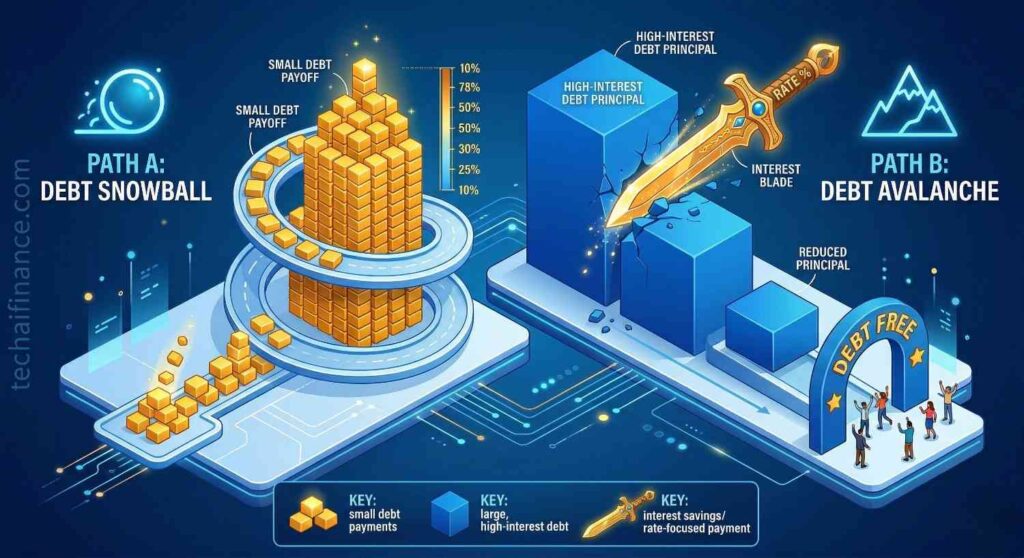
The Debt Snowball ranks all debts by outstanding balance from smallest to largest, regardless of interest rate. The account with the smallest balance receives all extra payments first. Minimum payments continue on everything else.
The method was popularised by financial educator Dave Ramsey as part of his Baby Steps program. His argument for it was not mathematical. It was psychological. Clearing a small debt produces a tangible win. That win, he argued, motivates continued effort in a way that the abstract knowledge of saving more in interest does not.
Snowball in Practice: A Worked Example
Using a hypothetical debt list of four accounts:
| Account | Balance | APR | Monthly Minimum | Snowball Rank |
| Store Card | $480 | 29% | $20 | 1st: target first |
| Personal Loan | $1,200 | 14% | $40 | 2nd |
| Credit Card A | $3,400 | 22% | $85 | 3rd |
| Credit Card B | $6,100 | 18% | $130 | 4th: target last |
With an additional $150 per month available for debt repayment:
- The $480 store card receives $20 minimum plus $150 extra = $170 per month. At this rate it clears in approximately 3 months.
- The freed $170 combines with the $40 minimum on the personal loan. Account 2 now receives $210 per month. It clears in approximately 6 additional months.
- The freed $210 combines with the $85 minimum on Credit Card A. Account 3 now receives $295 per month.
- Eventually the freed total combines onto Credit Card B for a final accelerated payoff.
The defining feature of the Snowball is the speed of the first win. Clearing a $480 balance in three months gives the borrower a concrete experience of debt elimination early in the process.
How the Debt Avalanche Works
The Debt Avalanche ranks all debts by interest rate from highest to lowest, regardless of balance size. The account charging the highest APR receives all extra payments first.
The mathematical logic is straightforward: high-interest debt generates more total interest over time than low-interest debt of the same balance. Eliminating the highest-rate account first stops the most expensive interest accumulation as quickly as possible.
Avalanche in Practice: Using the Same Debt List
| Account | Balance | APR | Monthly Minimum | Avalanche Rank |
| Store Card | $480 | 29% | $20 | 1st: target first |
| Credit Card A | $3,400 | 22% | $85 | 2nd |
| Credit Card B | $6,100 | 18% | $130 | 3rd |
| Personal Loan | $1,200 | 14% | $40 | 4th: target last |
In this particular scenario, the first account targeted is the same under both methods, because the store card carries the highest APR and the smallest balance. This coincidence does not always occur. The key difference typically appears with the second and third targets, where the Avalanche may direct payment to a larger, longer-clearing balance while the Snowball would have cleared a small account first.
With the same $150 extra payment per month, the Avalanche clears the store card in approximately 3 months, the same as the Snowball. The difference emerges from month 4 onwards, where the Avalanche targets Credit Card A at 22 percent rather than the $1,200 personal loan at 14 percent.
Side-by-Side Comparison Using the Same Debt Scenario
Using the four-account scenario above with a $150 monthly extra payment, the following comparison illustrates the typical cost difference between the two methods. These figures are calculated using standard amortisation principles and are illustrative. Actual results depend on specific account terms, minimum payment structures, and consistency of extra payments.
| Comparison Point | Debt Snowball | Debt Avalanche |
| Order of payoff | Store card, personal loan, Card A, Card B | Store card, Card A, Card B, personal loan |
| Estimated total interest paid | Approximately $3,840 | Approximately $3,190 |
| Estimated months to debt-free | Approximately 47 months | Approximately 44 months |
| First account cleared | Month 3 (store card) | Month 3 (store card, same) |
| Psychological first win | Month 3 | Month 3 (same in this case) |
| Interest cost difference | Baseline | Saves approximately $650 |
| Time difference | Baseline | Approximately 3 months faster |
In this scenario, the Avalanche saves approximately $650 in interest and completes approximately 3 months sooner. The gap between methods varies considerably depending on the specific debt profile. In scenarios where the smallest balance also carries the highest rate, both methods are identical. In scenarios where a large high-rate balance sits in the middle of the list, the difference is larger.
| ⭐ Key Takeaway The mathematical advantage of the Avalanche is real but often smaller than people expect. Across many realistic debt scenarios, the difference in total interest between the two methods falls in the range of $200 to $1,500, depending on balance sizes and rate spread. For borrowers with tightly clustered interest rates, the difference may be minimal. For those with a very high-rate account and a large balance, the Avalanche advantage grows. The more important variable in most cases is not which method saves more in theory. It is which method the borrower actually maintains for 36 to 48 months. |
What the Research Says About Which Method People Actually Complete
The debate between Snowball and Avalanche has been studied by behavioral economists and consumer finance researchers. The findings are relevant to how you make this decision.
A 2012 study published in the Journal of Marketing Research by Amar Cheema and Dilip Soman found that consumers with multiple debts made faster progress when they focused on clearing individual accounts completely rather than reducing balances proportionally. The research identified that the sense of task completion from closing an account created a motivational effect that sustained effort over time.
A 2016 study by researchers at Harvard Business School and the University of Michigan, published in the Journal of Consumer Research, found that borrowers who used a balance-focused approach similar to the Snowball reduced their overall debt faster in practice than those using a rate-focused approach similar to the Avalanche. The authors attributed this to higher persistence rates, as Snowball users were more likely to stay with the plan.
This research does not suggest the Avalanche is the wrong approach. It suggests that the mathematical advantage of the Avalanche is only realized if it is sustained consistently, and that for some borrowers, the slower accumulation of visible wins makes sustained effort harder.
Our editorial team’s position on this: the best debt payoff method is not the one that saves the most on paper. It’s the one that the individual borrower actually completes. For someone who needs early visible proof that the plan is working, the Snowball’s psychological structure may produce a better real-world outcome than the Avalanche’s theoretical savings.

How to Choose Based on Your Situation
Rather than a universal recommendation, the following framework helps identify which approach is likely to suit different debt profiles and personal financial styles.
The Snowball Is Often Better Suited When
- You have several smaller debts that could be cleared within the first 3 to 6 months. Early wins are likely and motivating
- You have previously started debt repayment plans and abandoned them before completing them
- Your interest rates are clustered within a narrow range, meaning the mathematical difference between methods is small, making the psychological advantage of the Snowball more significant
- You are dealing with debt across many accounts, and the administrative simplicity of closing accounts matters to you
The Avalanche Is Often Better Suited When
- You carry one or more accounts with very high APRs, specifically above 25 percent, alongside lower-rate accounts with large balances
- You are motivated by numbers and long-term financial outcomes rather than short-term wins
- Your smallest balance account also carries a high interest rate, in which case, both methods target it first anyway, eliminating the psychological trade-off
- You are disciplined enough to sustain a plan that may not produce a first full payoff for 12 or more months
When the Choice Is Less Clear
For many borrowers, the debt list does not neatly favor one method. The rates are spread moderately, the balances are mixed, and neither the Snowball’s early win nor the Avalanche’s interest savings is dramatically compelling. In these cases, starting with either method and committing to it is more important than extended analysis over which is marginally better.
The Hybrid Approach: When Neither Method Fits Neatly
A third approach that some financial counselors recommend is a hybrid that uses the Snowball structure for psychological momentum in the early stages and switches to Avalanche logic once initial debts are cleared and motivation is established.
How a Hybrid Might Work
- Use the Snowball to clear one or two small accounts in the first 3 to 6 months
- Once those accounts are gone and the monthly cash flow has increased through freed minimums, switch to the Avalanche order for the remaining accounts
- The freed payment from the early Snowball wins now concentrates on the highest-rate remaining account
This approach sacrifices some of the Avalanche’s maximum interest savings in exchange for the early motivational structure of the Snowball. Whether that trade-off is worth it depends on whether the borrower genuinely needs the early win to sustain effort.
There is also a case for choosing based purely on the first debt. If the highest-rate account and the smallest balance account are the same, which occurs in many debt profiles, both methods are identical for the first payoff period. The choice only becomes meaningful from the second account onwards.
Common Mistakes with Both Methods
Not Redirecting Freed Payments
When an account is cleared, the minimum payment that was going to it must be redirected to the next target immediately. This is the mechanism that drives accelerating payoff speed. If that amount flows back into discretionary spending instead, the acceleration effect disappears and the method produces no advantage over paying minimums only.
Opening New Credit During the Payoff Period
Adding new debt while working through an existing payoff plan disrupts the calculation and can undo months of progress. New balances compete for the extra payment, new hard inquiries affect credit, and new minimum payments reduce the amount available for targeted payoff. Unless a genuine emergency requires it, avoiding new credit applications during the payoff period is advisable.
Pausing After a Difficult Month
Most borrowers experience at least one month where an unexpected expense requires using the extra payment for something else. One disrupted month does not invalidate the plan. Returning to the method the following month is the correct response. The mistake is treating one interruption as a reason to stop entirely.
Choosing Based on Calculator Results Alone Without Considering Sustainability
Running a payoff calculator and choosing the method that produces the lower interest total without honestly assessing your own motivation pattern and past behavior with debt plans is a common and understandable mistake. The calculator shows the outcome if the plan is followed perfectly for 40 months. The honest question is whether you will follow it perfectly for 40 months. The honest question is what method makes that most likely for you specifically.
An Illustrative Comparison: Two Borrowers, Same Debt, Different Outcomes
| Illustrative Example: Not a Guarantee Two hypothetical borrowers in Texas each carry the same four debts: $480 store card at 29%, $1,200 personal loan at 14%, $3,400 credit card at 22% and $6,100 credit card at 18%. Both have $150 extra per month for debt repayment. Borrower A chooses the Avalanche. For the first 3 months, the store card clears on schedule. In months 4 through 16, the focus shifts to the $3,400 card at 22%. This takes 13 months to clear with no visible payoff event in the interim. Around month 11, Borrower A, frustrated by the slow visible progress, reduces the extra payment to $75 to cover a budget shortfall and never fully returns to $150. Borrower B chooses the Snowball. The store card clears in 3 months. The personal loan clears in month 9. By month 10, Borrower B has eliminated two accounts, has concrete proof the method works and is paying $210 per month against the credit card. They reach debt freedom in month 47, which is 3 months after the theoretical Avalanche completion, but 8 months before Borrower A at the reduced payment rate. This example is constructed to illustrate how sustained effort with a less optimal method can outperform an optimal method that is not fully maintained. It is not a prediction of individual outcomes. |
Free Tools to Calculate Your Own Payoff Order
Several free tools allow you to enter your specific debts and model both the Snowball and Avalanche order against your exact balances and rates.
- Undebt.it: undebt.it: free debt payoff planner that calculates both Snowball and Avalanche timelines and total interest from your own entered debt data. Also models custom payoff orders.
- PowerPay (Utah State University Extension): powerpay.org: free tool developed by a university extension program. Calculates payoff timelines for both methods and provides a month-by-month payment schedule. Established and frequently referenced in financial literacy programs.
- Consumer Financial Protection Bureau Debt Repayment Calculator: consumerfinance.gov: free government tool for modeling debt repayment schedules..
- The free download below: includes a comparison worksheet that calculates Snowball and Avalanche order from your own entered debt data in Excel or Google Sheets.
Frequently Asked Questions
Which method saves more money overall?
The Debt Avalanche saves more in total interest paid in most scenarios because it eliminates high-rate debt first. The size of the saving depends on how much the interest rates on your accounts differ. In scenarios where rates are clustered within a few percentage points of each other, the difference may be small. Where one account carries a significantly higher rate, the Avalanche advantage grows.
Which method do most financial advisors recommend?
It varies. Many financial educators who emphasize behavioral factors, including Dave Ramsey, recommend the Snowball specifically because of its motivational structure. Others with a purely mathematical orientation favor the Avalanche. The NFCC and CFPB both present both methods without a categorical recommendation, noting that the right choice depends on individual circumstances and motivation patterns.
Can I switch methods midway through my payoff plan?
Yes. Switching from Snowball to Avalanche once initial accounts are cleared is the basis of the hybrid approach described in this article. The freed payments from early Snowball wins can then be directed using Avalanche logic on remaining accounts. The only consideration is that switching disrupts the order you started with, so the total interest calculation changes from the point of switching.
What if I have only two debts?
With two debts, the method comparison is straightforward. If the smaller balance also carries the higher rate, both methods are identical. If the larger balance carries the higher rate, the Snowball clears the smaller account first and then tackles the larger one, while the Avalanche goes directly to the larger account. The interest saving from going Avalanche with two accounts is real but often modest.
Does the method matter if I can only afford minimum payments right now?
If your current income only covers minimum payments with nothing extra, neither method can be applied as designed until additional funds are available. The most useful step in that situation is reviewing your budget for any possible adjustment. Even $25 per month directed to the targeted account changes the trajectory. Our guide on how to find extra money on a tight budget covers this in detail.
Where can I get free debt payoff guidance in the US?
- National Foundation for Credit Counseling: free certified counseling in every US state. Can advise on which payoff approach fits your specific debt profile. Opens in new tab.
- Consumer Financial Protection Bureau: free tools, debt repayment guidance and consumer rights information. Opens in new tab.
| The Snowball vs Avalanche question is not a debate with a single correct answer. It is a question about which structure will keep you consistently paying down debt for the two to five years a typical payoff plan requires. That answer is different for every borrower. |
Conclusion
The Debt Snowball and Debt Avalanche are both proven debt payoff approaches with a shared underlying mechanic. The Snowball prioritizes early motivational wins by targeting the smallest balance first. The Avalanche prioritizes minimizing total interest by targeting the highest rate first.
Research in behavioral finance suggests that the Snowball’s structure produces higher completion rates for some borrowers, while the Avalanche produces better outcomes for those who are disciplined enough to sustain effort through a longer wait for the first full payoff.
The practical recommendation from our editorial team is to run your debt list through both methods using the free tools listed above, assess the interest difference honestly and then ask which method you will actually maintain for the full duration. If the answer is the Snowball, the slightly higher interest cost is likely worth the higher probability of completion.
Free certified guidance is available through the NFCC at no cost if you would like a counselor to review your specific debt list and recommend an approach suited to your situation.
| 📥 Free Download: Debt Payoff Strategy Comparison Worksheet An educational tool to model both the Snowball and Avalanche methods against your actual debt list and compare total interest and payoff timelines. Includes: ✔ Debt entry grid: balance, APR and minimum payment for up to 10 accounts ✔ Snowball order calculator: ranked by balance from smallest to largest ✔ Avalanche order calculator: ranked by APR from highest to lowest Free. Email required. Works in Excel and Google Sheets. Educational tool only. Not financial advice |
| 📲 Share This Article If this comparison has been useful, consider sharing it with someone currently managing multiple debts. Share on WhatsApp, Facebook, or by text message. Thank you for reading TechAIFinance.com. |
Read Next
Continue building your financial knowledge on TechAIFinance.com:
- How to Get Out of Debt on a Low Income in the US
- How to Negotiate With Creditors in the US
- How to Fix Bad Credit in 6 Months: Step-by-Step Guide
- How to Create a Budget When Living Paycheck to Paycheck
- How to Build an Emergency Fund From Zero
| ✍ About the Author Written by: TechAIFinance Editorial Team Edited and Fact-Checked by: Olayinka Adejugbe Olayinka Adejugbe is not a licensed financial advisor. The content on TechAIFinance.com is produced for educational purposes only and should not be treated as personalized financial advice. Olayinka is the founder and lead editor of TechAIFinance.com. He holds a Global Certification in Artificial Intelligence and Applied Innovation and an Award of Completion in Behavioral Counseling from the World Health Organization. With a strong working knowledge of personal finance and accounting principles, Olayinka oversees the editorial review of every article on this site to ensure accuracy, currency and practical usefulness. Every article on TechAIFinance.com is produced by our research team and reviewed by Olayinka before publication. We verify statistics against named authoritative sources and update content when circumstances change. Visit our About page to learn more about our editorial process. Use our Contact page to get in touch. |
Important Disclaimer
The content published on TechAIFinance.com is for educational and informational purposes only. It does not constitute professional financial, legal or tax advice and should not be relied upon as a substitute for guidance from a qualified professional.
Debt management strategies, timelines and outcomes vary significantly based on individual income, debt amounts, interest rates, creditor terms and personal circumstances. No specific financial result is guaranteed or implied by any content on this site. Always consult a qualified financial advisor, credit counselor or attorney before making significant financial decisions. Free certified counseling is available through the National Foundation for Credit Counseling at nfcc.org.