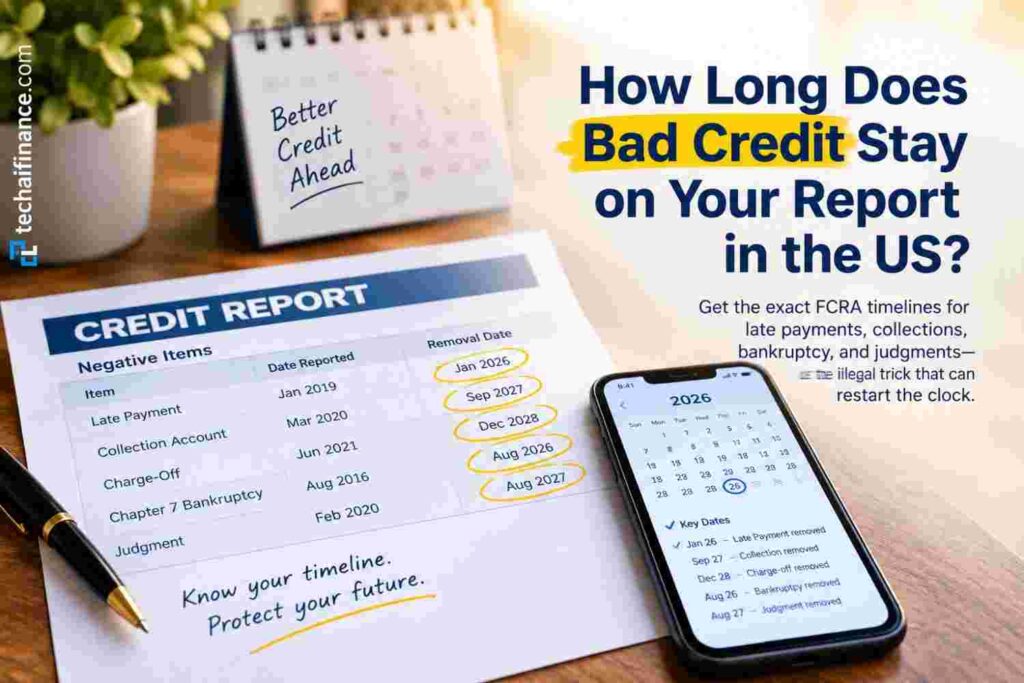
A missed payment feels permanent when you are staring at it on your credit report. It is not. Federal law puts a hard expiration date on almost every negative item, and once that date passes, the item has to come off whether the bureau feels like removing it or not.
The catch is that the clock does not always start where people assume it does, and in some cases collectors have been caught illegally resetting it. A 2024 study found mistakes on roughly half of credit reports reviewed, with more than a quarter of those errors involving the kind of negative item that can meaningfully hurt a score, per Consumer Reports 2024.
This guide lays out the exact timeline for every major type of negative item, explains where the clock actually starts, and covers a real illegal practice called debt parking that can make an old debt look brand new.
| ℹ Quick Summary Most negative items fall off after 7 years, and bankruptcies after 7 to 10 years depending on the chapter, per the Consumer Financial Protection Bureau 2026. Collection accounts and charge-offs get 7 years plus 180 days, counted from the original delinquency date, not from when the account was sent to collections, per the Consumer Financial Protection Bureau 2026.A 2024 review found mistakes on about half of credit reports checked, with more than 25% involving negative items serious enough to hurt a score, per Consumer Reports 2024.The FTC’s first debt parking enforcement case found that 80% to 97% of the disputed debts one collector had reported were later found inaccurate or invalid, per the Federal Trade Commission 2020.42% of Americans say their credit score has kept them from getting a financial product in the past year, per LendingTree 2022. |
| 📘 What This Guide Covers The exact FCRA timeline for every major type of negative item Why the reporting clock starts earlier than most people think Debt parking: the illegal practice that can make an old debt look new What actually happens to your score as an item gets older Where medical debt currently stands after a major rule was struck down What to do if a negative item is still showing after its legal deadline Common mistakes people make tracking their own timelines |
Table of Contents
- The FCRA Timeline for Every Major Negative Item
- Why the Clock Starts Earlier Than You Think
- Debt Parking: The Illegal Trick That Resets the Clock
- Does an Old Negative Item Still Hurt Your Score?
- Where Medical Debt Actually Stands in 2026
- What to Do If an Item Overstays Its Deadline
- Real-World Example
- Common Mistakes to Avoid
- Frequently Asked Questions
1. The FCRA Timeline for Every Major Negative Item
| Most negative items must be removed after 7 years, collections and charge-offs get 7 years and 180 days, Chapter 7 bankruptcy can stay up to 10 years, and Chapter 13 bankruptcy up to 7 years, all counted from specific trigger dates set by federal law, per the Consumer Financial Protection Bureau 2026. |
The Fair Credit Reporting Act sets a hard ceiling on how long each type of negative item can legally appear. Bureaus are allowed to remove items sooner, but they are not allowed to report most negative information past these limits.
| Item | How Long It Stays | Clock Starts |
| Late payment | 7 years | Date of the missed payment |
| Collection account or charge-off | 7 years and 180 days | Date of original delinquency, not the collection date |
| Chapter 7 bankruptcy | 10 years | Filing date |
| Chapter 13 bankruptcy | 7 years | Filing date |
| Foreclosure or repossession | 7 years | Date of first delinquency |
| Civil judgment | 7 years or until the statute of limitations expires, whichever is longer | Entry of judgment |
| Hard inquiry | 2 years on report, affects score for about 12 months | Date of the inquiry |
| On-time payment history | No fixed limit, can remain indefinitely | Ongoing |
2. Why the Clock Starts Earlier Than You Think
When Does the Credit Reporting Clock Actually Start?
| For a collection account, the 7 year and 180 day clock starts on the date of the original delinquency with the original creditor, not the date the account was sold or sent to a collection agency, which means a debt cannot be given a fresh 7-year window just because it changed hands. |
This is the single most misunderstood rule in credit reporting. Say you missed a payment in January 2020, the account charged off in July 2020, and it was sold to a collection agency in 2023. The legal clock still runs from that original 2020 delinquency date, called the Date of First Delinquency, not from when the collection agency picked it up in 2023.
Debt buyers sometimes change hands two or three times before a debt is paid off or ages out. Every time that happens, the Date of First Delinquency is supposed to travel with the account. It is not supposed to reset.
3. Debt Parking: The Illegal Trick That Resets the Clock
| ⚠ Watch Out If an old debt you do not recognize suddenly appears on your report as a brand-new collection account, that can be a sign of illegal re-aging or debt parking, not a legitimate reset of the clock. |
In 2020, the FTC brought its first enforcement case specifically targeting a practice called debt parking, in which a collector posts a debt to your credit report without first trying to contact you, sometimes with a Date of First Delinquency that makes the debt look far newer than it actually is. In that case, the collector had reported roughly $98 million in debts, and its own internal reviews found that 80% to 97% of investigated debts were inaccurate or invalid, per the Federal Trade Commission 2020.
The CFPB has separately flagged inaccurate transfer of the Date of First Delinquency as a recurring supervisory finding, and treats deliberate re-aging as an unfair practice under federal law. If a collection account suddenly shows a delinquency date that is much more recent than you remember, that mismatch is worth disputing directly, since it can mean the account is illegally restarting its own clock.
| 💡 Pro Tip When disputing a suspected re-aged account, request the Date of First Delinquency the furnisher has on file. If it does not match your own records, cite that specific mismatch in your dispute rather than disputing the account generally. |
4. Does an Old Negative Item Still Hurt Your Score?
| Most scoring models weigh recent activity more heavily than older activity, so a negative item from five years ago typically drags your score down less than the same item would have in its first year, even though it is still technically on your report. |
This is why people sometimes see their score recover well before a negative item is legally required to disappear. The item is still visible to anyone pulling your report, but its statistical weight in most scoring models fades as it ages, especially if you have built new positive history in the meantime.
5. Where Medical Debt Actually Stands in 2026
Is Medical Debt Banned From Credit Reports?
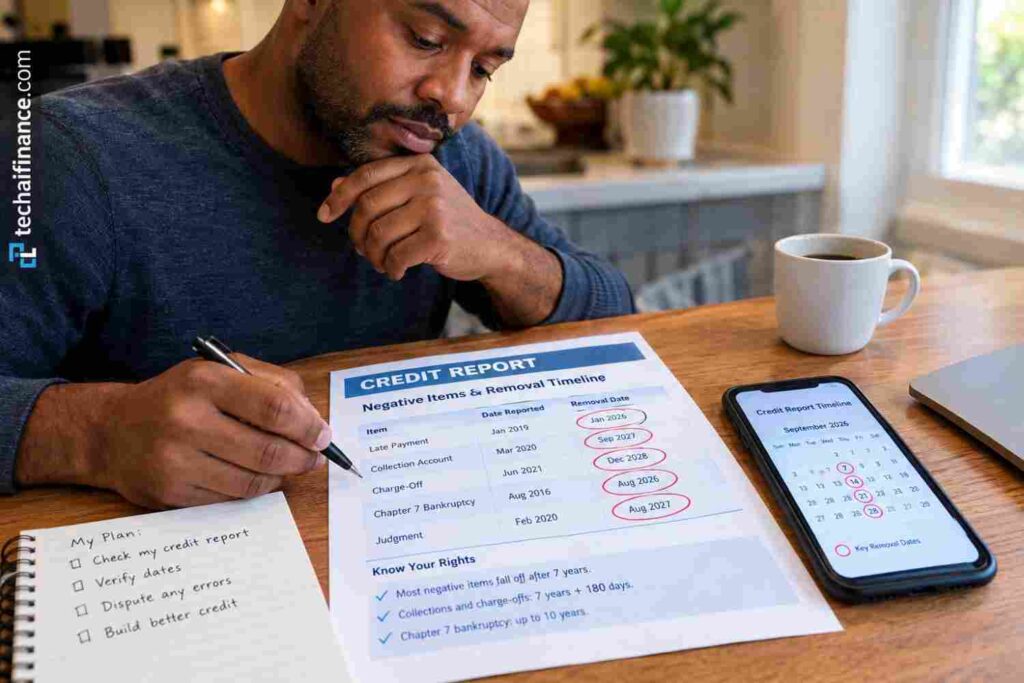
| No. A CFPB rule finalized in January 2025 would have banned most medical debt from credit reports, but a federal court vacated that rule in July 2025, so there is currently no federal ban. The three major bureaus’ separate voluntary policies from 2023 are still in effect. |
This is a common source of outdated advice online. Under the bureaus’ voluntary 2023 policy, paid medical collections are removed regardless of amount, medical collections under $500 are excluded entirely, and unpaid medical debt gets a full year before it can appear at all, per Experian 2023. Those voluntary protections are unaffected by the court ruling and remain active.
What did not happen is a full federal ban on medical debt appearing on credit reports. If you are relying on something you read about a nationwide medical debt ban, it is worth double-checking whether that information predates July 2025.
6. What to Do If an Item Overstays Its Deadline
| If a negative item is past its legal reporting window, you can dispute it directly with the bureau on the basis of age alone, without needing to prove the underlying debt was inaccurate. |
- Pull your free report at AnnualCreditReport.com and find the exact date the item is supposed to age off.
- Calculate the deadline using the trigger date for that item type, not today’s date.
- If the deadline has passed, file a dispute citing the item as obsolete under the FCRA.
- Keep your dispute confirmation number and follow up if it is not removed within 30 to 45 days.
7. Real-World Example
| 💡 Real-World Example Marcus, a 36-year-old electrician in Nashville, Tennessee, noticed a collection account from 2018 still showing on his report in 2026, past its 7-year-and-180-day window. He disputed it citing the age alone, and it was removed within three weeks. Ashley, a 44-year-old office manager in Denver, Colorado, saw a collection account she had never heard of appear with a delinquency date only a year old. After digging through old statements, she realized it was a repackaged version of a medical bill from six years earlier. She disputed it as a re-aged account and had it deleted after the bureau could not verify the newer date. These examples are illustrative. Actual results depend on individual circumstances. |
8. Common Mistakes to Avoid
- Assuming the clock starts when a debt is sold to a collector rather than the original delinquency date
- Not double-checking the delinquency date shown on a collection account
- Believing medical debt is now fully banned from credit reports nationwide
- Paying an old, expired debt out of fear, which can sometimes restart the statute of limitations for a lawsuit depending on your state
- Waiting for an item to disappear on its own instead of disputing it once the deadline has clearly passed
9. Frequently Asked Questions
Does paying off an old collection reset the 7-year clock?
No. Paying a debt does not restart the legal reporting window. It should be updated to show as paid, but the original delinquency date determines when it must come off.
Can a debt collector legally sue me after 7 years?
The 7-year credit reporting limit is separate from your state’s statute of limitations on debt collection lawsuits, which can be shorter or longer. A debt can be too old to report but not too old to be sued over, or the reverse, depending on your state.
Is it true that bankruptcy ruins your credit for 10 years?
Not in practice. The public record can stay up to 10 years for Chapter 7, but scores typically begin recovering well before that as new positive history builds and the bankruptcy carries less statistical weight over time.
What should I do if I spot debt parking on my report?
Dispute the account directly, specifically noting the delinquency date discrepancy, and keep documentation of your own records showing when the original account actually became delinquent.
Does closing an account remove it from my report sooner?
No. A closed account, whether in good standing or not, still follows the same reporting timeline. Closing an account does not accelerate removal of negative history tied to it.
| ⭐ Key Takeaway Federal law puts a firm deadline on nearly every negative item, generally 7 years, with collections getting 7 years and 180 days and bankruptcies getting 7 to 10 years depending on the chapter. The clock is based on when the debt originally became delinquent, not when it was sold to a collector, and any attempt to reset that date by parking an old debt as if it were new is illegal. Knowing your exact deadlines turns a vague hope that bad credit will eventually fade into a specific date you can act on. |
Conclusion
Bad credit is not a life sentence. Every negative item on your report has a legal expiration date, and knowing the real trigger date for that item, not just the type of debt, is what lets you catch both simple errors and illegal re-aging before they cost you an approval you should have gotten.
Start by pulling your reports through our guide on How to Get Your Free Annual Credit Report, and if you want to lock down new-account fraud while you wait out an old item’s timeline, see our guide on Credit Freeze vs Credit Lock.
Circle the actual deadline on your calendar. It is usually closer than it feels.
| 📲 Share This Guide Know someone convinced their credit is ruined forever? Send them this guide and the actual deadline math. |
Read Next
- How to Get Your Free Annual Credit Report in the US 2026
- Credit Freeze vs Credit Lock: What Every American Needs to Know in 2026
- What to Do After a Data Breach: A Step-by-Step Guide for Americans 2026
- Credit Score Ranges Explained: What Your Number Means for Americans in 2026
| ✍ About the Author Written by: TechAIFinance Editorial Team Edited and Fact-Checked by: Olayinka Adejugbe Olayinka Adejugbe is not a licensed financial advisor. The content on TechAIFinance.com is produced for educational purposes only and should not be treated as personalized financial advice. Olayinka is the founder and lead editor of TechAIFinance.com. He holds a Global Certification in Artificial Intelligence and Applied Innovation and an Award of Completion in Behavioral Counseling from the World Health Organization. With a strong working knowledge of personal finance and accounting principles, Olayinka oversees the editorial review of every article on this site to ensure accuracy, currency and practical usefulness. Every article on TechAIFinance.com is produced by our research team and reviewed by Olayinka before publication. We verify statistics against named authoritative sources and update content when circumstances change. Visit our About page to learn more about our editorial process. Use our Contact page to get in touch. |
Disclaimer & Content Note
The information provided on TechAIFinance.com—including content on personal finance, side hustles, AI tools, and tech reviews is for educational and informational purposes only and does not constitute professional financial, legal, tax, or technical advice. Financial outcomes, business earnings, and tech performance vary based on individual circumstances and market conditions. TechAIFinance.com makes no guarantees regarding results or tool performance. Always consult a qualified professional before making major financial, business, or tech purchasing decisions. Free certified credit counseling is available through the National Foundation for Credit Counseling at nfcc.org.