
Every American who has ever been hit by a car repair bill, a holiday spending crunch or an annual insurance premium they forgot was coming has experienced the same problem. It was not a surprise. It was a predictable expense that arrived without a plan. The car needed tires eventually. The holidays come every December. The insurance renews every six months. None of these are emergencies. They are known expenses that most Americans fund with credit cards because their monthly budget has no category for costs that do not arrive monthly.
This is the problem sinking funds solve. A sinking fund is a dedicated savings account built up over time for a specific known future expense. Instead of treating the $600 car repair as a crisis when it hits in October, you have been setting aside $50 per month since January, and when October comes the money is already there. The repair does not go on a credit card. It does not drain the emergency fund. It comes out of the account you built specifically for it.
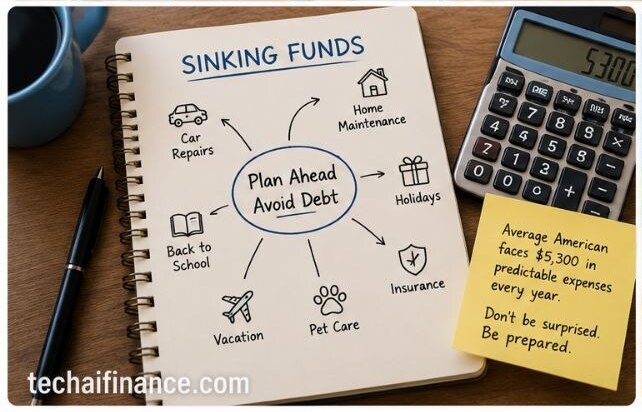
The average American faces approximately $5,300 in irregular but entirely predictable expenses per year, per the National Foundation for Credit Counseling Financial Literacy Survey 2025. That is more than $440 per month in costs that most households either do not budget for or handle reactively with debt. Sinking funds convert those reactive crises into scheduled deposits you made months in advance.
| ℹ Quick Summary The average American faces approximately $5,300 per year in irregular but predictable expenses including vehicle maintenance, home repairs, annual subscriptions, holiday spending and insurance premiums, per the National Foundation for Credit Counseling Financial Literacy Survey 2025. Americans hold a record $1.28 trillion in credit card balances as of 2026, with the Consumer Financial Protection Bureau identifying irregular non-monthly expenses as a leading driver of credit card debt accumulation for households that otherwise consider themselves budget-conscious, per CFPB Consumer Credit Card Market Report 2026. Just 47 percent of Americans indicate they have sufficient liquidity or access to funds to cover a $1,000 emergency expense, per the Bankrate Emergency Savings Report January 2026, meaning the majority of Americans are one predictable irregular expense away from credit card debt. Nearly half of American pet owners say unexpected pet expenses caused financial concern in 2025, up from one third in 2022, with the average 15-year cost of caring for a dog exceeding $60,000, per the American Animal Hospital Association Pet Ownership Cost Study 2025. Americans who use dedicated sub-accounts for specific savings goals, the structural equivalent of sinking funds, are significantly more likely to reach those goals than those who save into a single general savings account, per research published in the Journal of Economic Behavior and Organization 2024. |
| 📘 What This Guide Covers Exactly what a sinking fund is and how it differs from an emergency fund The simple monthly contribution formula anyone can use The 10 most important sinking fund categories for American households in 2026 Where to keep your sinking funds and which account types work best How to start your first sinking fund this week even on a tight budget How sinking funds fit into a complete budget framework Common sinking fund mistakes Americans make and how to avoid them A real-world example of two Americans who handled the same car repair very differently |
Table of Contents
- What Is a Sinking Fund?
- Sinking Fund vs Emergency Fund: The Critical Difference
- The Sinking Fund Formula
- The 10 Most Important Sinking Fund Categories for Americans
- Where to Keep Your Sinking Funds
- How to Start Your First Sinking Fund This Week
- How Sinking Funds Fit Into Your Budget
- Common Sinking Fund Mistakes Americans Make
- Real-World Example: Two Americans, Same Car Repair
- Frequently Asked Questions
What Is a Sinking Fund?
| A sinking fund is a dedicated savings account built up over time with regular deposits to cover a specific known future expense. Unlike an emergency fund, which covers unexpected events, a sinking fund covers predictable costs you know are coming but do not arrive monthly, such as car maintenance, holiday gifts, annual insurance premiums, home repairs or vacation. The term comes from corporate finance but the personal finance application is simple: save a fixed amount each month so the money is ready when the bill arrives. |
The concept is simple enough to explain in one sentence: you know the expense is coming, so you save for it in advance rather than funding it reactively with credit. What makes sinking funds powerful is that they change the emotional and financial experience of irregular expenses. Instead of a $700 car repair feeling like a crisis that derails your month, it becomes a withdrawal from a fund you built for exactly that purpose.
Most Americans already understand this concept intuitively because they accept it for retirement. Saving $400 per month for 30 years so you have money in year 30 is a sinking fund operating over decades. The same logic applied to a 12-month timeline for holiday spending or a 6-month timeline for an insurance renewal is simply the same idea compressed into a shorter timeframe.
Sinking Fund vs Emergency Fund: The Critical Difference
What is the difference between a sinking fund and an emergency fund?
| An emergency fund covers unexpected events you cannot predict: a job loss, a medical emergency, a natural disaster. A sinking fund covers predictable expenses you know are coming but that do not arrive every month: car repairs, holidays, annual insurance, home maintenance. The key distinction is known versus unknown. If you can put the expense on a calendar, it belongs in a sinking fund. If it is genuinely unforeseeable, it belongs in your emergency fund. Using your emergency fund for predictable expenses depletes the protection you need for actual emergencies. |
| Sinking Fund vs Emergency Fund at a Glance Sinking Fund: Covers known, predictable, irregular expenses. You know the expense is coming. You know roughly when. You know roughly how much. Example: car tires, holiday gifts, annual insurance renewal. Emergency Fund: Covers unknown, unpredictable events. You do not know if or when it will happen. You do not know how much it will cost. Example: job loss, unexpected medical diagnosis, major storm damage. The most important rule: do not drain your emergency fund for expenses that belong in a sinking fund. Car maintenance is predictable. Holiday spending is predictable. Using emergency savings for these depletes your true safety net and leaves you without protection when a genuine emergency hits. |
The Sinking Fund Formula
How do you calculate a sinking fund contribution?
| The sinking fund formula is: annual cost divided by months until the expense equals your monthly contribution. For example, a $1,200 car maintenance budget divided by 12 months equals $100 per month. A $900 holiday gift budget with 9 months until December equals $100 per month. A $600 annual insurance premium due in 6 months equals $100 per month. Apply this formula to every predictable irregular expense in your life and you will never again be blindsided by a bill you already knew was coming. |
The formula has three variables. The annual or total cost of the expense, which you estimate based on history. The number of months until the expense arrives, which gives you your savings runway. And the monthly contribution, which is simply
the first divided by the second.
| Sinking Fund Formula Formula: Annual Cost / Months Until Expense = Monthly Contribution Example 1: Car maintenance budget of $1,200 per year / 12 months = $100 per month Example 2: Holiday gifts budget of $900 / 9 months remaining = $100 per month starting March Example 3: Annual insurance premium of $840 / 12 months = $70 per month Example 4: Vacation fund of $2,400 for a trip 16 months away / 16 months = $150 per month Apply this formula to every known irregular expense. Your total monthly sinking fund contribution is the sum of all individual fund amounts. |
The 10 Most Important Sinking Fund Categories for Americans
What should I have a sinking fund for?
| The most important sinking fund categories for American households in 2026 are car maintenance and repairs, home repairs and maintenance, holiday and gift spending, annual insurance premiums, medical and dental expenses not covered by insurance, vacation and travel, back-to-school expenses, annual subscriptions and memberships, pet care and veterinary costs and technology replacement. Most American households benefit from having 6 to 10 active sinking funds running simultaneously, per the National Foundation for Credit Counseling 2025. | |||
| Sinking Fund Category | Typical Annual Cost | Monthly Contribution | Notes |
| Car maintenance and repairs | $900 to $1,500 | $75 to $125 | Tires, oil changes, brakes, registration, surprises |
| Home repairs and maintenance | $1,500 to $3,000 | $125 to $250 | Rule of thumb: 1% of home value per year |
| Holiday gifts and celebrations | $600 to $1,500 | $50 to $125 | Start January 1 for December |
| Annual insurance premiums | $400 to $1,200 | $33 to $100 | Auto, renters, life, if paying annually |
| Medical and dental out-of-pocket | $500 to $2,000 | $42 to $167 | Deductibles, copays, dental work |
| Vacation and travel | $1,000 to $3,000 | $83 to $250 | Adjust to your actual trip frequency |
| Back-to-school expenses | $300 to $800 | $25 to $67 | Clothes, supplies, fees |
| Annual subscriptions | $200 to $600 | $17 to $50 | Software, streaming bundles, memberships |
| Pet care and veterinary | $500 to $1,500 | $42 to $125 | Annual vet visits, grooming, emergencies |
| Technology replacement | $300 to $800 | $25 to $67 | Phone, laptop, appliances over time |
Source: Typical cost ranges per ConsumerAffairs 2025, American Animal Hospital Association 2025 and National Foundation for Credit Counseling 2025. Actual costs vary by household size, location and lifestyle.
Where to Keep Your Sinking Funds
Where should I keep my sinking funds?
| Keep sinking funds in high-yield savings accounts rather than your regular checking account. The best structure is to open separate labeled sub-accounts for each fund at a bank that allows multiple savings buckets, such as Ally Bank, SoFi or Marcus by Goldman Sachs. Keeping sinking funds separate from your emergency fund and daily checking reduces the temptation to spend the money and makes it easy to see exactly how each fund is progressing. High yield savings accounts paying 4 to 5 percent APY in 2026 also earn interest on your contributions while you save. |
Best account types for sinking funds
- High yield savings sub-accounts: The ideal structure. Banks like Ally at ally.com, SoFi at sofi.com and Marcus at marcus.com allow you to open multiple named savings buckets within one account. Label each one: Car, Holidays, Medical. Each fund earns 4 to 5 percent APY in 2026 while you save toward your goal.
- Separate savings accounts at the same bank: If your bank does not offer sub-accounts, open a separate savings account for each fund. Some banks allow multiple savings accounts under one login. This achieves the same organizational goal.
- Regular savings account if necessary: A regular savings account works fine even if the interest rate is lower. The organizational benefit of keeping sinking funds separate from checking and emergency savings matters more than the interest rate difference at typical sinking fund balances.
| ⚠ Watch Out Do not keep sinking funds in your regular checking account. Money sitting in checking gets spent. The psychological separation of a labeled savings account with a specific purpose is what makes sinking funds work. When the car repair money is in an account called Car Maintenance rather than mixed into your checking balance, you are far less likely to spend it on something else. The CFPB identifies irregular non-monthly expenses as a leading driver of credit card debt for households that otherwise consider themselves budget-conscious, per the CFPB Consumer Credit Card Market Report 2026. The failure is almost always organizational rather than income-based. |
How to Start Your First Sinking Fund This Week
Starting a sinking fund does not require a big income or a perfect budget. It requires identifying one predictable expense, calculating the monthly contribution and opening a savings account. That is the entire process for the first fund.
- Choose one expense to start: Pick the predictable irregular expense that stresses you most. For most Americans that is either car maintenance or holiday spending. Starting with one fund is better than planning ten and starting none.
- Estimate the annual cost: Look at what you spent on this category last year if you can. If you do not have records, use the typical ranges in the table above as a starting point and adjust based on your specific situation.
- Calculate your monthly contribution: Divide the annual cost by 12 for a year-round fund or by the number of months until the next occurrence for a deadline-based fund.
- Open a separate savings account: Name it specifically for this fund. Most online banks allow you to name savings accounts. Car Fund, Holiday Fund or Vacation 2027 are all appropriate names that remind you what the money is for.
- Set up an automatic transfer: Transfer your calculated monthly amount from checking to the new account on the same day your paycheck deposits. Automation removes the decision to save from your active choices and makes the system work without willpower.
- Add more funds over time: Once your first fund feels natural, add a second. Most households end up with 4 to 8 active sinking funds once they have built the habit.
| 💡 Pro Tip Your first sinking fund contribution does not need to be the full calculated amount if money is tight this month. If the formula says $100 per month but you can only start with $25, start with $25. A small contribution today builds the habit and the account. Increase the amount as your budget allows. Starting late on a sinking fund is not a reason to not start. If Christmas is four months away and your gift budget is $800, divide by four and set aside $200 per month. You will not be fully funded but you will be significantly less reliant on credit than if you had saved nothing. |

How Sinking Funds Fit Into Your Budget
Sinking funds work with every major budgeting method. They are not a competing system. They are an addition that fills a gap most budgeting frameworks handle poorly.
Sinking funds and the 50/30/20 rule
In the 50/30/20 framework, sinking fund contributions belong in the 20 percent savings category alongside retirement contributions and emergency fund savings. Total your monthly sinking fund contributions and add them to your 20 percent savings allocation. If your contributions push the savings category above 20 percent, consider reducing discretionary spending in the 30 percent category temporarily to fund the most important sinking funds first.
Sinking funds and zero-based budgeting
Zero-based budgeting, where every dollar of income is assigned a job before it is spent, is the budgeting method that most naturally accommodates sinking funds. Each sinking fund category becomes a budget line item with its monthly contribution amount. This is how YNAB structures irregular expenses: as categories with monthly allocations that accumulate until the expense arrives.
Sinking funds and envelope budgeting
The envelope budgeting method, whether physical cash envelopes or digital envelope apps like Goodbudget, is conceptually identical to sinking funds. Each envelope represents a category with a monthly allocation. Sinking fund categories are simply envelopes with longer accumulation timelines than monthly expenses.
Common Sinking Fund Mistakes Americans Make
- Underestimating costs: The most common mistake. Americans consistently underestimate irregular expenses until they track them for a year. If your car maintenance sinking fund is based on the cost of an oil change and your car needs new brakes in month eight, the fund will not cover it. Budget toward the higher end of cost ranges for your first year and adjust downward based on actual spending.
- Keeping sinking funds in checking: Money in checking gets spent. The separation between your sinking fund accounts and your spending account is not bureaucratic friction. It is the protection that makes the system work.
- Starting too many funds at once: Opening eight sinking funds simultaneously when your budget is already tight spreads contributions too thin to make meaningful progress on any of them. Start with one or two priority funds and add more as your financial position allows.
- Raiding sinking funds for other purposes: Using the car maintenance fund to pay for an unexpected medical bill converts a purpose-built reserve into general savings and defeats the organizational benefit of the system. If you need to raid a sinking fund, treat it like an internal debt and replenish it before resuming contributions to other goals.
- Not adjusting for inflation: A car maintenance budget that was accurate in 2022 may be too low in 2026. Average vehicle maintenance costs rose approximately 19 percent between 2022 and 2025, per the Bureau of Labor Statistics Consumer Price Index data. Review and update your sinking fund contribution amounts annually.
| 💡 Real-World Example Consider two hypothetical Americans who both drove the same model car and both needed the same $680 tire replacement in October 2026. Diana is 34 and lives in Charlotte, North Carolina. In January 2026 she had read about sinking funds and opened a high yield savings account at Ally Bank named Car Maintenance. She set up an automatic transfer of $90 per month, which she calculated based on the prior year’s car costs of approximately $1,080 divided by 12. By October she had accumulated $810 in the fund from nine months of contributions plus interest. When the tire quote came in at $680, she transferred the money from her Car Maintenance account and paid in full. No credit card. No interest. No disruption to her monthly budget or her emergency fund. She had $130 left in the fund for the next routine maintenance item. Marcus is 31 and lives in Charlotte, North Carolina. He drives the same car. In October the same tire issue came up. Marcus had no dedicated car fund. The $680 went on his credit card at 22.8 percent APR. He planned to pay it off quickly but two other irregular expenses arrived in November and he carried the balance for four months, paying approximately $62 in interest on top of the original cost. The total cost of the same tire replacement was $742 for Marcus versus $680 for Diana. More importantly, Diana experienced zero financial stress. Marcus experienced four months of it. The only difference between their outcomes was that Diana had built a $90-per-month habit in January that Marcus had not. These examples are illustrative. Actual results depend on individual circumstances. |
Frequently Asked Questions
How many sinking funds do I need?
Most American households benefit from 4 to 8 active sinking funds once the system is running, per the National Foundation for Credit Counseling 2025. The right number depends on how many significant irregular expenses you regularly face. Start with the one or two categories that cause the most financial stress when they arrive unexpectedly and add more funds over time as the habit becomes natural. There is no upper limit, but managing more than 10 to 12 separate funds can become administratively complicated without meaningful additional benefit.
What if I cannot afford to fund all my sinking funds right now?
Prioritize by urgency and impact. Fund the categories where you are most likely to face an expense soon and where the cost would cause the most financial damage if you had to charge it to a credit card. Car maintenance and medical expenses tend to be the highest priority for most Americans. Holiday spending is high priority if the holiday is within six months. Start with partial contributions on your top priorities rather than waiting until you can fully fund all categories simultaneously.
Should I use a sinking fund or a credit card with cash back rewards?
This depends on whether you pay your credit card balance in full every month. If you pay in full monthly, using a cash back card for irregular expenses and immediately transferring the equivalent amount from your sinking fund to cover the charge can earn you rewards while maintaining the organizational discipline of the system. If you carry a balance, the interest cost at 22.8 percent APR far exceeds any cash back benefit. In that case, paying directly from your sinking fund and avoiding the credit card entirely is the better financial choice.
Is a sinking fund the same as a savings account?
A sinking fund is a use of a savings account rather than a different type of account. The account itself is typically a standard high yield savings account. What makes it a sinking fund is how you use it: a specific purpose, a specific contribution amount and a specific target. A general savings account with no designated purpose is not a sinking fund. The same account at the same bank becomes a sinking fund when you name it Car Maintenance and contribute a fixed amount monthly toward a specific car maintenance budget.
How do I handle a sinking fund expense that costs more than I saved?
If the expense arrives before you have fully funded the sinking fund, cover the remainder from whatever source causes the least financial damage in priority order: other non-emergency savings, a one-time reduction in discretionary spending or if necessary a credit card that you pay off within the next one to two months. After the expense, continue your normal monthly contribution while also making additional contributions to rebuild any depleted balance. Adjust your monthly contribution amount upward if the actual expense revealed that your original estimate was too low.
Can sinking funds help me stop living paycheck to paycheck?
Yes, in a specific way. Sinking funds do not increase your income but they eliminate the irregular expenses that most often break a budget that would otherwise be sustainable. Many Americans who describe themselves as living paycheck to paycheck are actually living in a cycle where every time they get ahead slightly, an irregular predictable expense arrives and resets them to zero or into debt. Sinking funds break that cycle by converting those irregular expenses from budget-breaking surprises into pre-funded line items. For the full framework on building financial stability from a tight budget, our guide on how to create a budget when living paycheck to paycheck covers the complete system that sinking funds fit into.
| ⭐ Key Takeaway Sinking funds do not require a higher income. They require a different relationship with expenses you already know are coming. The average American faces over $5,300 per year in predictable irregular expenses. At $440 per month, that is a meaningful share of most household budgets. Whether those expenses are funded in advance through sinking funds or reactively through credit cards is the single biggest practical difference between households that stay out of debt and households that do not. Start with one fund this week. Car maintenance or holiday spending. Calculate the monthly amount. Open a named savings account. Set up the automatic transfer. That is the entire system. |
Conclusion
Sinking funds are not a complicated financial strategy. They are the recognition that most of the expenses people describe as financial surprises were never actually surprising. The car needed maintenance. The holidays came in December. The insurance premium renewed on schedule. Treating predictable irregular expenses as surprises and funding them reactively with credit cards is expensive both financially and emotionally. Sinking funds convert that reactive pattern into a proactive one that costs nothing extra to implement.
For Americans who are also working on building their emergency fund alongside their sinking funds, our guide on how to build an emergency fund from zero covers the priority sequence for building both simultaneously on a tight budget. For those managing debt while trying to save, our guide on how to get out of debt fast on a low income covers the complete debt payoff framework that sinking funds protect once you are on your way out.
| 📲 Share This Guide If this guide helped you understand sinking funds and how to start your first one, share it with someone who keeps getting hit by expenses they knew were coming. Share on WhatsApp, Facebook or by text message. Thank you for reading TechAIFinance.com. |
Read Next
Continue building your financial knowledge on TechAIFinance.com:
- How to Create a Budget When Living Paycheck to Paycheck in the US
- How to Build an Emergency Fund From Zero
- How to Get Out of Debt Fast on a Low Income: 7-Step Plan
- How to Build Wealth on a Single Income in the US 2026
- Credit Score Ranges Explained: What Your Number Means for Americans in 2026
| ✍ About the Author Written by: TechAIFinance Editorial Team Edited and Fact-Checked by: Olayinka Adejugbe Olayinka Adejugbe is not a licensed financial advisor. The content on TechAIFinance.com is produced for educational purposes only and should not be treated as personalized financial advice. Olayinka is the founder and lead editor of TechAIFinance.com. He holds a Global Certification in Artificial Intelligence and Applied Innovation and an Award of Completion in Behavioral Counseling from the World Health Organization. With a strong working knowledge of personal finance and accounting principles, Olayinka oversees the editorial review of every article on this site to ensure accuracy, currency and practical usefulness. Every article on TechAIFinance.com is produced by our research team and reviewed by Olayinka before publication. We verify statistics against named authoritative sources and update content when circumstances change. Visit our About page to learn more about our editorial process. Use our Contact page to get in touch. |
Disclaimer & Content Note
The information provided on TechAIFinance.com—including content on personal finance, side hustles, AI tools, and tech reviews is for educational and informational purposes only and does not constitute professional financial, legal, tax, or technical advice. Financial outcomes, business earnings, and tech performance vary based on individual circumstances and market conditions. TechAIFinance.com makes no guarantees regarding results or tool performance. Always consult a qualified professional before making major financial, business, or tech purchasing decisions. Free certified credit counseling is available through the National Foundation for Credit Counseling at nfcc.org.