| Important Disclosure This guide provides information about cryptocurrency for educational purposes only. It is not financial or investment advice. Cryptocurrency is a highly volatile and speculative asset class. You can lose some or all of the money you invest. Never invest money you cannot afford to lose completely. Always consult a qualified financial advisor before making investment decisions. Some links may be affiliate links. TechAIFinance.com may earn a commission if you sign up through our link at no additional cost to you. All platform details and regulatory information were verified in April 2026. |

If you have ever had a conversation about money in America in the past five years, someone mentioned Bitcoin or cryptocurrency. Maybe a coworker told you they made a fortune on it. Maybe a family member warned you it was a scam. Maybe you saw the headlines when Bitcoin hit $100,000 and wondered what you missed or whether there is still time to get involved.
The honest answer is that cryptocurrency is one of the most misunderstood financial topics in America today, not because it is impossibly complicated but because most of the content about it is written either by enthusiasts who want you to buy in or by skeptics who want you to stay away. Very little of it explains clearly and without an agenda what cryptocurrency actually is, how it works technically without the jargon, what the real risks look like in plain numbers and what the IRS expects from every American who buys it.
This guide fills that gap. It covers the fundamentals of cryptocurrency and Bitcoin in the kind of plain language that a person with no financial or technical background can read and genuinely understand. It covers which cryptocurrencies Americans are actually using and why, how to buy safely through legitimate US platforms, what security practices protect your holdings from theft and exactly what your tax obligations are the moment you make your first purchase.
This is not a guide that tells you whether to buy cryptocurrency. That decision is yours and depends on your personal financial situation, your risk tolerance and your investment goals. This guide gives you the information you need to make that decision intelligently rather than based on hype or fear.
This guide was written by Olayinka Adejugbe, founder of TechAIFinance.com and holder of a Global Certification in Artificial Intelligence and Applied Innovation.
| ℹ Quick Summary Cryptocurrency in the US in 2026: key facts Approximately 40 percent of American adults owned or had previously owned cryptocurrency as of early 2026, per a Pew Research Center survey. Bitcoin reached an all-time high above $100,000 in late 2024 following the approval of Bitcoin spot ETFs by the SEC in January 2024. The IRS treats cryptocurrency as property, meaning every sale, trade or use of cryptocurrency to purchase goods is a taxable event subject to capital gains tax. The total cryptocurrency market capitalization exceeded $3 trillion in April 2026, per CoinGecko data. Coinbase, Kraken and Gemini are the three most widely used cryptocurrency exchanges by US retail investors. Sources: Pew Research Center cryptocurrency ownership survey 2026. CoinGecko global crypto market cap data April 2026. IRS Notice 2014-21 and subsequent guidance at irs.gov. |
| 📘 What This Guide Covers In this guide you will find: What cryptocurrency actually is in plain language with no technical jargon How the blockchain works and why it matters for understanding crypto The 6 most important cryptocurrencies for Americans to understand in 2026 How to buy cryptocurrency safely through legitimate US platforms How to store cryptocurrency securely and avoid the most common theft methods Exactly what the IRS requires from US crypto owners including how gains are taxed The honest risk picture including what real losses look like A beginner action plan for Americans who want to start responsibly |
Table of Contents
- What Cryptocurrency Actually Is: Plain Language Explanation
- How the Blockchain Works and Why It Matters
- The 6 Cryptocurrencies Americans Need to Understand in 2026
- How to Buy Cryptocurrency Safely as an American
- How to Store Your Cryptocurrency Securely
- Cryptocurrency Taxes in the US: What the IRS Requires
- The Honest Risk Picture: What Real Crypto Losses Look Like
- A Beginner Action Plan for Responsible US Crypto Ownership
- Frequently Asked Questions
What Cryptocurrency Actually Is: Plain Language Explanation
A cryptocurrency is a form of digital money that exists only electronically and is not issued or controlled by any government, central bank or financial institution. Unlike the dollars in your bank account, which are created and managed by the Federal Reserve and backed by the US government, cryptocurrency is created and managed by computer networks following rules written into software code.
The word cryptocurrency combines crypto, referring to the cryptography, which is a type of mathematical encryption, used to secure it, and currency, referring to its intended use as a medium of exchange. In practice, most Americans who own cryptocurrency in 2026 hold it as a speculative investment rather than using it for everyday transactions, though its use as a payment method is expanding.
What makes cryptocurrency different from regular money
Decentralization
Traditional money exists within a centralized system. Your bank holds your dollars, the Federal Reserve controls how many exist and the government can freeze accounts, reverse transactions or seize funds under certain legal circumstances. Cryptocurrency operates on a decentralized network of computers spread across the world with no single controlling authority. No government, bank or company owns Bitcoin. The network is maintained collectively by thousands of computers running the same software simultaneously.
Scarcity by design
The US dollar supply can be expanded by the Federal Reserve at any time. The total supply of Bitcoin, by contrast, is fixed in its code at 21 million coins. No authority can create more. Approximately 19.7 million Bitcoin had been mined as of April 2026, leaving fewer than 1.3 million remaining to be created. This fixed supply is central to Bitcoin’s appeal as a potential store of value: proponents argue that unlike dollars, which can lose purchasing power through inflation when more are printed, Bitcoin cannot be inflated away because its supply cannot be increased.
Transparency with pseudonymity
Every transaction on the Bitcoin network is recorded on a public ledger called the blockchain, which anyone in the world can view in real time. However, the identities behind those transactions are not directly visible. Transactions are recorded using wallet addresses, which are long strings of letters and numbers, rather than names. This creates pseudonymity: transactions are transparent but not immediately traceable to specific individuals without additional investigation.
Irreversibility
When you send cryptocurrency to another wallet address, the transaction cannot be reversed. There is no customer service number to call, no dispute process and no chargeback mechanism like the one credit cards provide. If you send cryptocurrency to the wrong address by mistake, it is gone. If a scammer tricks you into sending cryptocurrency, you cannot get it back. This irreversibility is one of the most important practical differences between cryptocurrency and traditional payment methods that every American considering crypto must understand before making any transactions.
How the Blockchain Works and Why It Matters
The blockchain is the technology that makes cryptocurrency possible. Understanding it at a basic level removes most of the mystery from how cryptocurrency works and why people trust it without a central authority backing it.
The blockchain explained simply
Imagine a notebook where every financial transaction ever made is written down in order. Everyone in the world has an identical copy of this notebook. When a new transaction happens, it is written on the next available line and everyone’s copy is updated simultaneously. No one can go back and change an earlier line without changing every subsequent line and then convincing the majority of notebook holders around the world that the changed version is the correct one, which would require more computing power than exists in practice.
That notebook is the blockchain. Each page of the notebook is called a block, which contains a batch of recent transactions, a timestamp and a mathematical link to the previous block. When a block is completed and added to the chain, it cannot be altered without breaking the mathematical link to every block that follows it. This chain of linked blocks gives the technology its name and its security.
Who maintains the blockchain
The blockchain is maintained by computers called nodes that run the cryptocurrency’s software and store a complete copy of the transaction history. For Bitcoin specifically, special nodes called miners compete to add new blocks to the chain by solving complex mathematical puzzles using computing power. The first miner to solve the puzzle adds the next block and receives newly created Bitcoin as a reward. This process is called proof of work and is why Bitcoin mining requires enormous amounts of electricity.
Ethereum, the second largest cryptocurrency, uses a different system called proof of stake, where validators lock up their own Ethereum as collateral to earn the right to validate transactions. Proof of stake uses dramatically less energy than proof of work, which is one reason Ethereum switched to this model in September 2022 in what the crypto industry called the Merge.
Why the blockchain matters for Americans
For practical purposes, the blockchain matters because it is what allows cryptocurrency to function without a trusted central authority like a bank. You do not need to trust Coinbase, your government or any financial institution to verify that your Bitcoin exists and belongs to you. You can verify it yourself against the public record on the blockchain. That self-verifiable ownership is what distinguishes cryptocurrency from every other financial instrument in history.
| 💡 Pro Tip You can view the Bitcoin blockchain in real time at blockchain.com/explorer. Every transaction ever made on the Bitcoin network is publicly visible there. Type any Bitcoin wallet address into the search bar and you can see its complete transaction history: every time it received Bitcoin, every time it sent Bitcoin and its current balance. This transparency is one of the properties that makes the blockchain genuinely revolutionary as a record-keeping system, even for applications beyond cryptocurrency. |
The 6 Cryptocurrencies Americans Need to Understand in 2026
There are more than 10,000 cryptocurrencies listed on tracking sites in 2026. Most of them are speculative projects with no meaningful user base, no real utility and a high probability of eventually becoming worthless. This guide covers the six that matter most for Americans trying to understand the space honestly: the ones with the largest market capitalizations, the most established track records and the most meaningful use cases.
Understanding these six does not mean you should buy all of them. It means you can have an informed conversation about cryptocurrency in 2026 and evaluate any investment opportunity in this space against a baseline of genuine knowledge.
| Bitcoin (BTC) The Original Cryptocurrency and the Most Widely Held by Americans Type: Decentralized digital currency and store of value | Founded: 2009 by pseudonymous creator Satoshi Nakamoto | Market Cap Rank: #1 by market capitalization Best For: Long-term store of value, inflation hedge, portfolio diversification | Our Rating: 9.5/10 for established track record What it actually is Bitcoin is the original cryptocurrency, created in 2009 by a person or group using the pseudonym Satoshi Nakamoto. It was the first successful implementation of a decentralized digital currency that solved the double-spend problem, meaning preventing the same digital money from being spent twice, without requiring a trusted central authority. Bitcoin has been operating continuously for 15 years without a successful attack on the core network, which gives it the longest track record of any cryptocurrency by a significant margin. How it works Bitcoin operates on a proof-of-work blockchain where miners compete to validate transactions and create new coins. New Bitcoin is created at a mathematically predetermined rate that halves approximately every four years in an event called the halving. The most recent halving occurred in April 2024, reducing the reward to miners from 6.25 Bitcoin per block to 3.125 Bitcoin per block. This programmatic reduction in new supply, combined with the fixed total cap of 21 million coins, is the foundation of Bitcoin’s monetary policy. As of April 2026, over 19.7 million of the 21 million total Bitcoin have been mined. Why Americans own it Americans hold Bitcoin for several distinct reasons. Some view it as digital gold, a store of value that protects purchasing power against dollar inflation over long time horizons. Some hold it as a speculative investment seeking price appreciation. Some hold it as portfolio diversification because Bitcoin’s price correlation with traditional stocks and bonds has historically been lower than most asset classes, meaning it sometimes moves independently of the broader market. Following the SEC approval of Bitcoin spot ETFs in January 2024, institutional investors including pension funds, endowments and public companies began holding Bitcoin in significant quantities, adding a new layer of legitimacy and demand that was not present before. The risk you must understand Bitcoin’s price volatility is the primary risk for American investors. Bitcoin fell from approximately $69,000 in November 2021 to approximately $16,000 in November 2022, a decline of more than 76 percent over 12 months. It subsequently recovered and exceeded $100,000 in late 2024 before fluctuating in a range during 2025 and early 2026. An investor who bought at the November 2021 peak and needed to sell in November 2022 experienced a catastrophic loss. An investor who bought in November 2022 and held through 2024 experienced extraordinary gains. The same asset, with dramatically different outcomes depending entirely on the timing of the purchase and sale. How to buy it as an American: Americans can buy Bitcoin through regulated exchanges including Coinbase at coinbase.com, Kraken at kraken.com and Gemini at gemini.com. These platforms require identity verification through a process called Know Your Customer, which involves uploading a government-issued ID and providing a Social Security number. Americans can also gain Bitcoin exposure without directly owning it through Bitcoin spot ETFs available through standard brokerage accounts, including the iShares Bitcoin Trust from BlackRock under the ticker IBIT. The honest limitation: Bitcoin’s 15-year track record is genuinely impressive, but past performance does not predict future results in any asset class and is particularly unreliable in cryptocurrency, where regulatory changes, technological competition or shifts in investor sentiment can produce dramatic price movements in either direction within weeks. Sources: CoinGecko Bitcoin market data at coingecko.com, April 2026. Bitcoin halving history at bitcoin.org. SEC Bitcoin ETF approval announcement at sec.gov, January 2024. IRS cryptocurrency guidance at irs.gov. |
| Ethereum (ETH) The Most Important Programmable Blockchain for American Investors Type: Programmable blockchain platform and digital currency | Founded: 2015 by Vitalik Buterin and co-founders | Market Cap Rank: #2 by market capitalization Best For: Understanding decentralized applications, DeFi and NFTs | Our Rating: 9.3/10 for utility and ecosystem breadth What it actually is Ethereum is the second largest cryptocurrency by market capitalization and the most significant blockchain platform for programmable applications. While Bitcoin was designed primarily as a digital currency, Ethereum was designed as a programmable platform where developers can build and deploy decentralized applications, called dApps, that run on the blockchain without centralized control. This programmability makes Ethereum the foundation of most of the major innovations in the cryptocurrency space including decentralized finance, non-fungible tokens and smart contracts. How it works Ethereum operates using smart contracts, which are programs stored on the blockchain that execute automatically when predetermined conditions are met. A smart contract can hold funds and release them to specific parties only when specific conditions are verified without any human intermediary involved in the execution. This capability makes Ethereum the infrastructure layer for a wide range of applications: decentralized exchanges where users trade cryptocurrencies without a company in the middle, lending platforms where users borrow against crypto collateral without a bank, and digital ownership systems for art, music and collectibles. Ethereum switched from proof of work to proof of stake in September 2022, reducing its energy consumption by approximately 99.95 percent according to the Ethereum Foundation. Why Americans own it Americans own Ethereum primarily because of its position as the dominant programmable blockchain platform. Just as owning shares in the infrastructure that powers the internet would have been valuable in the 1990s, some investors view owning Ethereum as owning a stake in the infrastructure layer of the decentralized web. Ethereum also generates yield through staking: ETH holders can lock up their coins to participate in network validation and earn staking rewards of approximately 3 to 5 percent annually as of April 2026, which is a form of passive income from the holding. The risk you must understand Ethereum faces competition from newer blockchain platforms including Solana, Cardano and Avalanche that offer faster transaction speeds and lower fees. While Ethereum has maintained its dominant position, the competition is genuine and the outcome is not predetermined. Ethereum also remains significantly more volatile than traditional investments. It fell from approximately $4,800 in November 2021 to approximately $1,000 in June 2022, a decline of nearly 80 percent, before recovering. How to buy it as an American: Ethereum is available on the same major US exchanges as Bitcoin: Coinbase, Kraken and Gemini all list ETH for US buyers. Ethereum ETFs were approved by the SEC for US trading and are available through standard brokerage accounts, providing exposure without the complexity of direct wallet management. The honest limitation: Ethereum’s programmability makes it more complex to fully understand than Bitcoin. Many Americans own Ethereum without understanding the applications built on it, which limits their ability to evaluate whether changes in the ecosystem affect its long-term value. Before buying Ethereum, understand what it is used for beyond price speculation. Sources: Ethereum Foundation at ethereum.org. CoinGecko Ethereum market data at coingecko.com, April 2026. Ethereum staking yield data at beaconcha.in, April 2026. |
| USDC (USD Coin) The Most Important Stablecoin for Americans to Understand Type: Stablecoin pegged to the US dollar | Founded: 2018 by Circle and Coinbase | Market Cap Rank: #5 to 8 range by market cap depending on market conditions Best For: Understanding stablecoins, earning crypto yield without price volatility | Our Rating: 9.0/10 for stability and US regulatory compliance What it actually is USDC is a stablecoin, a type of cryptocurrency specifically designed to maintain a stable value of $1.00 at all times. Each USDC token is backed by one US dollar held in reserve by Circle, the company that manages the currency. Circle publishes monthly attestations from major accounting firms confirming that the reserves backing USDC equal or exceed the total USDC in circulation. This reserve backing is what distinguishes USDC from algorithmic stablecoins, which maintain their peg through financial engineering rather than direct dollar backing and have a history of spectacular failures, including the TerraUSD collapse of May 2022 which wiped out approximately $40 billion in value within days. How it works USDC functions as a digital dollar that can be transferred on blockchain networks instantly at any time of day or night, including weekends and holidays when traditional bank transfers are unavailable. It can be used within cryptocurrency platforms to earn interest, as a stable unit of account within decentralized finance applications and as a way to hold dollar value inside a crypto portfolio without converting back to a bank account. Transferring USDC between wallets on most networks costs a small transaction fee called gas and settles in seconds to minutes rather than the days that traditional wire transfers require. Why Americans own it Americans use USDC primarily for three purposes. First, as a stable parking place within cryptocurrency exchanges: rather than converting crypto gains back to dollars and waiting for bank transfers to clear, traders move gains to USDC to lock in dollar value instantly. Second, to earn interest: some platforms offer USDC lending or savings rates above what traditional banks pay, though these come with platform risk that FDIC-insured savings do not. Third, to understand how stablecoins work as a foundational piece of cryptocurrency infrastructure before engaging with more complex or volatile crypto assets. The risk you must understand USDC is not FDIC insured. While Circle maintains dollar reserves backing each token, a failure of Circle as a company or a regulatory action against it could affect USDC holders. In March 2023, USDC briefly lost its dollar peg after Circle disclosed that approximately $3.3 billion of its reserves were held at Silicon Valley Bank during that bank’s failure. USDC fell to approximately $0.87 before recovering to $1.00 within 48 hours when Circle confirmed access to its reserves through alternative banks. This event demonstrated that even well-backed stablecoins carry operational risks that traditional bank accounts do not. How to buy it as an American: USDC is available on Coinbase, Kraken, Gemini and most other major US exchanges. Coinbase specifically does not charge fees to convert between US dollars and USDC, making it the most accessible entry point for Americans wanting to hold digital dollars. The honest limitation: USDC should not be confused with a savings account or treated as equivalent to FDIC-insured bank deposits. It is a cryptocurrency product with its own specific risks even though its value is designed to remain stable at $1.00. Sources: Circle USDC reserve attestations at circle.com/usdc. CoinGecko USDC data at coingecko.com. TerraUSD collapse timeline at coindesk.com, May 2022. |
| Solana (SOL) The Fastest Growing Major Blockchain Americans Are Watching Type: High-speed programmable blockchain platform | Founded: 2020 by Anatoly Yakovenko and Raj Gokal | Market Cap Rank: #4 to 6 range by market cap depending on market conditions Best For: Understanding Ethereum alternatives and high-speed blockchain applications | Our Rating: 8.8/10 for technical capability, lower for stability history What it actually is Solana is a programmable blockchain platform that competes directly with Ethereum by offering significantly faster transaction processing speeds and lower transaction fees. Where Ethereum processes approximately 15 to 30 transactions per second and charges variable gas fees that can spike to tens of dollars during network congestion, Solana is designed to process up to 65,000 transactions per second at fees typically below one cent per transaction. This speed and cost advantage has attracted significant developer activity and has made Solana the preferred blockchain for several high-volume applications including decentralized exchanges, gaming applications and NFT marketplaces. How it works Solana uses a unique consensus mechanism called proof of history combined with proof of stake. Proof of history creates a cryptographic record of the passage of time between events on the blockchain, allowing validators to process transactions more efficiently than traditional proof-of-stake systems. In practical terms, this technical architecture produces the speed advantage that Solana is known for. Solana has attracted significant investment from venture capital firms and has become the second most active developer ecosystem after Ethereum as of early 2026 according to Electric Capital’s annual developer report. Why Americans own it Americans who own Solana typically hold it as a speculative investment in a potentially significant competitor to Ethereum, or they use it as the network for interacting with Solana-based decentralized applications. Solana’s lower transaction costs make it more practical than Ethereum for small transactions, which has driven adoption among users who found Ethereum’s fees prohibitive during periods of network congestion. The risk you must understand Solana has experienced three significant network outages where the blockchain stopped processing transactions for extended periods, including a 17-hour outage in September 2021 and multiple shorter outages since. These outages, which cannot happen on Bitcoin or Ethereum due to their design, represent a genuine reliability concern for a blockchain intended to serve as financial infrastructure. Solana’s price history is also extremely volatile, having fallen from approximately $260 in November 2021 to approximately $10 in December 2022 before recovering above $200 in early 2024. How to buy it as an American: Solana is available on Coinbase, Kraken and Gemini for US buyers. The purchase process is identical to buying Bitcoin or Ethereum: create an account, verify your identity, link a bank account or debit card and place a buy order. The honest limitation: Solana’s network reliability concerns are a legitimate reason for caution. A blockchain that has experienced multiple extended outages has not yet proven the level of reliability that financial infrastructure requires. Monitor Solana’s network uptime record before making it a significant portion of any cryptocurrency allocation. Sources: Solana Foundation at solana.com. Electric Capital Developer Report 2025. CoinGecko Solana data at coingecko.com, April 2026. |
| XRP (Ripple) The Most Controversial Major Crypto With a Resolved US Legal History Type: Digital payment protocol and currency for institutional transfers | Founded: 2012 by Ripple Labs | Market Cap Rank: #3 to 5 range by market cap depending on market conditions Best For: Understanding institutional crypto and cross-border payment applications | Our Rating: 8.5/10 for institutional use case, lower for decentralization What it actually is XRP is the cryptocurrency associated with Ripple Labs, a San Francisco-based company that builds payment technology for financial institutions. Unlike Bitcoin and Ethereum, which were created to function without central control, XRP was designed by a company with a specific institutional use case: enabling fast and low-cost international money transfers for banks and payment processors. XRP transactions settle in three to five seconds at a cost of a fraction of a cent, compared to international wire transfers that can take three to five business days and cost $25 to $50 per transfer. How it works XRP operates on the XRP Ledger, a blockchain controlled by a network of validators rather than miners. Ripple Labs pre-mined all 100 billion XRP that will ever exist and releases a portion from escrow monthly. This pre-mined supply structure is fundamentally different from Bitcoin’s mining-based supply creation and is one of the reasons XRP is criticized for being more centralized than other major cryptocurrencies. Ripple Labs controls a significant portion of total XRP supply, which gives the company influence over the asset that no individual or company has over Bitcoin. Why Americans own it Americans who own XRP are primarily holding it as a speculative investment in a cryptocurrency that has a high-profile institutional use case and significant name recognition. XRP also attracted attention following a landmark legal case in which the SEC sued Ripple Labs in December 2020 alleging that XRP was an unregistered security. A federal court ruled in July 2023 that XRP sold on public exchanges to retail investors was not a security, providing meaningful legal clarity for American retail buyers. The case was fully settled in 2024, removing the primary regulatory overhang that had caused XRP to be delisted from several US exchanges. The risk you must understand XRP’s centralization relative to Bitcoin and Ethereum is a genuine concern for investors who value decentralization as a core property of cryptocurrency. Ripple Labs’ large XRP holdings represent a potential supply overhang: if Ripple sells significant portions of its escrow holdings into the market, downward price pressure can result. XRP also fell dramatically in December 2020 when the SEC lawsuit was announced, highlighting how regulatory news can immediately affect price regardless of the underlying business fundamentals. How to buy it as an American: XRP returned to most major US exchanges including Coinbase and Kraken following the 2023 court ruling. The purchase process is the same as other major cryptocurrencies: account creation, identity verification and a buy order. The honest limitation: XRP’s value is more closely tied to Ripple Labs as a company than Bitcoin or Ethereum are tied to any single entity. Monitor Ripple Labs’ business relationships and regulatory standing as factors in XRP’s long-term outlook in a way that is not necessary for more decentralized cryptocurrencies. Sources: Ripple Labs at ripple.com. SEC v. Ripple Labs court ruling summary at sec.gov. CoinGecko XRP data at coingecko.com, April 2026. |
| Bitcoin ETFs (IBIT, FBTC, BITB) The Best Way for Most Americans to Get Bitcoin Exposure in 2026 Type: Exchange-traded funds holding Bitcoin directly | Founded: Approved by SEC in January 2024 | Market Cap Rank: Combined AUM exceeded $50 billion within 12 months of launch Best For: Bitcoin exposure through a standard brokerage account with no crypto wallet required | Our Rating: 9.4/10 for accessibility and regulatory safety for US retail investors What it actually is Bitcoin spot ETFs are exchange-traded funds that hold actual Bitcoin and issue shares to investors, allowing Americans to gain exposure to Bitcoin’s price movements through a standard brokerage account without ever owning or managing cryptocurrency directly. The SEC approved the first Bitcoin spot ETFs for US trading in January 2024, which was a watershed moment for cryptocurrency accessibility. Before this approval, Americans wanting Bitcoin exposure had to create crypto exchange accounts, manage digital wallets and navigate the technical complexity of direct crypto ownership. Bitcoin ETFs eliminate all of that complexity. How it works A Bitcoin ETF purchases and holds Bitcoin in custody through institutional-grade custodians such as Coinbase Custody. It then issues shares that trade on stock exchanges like any other ETF. When you buy shares of IBIT, the BlackRock iShares Bitcoin Trust, you are not receiving actual Bitcoin: you are receiving a share in a fund that owns Bitcoin on your behalf. The ETF’s share price tracks Bitcoin’s price, minus a small annual management fee. The major Bitcoin ETFs approved in the US include IBIT from BlackRock, FBTC from Fidelity, BITB from Bitwise and several others from established asset managers. Why Americans own it Bitcoin ETFs are the most appropriate Bitcoin investment vehicle for most American retail investors in 2026 for several reasons. They are available through existing brokerage accounts including Fidelity, Schwab, TD Ameritrade and most major platforms that Americans already use for stock and fund investing. They eliminate the need to create a crypto exchange account, manage passwords and seed phrases, worry about exchange security or navigate cryptocurrency tax software. They are regulated investment products subject to SEC oversight. They can be held inside a Roth IRA, which means Bitcoin price appreciation inside the IRA grows tax-free, a benefit that direct Bitcoin ownership cannot provide. The risk you must understand Bitcoin ETFs charge annual management fees ranging from 0.19 percent to 1.5 percent depending on the fund. These fees reduce your effective Bitcoin exposure relative to owning Bitcoin directly. ETF shares cannot be converted to actual Bitcoin: if you want to hold Bitcoin in your own wallet rather than through a fund, you need to buy Bitcoin directly through a crypto exchange. Bitcoin ETFs also do not allow you to participate in the broader cryptocurrency ecosystem including earning staking rewards or using decentralized applications. How to buy it as an American: Bitcoin ETFs are purchased through any standard brokerage account. Search for the ticker IBIT for BlackRock’s Bitcoin ETF, FBTC for Fidelity’s or BITB for Bitwise’s in your existing brokerage account’s investment search. The purchase process is identical to buying any stock or ETF. The honest limitation: Bitcoin ETFs do not protect against Bitcoin’s price volatility. If Bitcoin falls 60 percent, your ETF shares fall approximately 60 percent minus the management fee. The ETF structure makes Bitcoin more accessible and more tax-efficient for some investors but does not change the underlying price risk of Bitcoin itself. Sources: SEC Bitcoin ETF approval at sec.gov, January 2024. BlackRock IBIT fund details at blackrock.com. Fidelity FBTC fund details at fidelity.com. Bitwise BITB fund details at bitwiseinvestments.com, April 2026. |
How to Buy Cryptocurrency Safely as an American
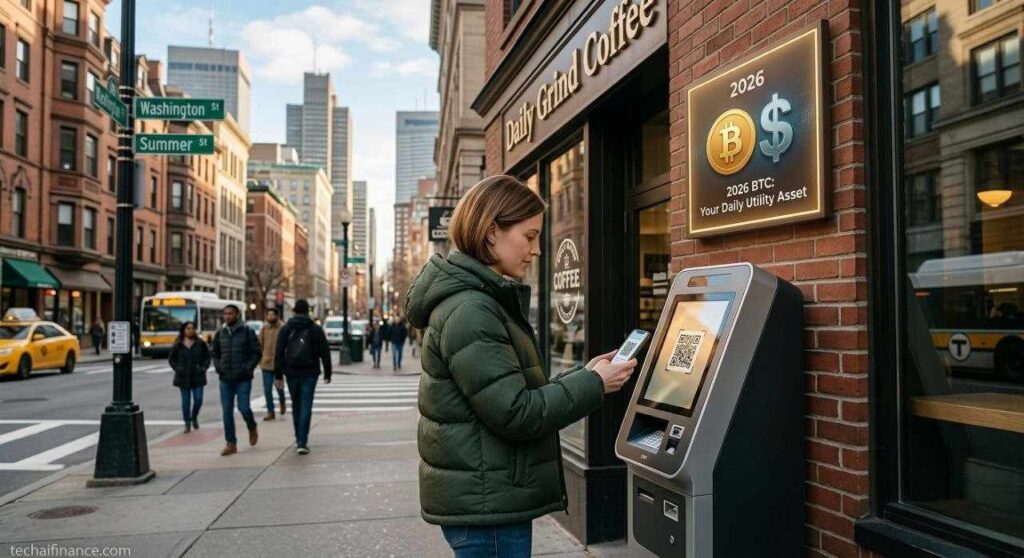
The most important decision you make in buying cryptocurrency is which platform you use to buy it. The United States has some of the most regulated cryptocurrency exchanges in the world, which means American buyers have access to legitimate, audited platforms that most countries do not offer. Using a regulated US exchange is not just convenient: it is the difference between buying cryptocurrency through a legitimate financial institution and sending money to a platform that can disappear overnight.
The three most trusted US cryptocurrency exchanges
Coinbase (coinbase.com)
Coinbase is the largest cryptocurrency exchange in the United States by trading volume and the first major crypto company to complete an IPO on a US stock exchange, which it did in April 2021. Being publicly traded means Coinbase is subject to SEC reporting requirements and financial auditing that private companies are not. Coinbase is registered with FinCEN as a Money Services Business and holds money transmission licenses in most US states. It is the most user-friendly exchange for beginners and covers the widest range of cryptocurrencies available to US buyers. Coinbase charges higher trading fees than some competitors, typically 0.5 to 1.5 percent per transaction depending on payment method and account level.
Kraken (kraken.com)
Kraken is one of the oldest cryptocurrency exchanges in the US, founded in 2011, and is well-regarded for its security track record and lower trading fees than Coinbase. Kraken charges 0.16 to 0.26 percent per trade for standard users, significantly below Coinbase’s standard rates. Kraken is particularly strong for Americans who want access to a wider range of cryptocurrencies beyond the most mainstream ones and for those who want to stake Ethereum and other proof-of-stake cryptocurrencies to earn yield. Kraken’s interface is slightly less beginner-friendly than Coinbase but its fee structure and security reputation make it worth the small additional learning curve.
Gemini (gemini.com)
Gemini was founded by Cameron and Tyler Winklevoss in 2014 and is notable for being one of the most regulatory-focused cryptocurrency exchanges in the US. Gemini was the first exchange to receive a BitLicense from the New York Department of Financial Services and maintains strong compliance practices across all US states where it operates. Gemini’s interface is clean and accessible for beginners. It charges slightly higher fees than Kraken on standard trades but offers a strong earn program and has maintained an excellent security record since its founding. Gemini is the exchange most often recommended for risk-conscious American buyers who prioritize regulatory compliance above all else.
| ⚠ Watch Out Platforms to avoid completely as an American cryptocurrency buyer: Any platform that does not require identity verification: legitimate exchanges are legally required to verify your identity under US anti-money-laundering laws. A platform that lets you buy cryptocurrency without submitting a government ID is not compliant with US law and carries significant counterparty risk. Any exchange promising unusually high guaranteed returns on your cryptocurrency: no legitimate exchange guarantees returns. Platforms promising 20, 30 or 50 percent annual yields on crypto deposits are almost always fraud. The collapse of FTX in November 2022 cost US investors billions and is the most prominent recent example of what happens when a large, seemingly legitimate crypto platform turns out to be fraudulent. Any platform pressuring you to act immediately: legitimate investment opportunities do not disappear in 24 hours. Urgency is the primary manipulation tactic used in cryptocurrency fraud. |
Step-by-step: buying your first cryptocurrency on a US exchange
- Choose your exchange: Coinbase for simplicity, Kraken for lower fees or Gemini for regulatory focus.
- Create your account: provide your email address, create a strong unique password and enable two-factor authentication immediately during account creation.
- Verify your identity: upload a government-issued ID such as your driver’s license or passport and provide your Social Security number. This is legally required for all US exchanges and typically takes a few minutes to a few hours for approval.
- Link your bank account or debit card: ACH bank transfers take one to three business days but have lower fees. Debit card purchases are instant but charge higher fees, typically 2 to 4 percent.
- Place your first order: start with a small amount you would be completely comfortable losing entirely. Decide in advance how much you are allocating to cryptocurrency and do not exceed it regardless of short-term price movements.
- Record the transaction immediately: note the date, the amount purchased, the price per coin and the platform fee. You will need this information for your taxes.
How to Store Your Cryptocurrency Securely
Owning cryptocurrency on an exchange means trusting that exchange to hold your assets safely. The exchange holds your private keys, which are the cryptographic passwords that prove ownership of your cryptocurrency, on your behalf. If the exchange is hacked, goes bankrupt or commits fraud, your cryptocurrency is at risk. The collapse of FTX in November 2022 resulted in over $8 billion in customer funds being misappropriated, demonstrating that this risk is real rather than theoretical.
Self-custody: moving cryptocurrency to your own wallet
Self-custody means transferring your cryptocurrency from an exchange to a wallet that only you control. When you hold cryptocurrency in your own wallet, only you have access to the private keys. No exchange, no company and no government can access or confiscate it without your cooperation. This is the most secure storage method but also the most demanding because losing your private keys or recovery phrase means losing access to your cryptocurrency permanently with no recourse.
Types of cryptocurrency wallets
Hardware wallets
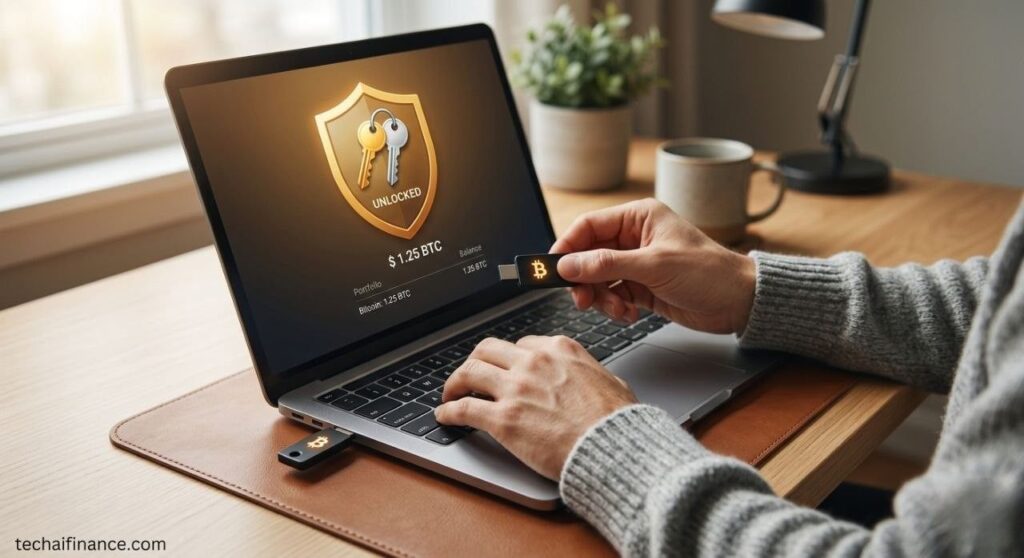
A hardware wallet is a physical device, similar in size to a USB drive, that stores your private keys offline. The most widely used hardware wallets in the US are the Ledger Nano X at ledger.com and the Trezor Model T at trezor.io, both priced between $70 and $200. Because the private keys are stored on the physical device and never transmitted to the internet, hardware wallets are resistant to hacking and malware. To access your cryptocurrency using a hardware wallet, you physically connect the device and confirm transactions on its screen. For Americans holding significant amounts of cryptocurrency, a hardware wallet is the recommended storage method.
Software wallets
A software wallet is an application installed on your computer or smartphone that stores your private keys locally. Examples include MetaMask at metamask.io for Ethereum and its ecosystem, and Exodus at exodus.com for multiple cryptocurrencies. Software wallets are more convenient than hardware wallets for regular transactions but are vulnerable to malware on your device. If a hacker compromises your computer and your software wallet is unprotected, they can steal your cryptocurrency. Software wallets are appropriate for small amounts used for regular transactions rather than long-term storage of significant holdings.
Exchange wallets
Leaving your cryptocurrency on the exchange where you bought it is technically storing it in the exchange’s custodial wallet. The exchange holds the private keys on your behalf. This is the most convenient option and appropriate for beginners who are still learning, for amounts small enough that the exchange risk is proportional to the convenience benefit, or for active traders who need quick access to their holdings. For Americans holding more than a few hundred dollars in cryptocurrency with a long-term holding intention, moving to self-custody is worth understanding.
The seed phrase: the most important thing to understand about crypto security
When you create a self-custody wallet, the software generates a seed phrase, also called a recovery phrase or mnemonic phrase. This is a sequence of 12 or 24 random English words that serves as the master key to your entire wallet. Anyone who has your seed phrase can access all of the cryptocurrency in your wallet from any device in the world. If you lose your seed phrase and your wallet device is damaged or lost, your cryptocurrency is permanently inaccessible.
| Seed phrase security rules that must never be broken: Write your seed phrase on paper, not digitally. Never store it in a text file, email, cloud storage, notes app or screenshot. Any digital storage is vulnerable to hacking. Store the written seed phrase in a physically secure location such as a fireproof safe or a bank safe deposit box. Water and fire damage are real risks for paper documents. Never share your seed phrase with anyone under any circumstances. No legitimate exchange, wallet company or customer support agent will ever ask for your seed phrase. Any request for your seed phrase is fraud. Consider storing a second copy of your seed phrase in a separate secure physical location in case the first copy is destroyed or inaccessible. |
Cryptocurrency Taxes in the US: What the IRS Requires
The single most important thing every American crypto buyer must understand before making their first purchase is the tax treatment. The IRS treats cryptocurrency as property, not as currency, for tax purposes. This classification has consequences that many Americans discover only when they receive a tax form or face an audit.
Every taxable event you must track
Selling cryptocurrency for dollars
When you sell cryptocurrency for US dollars, you realize a capital gain or loss equal to the difference between what you paid for it, called your cost basis, and what you sold it for. If you held the cryptocurrency for more than one year before selling, the gain is taxed at the lower long-term capital gains rate: 0 percent for taxpayers in the 10 to 12 percent income bracket, 15 percent for most Americans and 20 percent for high earners. If you held it for one year or less, the gain is taxed at your regular income tax rate, which can be significantly higher.
Trading one cryptocurrency for another
When you trade Bitcoin for Ethereum, you have not simply moved your money from one form to another in the IRS’s view. You have sold Bitcoin, which is a taxable event, and used the proceeds to purchase Ethereum. The taxable gain or loss is calculated at the moment of the trade based on the dollar value of Bitcoin at the time. This means every single crypto-to-crypto trade in your account history must be tracked and reported, regardless of whether you ever converted back to dollars.
Using cryptocurrency to buy goods or services
If you use Bitcoin to pay for a product or service, that transaction is a taxable event. You have effectively sold your Bitcoin at its current market value and used the proceeds to make the purchase. If your Bitcoin appreciated since you acquired it, you owe capital gains tax on the appreciation. This applies whether you are paying for a cup of coffee with crypto or making a major purchase.
Receiving cryptocurrency as income
If you receive cryptocurrency as payment for work, as mining rewards, as staking rewards or through an airdrop, the fair market value of the cryptocurrency at the time you received it is ordinary income subject to regular income tax. You then have a cost basis equal to that fair market value for calculating future capital gains when you eventually sell.
How to track your crypto taxes
Manual tracking of cryptocurrency transactions across multiple exchanges and wallets is extremely time-consuming and error-prone. Cryptocurrency-specific tax software automates most of this work by connecting to your exchange accounts and calculating your gains, losses and income automatically. The most widely used crypto tax platforms for Americans are Koinly at koinly.io, CoinTracker at cointracker.io and CoinLedger at coinledger.io. All three integrate with major US exchanges and generate IRS-compatible tax forms including Form 8949 and Schedule D.
The IRS has significantly increased its enforcement activity around cryptocurrency reporting in recent years. Major exchanges including Coinbase are required to report user transactions above certain thresholds to the IRS on Form 1099-DA starting with the 2025 tax year. Assuming that crypto transactions go unreported because they are digital or pseudonymous is a dangerous and legally incorrect assumption.
| ⭐ Key Takeaway The most important cryptocurrency tax rule for Americans: Every time you sell, trade or spend cryptocurrency, it is a taxable event. There is no exception for small amounts, for crypto-to-crypto trades or for purchases made with crypto. The best practice is to use a cryptocurrency tax software from the day you make your first purchase, before you have any transactions to track. Setting up your account when you have one transaction is dramatically easier than reconstructing years of transaction history later. Source: IRS Notice 2014-21, Revenue Ruling 2019-24 and IRS FAQ on virtual currency at irs.gov/businesses/small-businesses-self-employed/virtual-currencies. |
The Honest Risk Picture: What Real Crypto Losses Look Like
Cryptocurrency content tends toward extremes: enthusiasts share stories of extraordinary gains and skeptics warn that everything will go to zero. The more useful framing for an American considering cryptocurrency is an honest look at what losses actually look like in realistic scenarios.
Market volatility risk
Bitcoin has experienced six separate drawdowns of 50 percent or more from its peak price since 2011. Ethereum has experienced similar magnitude declines. A 50 percent price drop means that $10,000 invested becomes $5,000. A 70 percent drop means $10,000 becomes $3,000. A 90 percent drop means $10,000 becomes $1,000. All of these scenarios have occurred in cryptocurrency markets within the past decade. Anyone who cannot financially and psychologically tolerate a 70 to 90 percent decline in the value of their cryptocurrency allocation should either not invest in cryptocurrency or invest an amount small enough that a 90 percent loss would not materially affect their financial life.
Exchange failure risk
FTX was the second largest cryptocurrency exchange in the world by trading volume in mid-2022. By November 2022 it had collapsed, its founder Sam Bankman-Fried was facing criminal charges and approximately $8 billion in customer funds had been misappropriated. Customers who held cryptocurrency on FTX lost access to their funds during bankruptcy proceedings. This was not the first exchange failure: Mt. Gox, once the largest Bitcoin exchange in the world, collapsed in 2014 with 850,000 Bitcoin belonging to customers unaccounted for. Diversifying across multiple regulated exchanges or moving significant holdings to self-custody reduces but does not eliminate this risk.
Scam and fraud risk
The Federal Trade Commission reported that Americans lost more than $5.6 billion to cryptocurrency scams in 2023, making it the most common vehicle for fraud losses in the country. The most common scams targeting American crypto buyers are romance scams where fraudsters build online relationships before persuading victims to invest in fake crypto platforms, fake investment platforms promising guaranteed returns, phishing attacks that steal exchange login credentials and rug pulls where developers of new cryptocurrency projects disappear with investor funds after raising capital. The best protection against scams is a simple rule: any crypto investment that promises guaranteed returns or pressures you to act quickly is a scam.
Regulatory risk
The regulatory environment for cryptocurrency in the United States has become significantly more defined since 2023, with Bitcoin and Ethereum spot ETF approvals, SEC enforcement actions against several exchanges and increasing Congressional attention to comprehensive crypto legislation. However, regulatory risk remains real. A future administration could impose restrictions on cryptocurrency ownership, impose new tax reporting requirements or require exchanges to collect additional information. The direction of US cryptocurrency regulation in 2026 appears more accommodating than in previous years, but anyone holding significant cryptocurrency should monitor regulatory developments as a factor in their holding decisions.
| 💡 Real-World Example Consider two hypothetical Americans who both decided to invest $5,000 in Bitcoin during 2021. Marcus invested $5,000 in November 2021 when Bitcoin was at approximately $68,000. By November 2022, Bitcoin was at approximately $16,000, a 76 percent decline. His $5,000 investment was worth approximately $1,176. He needed that money for an unexpected car repair and sold at that point, realizing a loss of $3,824. Diana invested $5,000 in November 2022 when Bitcoin was at approximately $16,000. She invested money she had mentally committed to cryptocurrency as an experimental allocation and could genuinely afford to lose entirely. By December 2024, Bitcoin exceeded $100,000. Her $5,000 investment was worth approximately $31,250. She sold half, taking $15,625 off the table and letting the remaining $15,625 continue as a long-term speculative holding. Same asset. Same amount invested. Two-year difference in timing. Dramatically different outcomes. Neither Marcus nor Diana did anything wrong in choosing to invest in Bitcoin. The difference was that Marcus invested money he needed within a foreseeable timeframe while Diana invested money she genuinely did not need and could afford to hold through volatility. The lesson is not about timing the market, which is impossible to do reliably. It is about investing only what you can genuinely afford to lose and hold through any level of drawdown without being forced to sell. This example is illustrative. Cryptocurrency investments carry the real risk of total loss. These figures reflect actual Bitcoin price history but are not predictive of future performance. |
A Beginner Action Plan for Responsible US Crypto Ownership
If you have read this guide and decided you want to explore cryptocurrency, here is a specific action plan that prioritizes financial safety over excitement.
Step 1: Establish your financial foundation first
Do not buy cryptocurrency before you have an emergency fund covering three to six months of living expenses in a high yield savings account, no high-interest credit card debt and a funded retirement account. Cryptocurrency is a speculative asset appropriate for money beyond your financial foundation, not instead of it. If your financial foundation is not yet in place, building it is a higher priority than buying any speculative investment.
Step 2: Decide your maximum allocation before you start
Most financial professionals who discuss cryptocurrency as part of a diversified portfolio suggest limiting it to 1 to 5 percent of total investable assets for investors who want some exposure without concentration risk. A person with $50,000 in investments keeping cryptocurrency to 5 percent would allocate $2,500 maximum. Setting this limit before you buy prevents the common mistake of increasing your allocation during a price run because the excitement of gains makes larger positions feel justified.
Step 3: Choose the simplest entry point for your situation
If you already have a brokerage account at Fidelity, Schwab or a similar provider, the simplest entry point is purchasing a Bitcoin ETF such as FBTC or IBIT through your existing account. This gives you Bitcoin price exposure without creating a new account, learning cryptocurrency software or managing wallet security. If you want to own actual cryptocurrency in your own wallet, create a Coinbase account and follow the identity verification process before purchasing.
Step 4: Set up tax tracking immediately
Create a free account on Koinly or CoinTracker before or immediately after your first purchase. Connect your exchange account to the tax software. Record every transaction from day one. Do this before you have anything to track rather than retroactively reconstructing months of history at tax time.
Step 5: Commit to a holding period before you buy
Decide in advance whether you are buying Bitcoin as a long-term speculative holding of three years or more or as a short-term speculation of one year or less. Long-term holdings qualify for the lower capital gains tax rate. Short-term holdings are taxed at ordinary income rates. Making this decision before you buy aligns your strategy with your tax outcome and reduces the likelihood of selling during a drawdown out of panic rather than strategy.
Frequently Asked Questions
Is cryptocurrency legal in the United States?
Yes. Buying, selling, owning and trading cryptocurrency is fully legal for Americans. The regulatory environment has become significantly more defined since 2023 with Bitcoin and Ethereum ETF approvals, increasing SEC enforcement clarity and growing Congressional engagement with crypto legislation. Americans are required to report cryptocurrency gains and income on their federal tax returns under existing IRS guidance.
Should I buy Bitcoin or Ethereum as a first crypto investment?
If you are considering your first cryptocurrency investment, Bitcoin and Ethereum are the two with the longest track records, the largest market capitalizations and the most established regulatory treatment in the US. Bitcoin is simpler to understand: it is designed to be digital money with a fixed supply. Ethereum is more complex but has a broader ecosystem of applications. For most American beginners, starting with Bitcoin through a Bitcoin ETF in an existing brokerage account is the lowest-complexity entry point. Understanding what you own matters more than which specific asset you choose.
How much of my money should I put in cryptocurrency?
This depends entirely on your individual financial situation, your risk tolerance and your investment timeline. This guide cannot tell you the right allocation because it does not know your income, expenses, debts, savings or investment goals. What this guide can tell you is that cryptocurrency is a highly volatile speculative asset and any allocation should be money you can genuinely afford to lose completely without affecting your financial security. Most financial advisors who discuss crypto as part of a diversified portfolio suggest 1 to 5 percent of investable assets for investors who want exposure without concentration in a single volatile asset class.
What happens to my crypto if the exchange goes bankrupt?
If your cryptocurrency is held on an exchange that declares bankruptcy, your assets may be treated as unsecured claims in the bankruptcy proceeding rather than your personal property, depending on the exchange’s terms of service and the specific legal circumstances. FTX customers waited over a year to receive partial recovery of their funds through bankruptcy proceedings and many did not recover the full value of their holdings. Moving cryptocurrency you intend to hold long-term to a self-custody wallet eliminates exchange bankruptcy risk but introduces the responsibility of securing your own seed phrase.
Where can I learn more about cryptocurrency from reliable sources?
- IRS Virtual Currency FAQ: official IRS guidance on how cryptocurrency is taxed in the US. Opens in new tab.
- SEC Investor Education: Cryptocurrency: free SEC investor education resource covering crypto risks and fraud prevention. Opens in new tab.
- CFTC SmartCheck: free tool from the Commodity Futures Trading Commission to verify whether a crypto platform or investment opportunity is registered and legitimate. Opens in new tab.
- Coinbase Learn: free educational content from a regulated US exchange covering crypto basics, blockchain technology and specific cryptocurrencies. Opens in new tab.
| ⭐ Key Takeaway The most important thing to understand about cryptocurrency in 2026 is not which coin to buy. It is how to approach it responsibly. Invest only money you can genuinely afford to lose entirely. Establish your financial foundation first. Use only regulated US exchanges. Track every transaction for taxes from day one. Commit to a holding period before you buy. Never invest more because the price is going up. Cryptocurrency has made some Americans wealthy. It has also caused serious financial harm to Americans who invested money they could not afford to lose, chased prices during rallies or trusted platforms that turned out to be fraudulent. The difference between those outcomes is almost always the discipline of the investor, not the asset itself. |
Conclusion
Cryptocurrency is real, it is legal in the United States and it is now accessible through regulated platforms and standard brokerage accounts in ways that were not available three years ago. It is also genuinely risky, genuinely complex from a tax perspective and genuinely susceptible to fraud in ways that traditional financial assets are not.
This guide has given you a plain-language foundation for understanding what cryptocurrency is, how the major coins differ from each other, how to buy safely through legitimate US platforms, how to store your holdings securely, what the IRS requires from every American who participates and what the realistic risk picture looks like without the hype or the fear that dominates most crypto content.
For Americans who want to explore how cryptocurrency fits into a broader wealth-building strategy, our guide on how to build generational wealth in the US covers the role of speculative assets within a long-term financial plan. For those who prefer to start with the least volatile investment options, our guide on best high yield savings accounts in the US 2026 and our review of best stock trading apps for beginners in the US 2026 cover the less volatile foundations of a personal investment strategy.
| 📲 Share This Guide If this guide helped you understand cryptocurrency clearly for the first time, share it with someone who has been confused about what Bitcoin actually is. Share on WhatsApp, Facebook or by text message. Thank you for reading TechAIFinance.com. |
Read Next
Continue building your financial knowledge on TechAIFinance.com:
- Best Stock Trading Apps for Beginners in the US 2026
- How to Build Generational Wealth in the US
- How to Make Passive Income in the US 2026
- Best High Yield Savings Accounts in the US 2026
- How to Retire Early Using the FIRE Method in the US 2026
| ✍ About the Author Written by: TechAIFinance Editorial Team Edited and Fact-Checked by: Olayinka Adejugbe Olayinka Adejugbe is not a licensed financial advisor. The content on TechAIFinance.com is produced for educational purposes only and should not be treated as personalized financial advice. Olayinka is the founder and lead editor of TechAIFinance.com. He holds a Global Certification in Artificial Intelligence and Applied Innovation and an Award of Completion in Behavioral Counseling from the World Health Organization. With a strong working knowledge of personal finance and accounting principles, Olayinka oversees the editorial review of every article on this site to ensure accuracy, currency and practical usefulness. Every article on TechAIFinance.com is produced by our research team and reviewed by Olayinka before publication. We verify statistics against named authoritative sources and update content when circumstances change. Visit our About page to learn more about our editorial process. Use our Contact page to get in touch. |
Important Disclaimer
The content published on TechAIFinance.com is for educational and informational purposes only. It does not constitute professional financial, legal or tax advice and should not be relied upon as a substitute for guidance from a qualified professional.
Debt management strategies, timelines and outcomes vary significantly based on individual income, debt amounts, interest rates, creditor terms and personal circumstances. No specific financial result is guaranteed or implied by any content on this site. Always consult a qualified financial advisor, credit counselor or attorney before making significant financial decisions. Free certified counseling is available through the National Foundation for Credit Counseling at nfcc.org.