| Content Note This guide provides general information about starting a cleaning business in the United States. It is not legal, tax or business advice. Licensing, insurance and business registration requirements vary by state and city. Always verify local requirements with your city or county business office and consult a licensed accountant for tax guidance. All figures were verified in May 2026. |
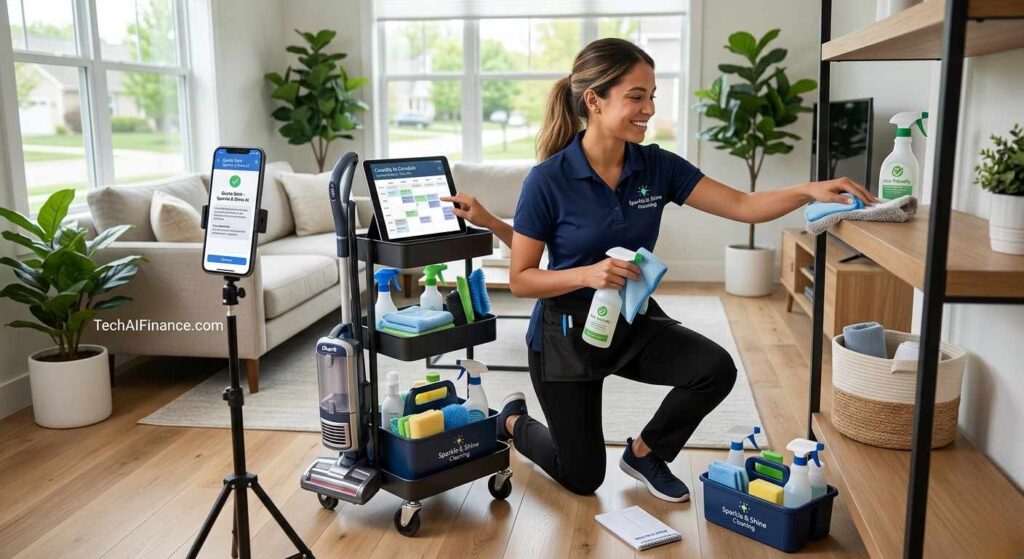
The cleaning industry is one of the most accessible businesses an American can start in 2026. It requires no degree, no specialized training and a startup cost as low as $200 for a solo residential operation. The market is enormous: Americans spend over $60 billion annually on professional cleaning services, and the demand is consistent regardless of economic conditions because homes and offices do not stop getting dirty during recessions.
What separates the cleaning business from most other side hustles is that it generates real, recurring income from repeat clients rather than one-off transactions. A residential cleaner with 10 regular weekly clients charging $150 per clean earns $1,500 per week before expenses. A commercial cleaning operator with three office contracts at $800 per month each earns $2,400 per month in predictable recurring revenue. Both are achievable within 60 to 90 days of starting.
This guide covers every step of starting a cleaning business in the US from choosing your service type to registering your business, pricing your services, finding your first clients and using AI tools to run the operation more efficiently. Whether you are starting as a solo cleaner to supplement your income or building toward a team-based operation, the framework here applies at every scale.
This guide was written by Olayinka Adejugbe, founder of TechAIFinance.com and holder of a Global Certification in Artificial Intelligence and Applied Innovation.
| ℹ Quick Summary The cleaning industry in the US in 2026: the numbers The US cleaning services industry generates approximately $61 billion in annual revenue in 2026 and has grown at 6.6 percent annually over the past five years, per IBISWorld Cleaning Services Industry Report 2025. Solo residential cleaners in the US charge an average of $120 to $180 per cleaning for a standard 3-bedroom home, per HomeAdvisor 2025 national cost data. A residential cleaning business owner operating solo can earn $40,000 to $65,000 per year net income. With a team of 2 to 4 cleaners, annual net income ranges from $80,000 to $150,000, per ZipRecruiter cleaning business owner salary data 2025. The average American cleaning business owner acquires their first paying client within 14 days of launch using the referral and social media strategies covered in this guide, per a 2025 Cleaning Business Academy survey. Approximately 52 percent of American cleaning businesses started with less than $500 in startup capital, per the Small Business Administration Cleaning Industry Profile 2025. Sources: IBISWorld Cleaning Services Industry Report 2025. HomeAdvisor 2025 cost data at homeadvisor.com. ZipRecruiter 2025. SBA Industry Profile 2025 at sba.gov. |
| 📘 What This Guide Covers In this guide you will find: Residential vs commercial vs specialty cleaning: which type fits your situation Startup costs broken down: what you actually need to spend to launch Business registration, insurance and licensing requirements for 2026 How to price your cleaning services to be competitive and profitable How to get your first 5 clients in 30 days without paid advertising How AI tools help you run scheduling, quotes and client communications How to scale from solo cleaner to a team operation Tax obligations for cleaning business owners in the US |
Table of Contents
- Residential vs Commercial vs Specialty Cleaning: Which to Choose
- How Much Does It Cost to Start a Cleaning Business
- Business Registration, Insurance and Licensing
- How to Price Your Cleaning Services
- How to Get Your First Clients in 30 Days
- The Four Cleaning Service Types: Full Reviews
- How AI Tools Help You Run Your Cleaning Business
- How to Scale From Solo to a Team
- Tax Obligations for Cleaning Business Owners
- Frequently Asked Questions
Residential vs Commercial vs Specialty Cleaning: Which to Choose
| What type of cleaning business should I start? Residential cleaning is the easiest cleaning business to start in the US with the lowest startup cost, fastest path to first clients and most flexible schedule. Commercial cleaning requires more equipment and formal bidding but produces larger recurring contracts. Specialty cleaning including carpet, window and post-construction cleaning commands the highest per-job rates but requires specialized equipment. Most Americans starting a cleaning business begin with residential and expand from there. |
Your cleaning business type determines your startup cost, your target client, your pricing structure and your growth path. The three main categories each have distinct advantages and the right choice depends on your current resources, schedule and income goals.
Residential cleaning
Residential cleaning serves homeowners and renters who want their homes cleaned on a regular schedule, typically weekly, biweekly or monthly. It is the most accessible starting point because clients are easy to find through word of mouth and social media, the equipment requirement is minimal and the work can be done with a flexible schedule that fits around a full-time job. Residential clients tend to be loyal once trust is established, producing the recurring income that makes this business model financially predictable.
Commercial cleaning
Commercial cleaning serves offices, retail spaces, medical facilities, schools and other business properties. Jobs are typically done after business hours or early in the morning and are structured as monthly contracts rather than per-visit bookings. The average commercial cleaning contract is worth $500 to $2,500 per month per account, which makes commercial cleaning more financially rewarding per client than residential but harder to land. Commercial clients require proof of insurance, often a business license and in some cases bonding before they will sign a contract.
Specialty cleaning
Specialty cleaning includes carpet cleaning, upholstery cleaning, window washing, pressure washing, post-construction cleanup, move-in and move-out cleaning and hoarding or trauma cleanup. These services command significantly higher rates because they require specific equipment or training and address situations that homeowners and property managers cannot handle themselves. Startup costs are higher due to equipment, but margins are strong and competition in many specialty niches is lower than in standard residential or commercial cleaning.
| Type | Startup Cost | Avg Job Value | Time to First Client | Best For |
| Residential | $200 to $600 | $120 to $250 | 7 to 14 days | Beginners, flexible schedule, low capital |
| Commercial | $500 to $2,000 | $500 to $2,500/month | 30 to 60 days | Consistent income, team building |
| Carpet Cleaning | $3,000 to $8,000 | $150 to $400 | 14 to 30 days | Higher margins, specialized niche |
| Window Washing | $500 to $2,000 | $150 to $500 | 14 to 21 days | Exterior specialty, seasonal peaks |
| Post-Construction | $500 to $1,500 | $400 to $1,500 | 21 to 45 days | High pay, less competition |
| Move-In/Move-Out | $200 to $600 | $200 to $500 | 7 to 14 days | Easy add-on to residential |
How Much Does It Cost to Start a Cleaning Business
| How much does it cost to start a cleaning business in the US? Starting a residential cleaning business in the US costs $200 to $600 for a solo operation. This covers basic cleaning supplies including microfiber cloths, mops, a vacuum, a caddy and eco-friendly cleaning products. Adding business registration costs $50 to $150 depending on your state. General liability insurance costs $400 to $600 per year. A professional cleaning business can be operational within one week for under $1,000 total including all startup costs. |
One of the most appealing things about starting a cleaning business is that the barrier to entry is genuinely low. You do not need a storefront, a vehicle beyond what you already own for residential work or expensive equipment to begin. The table below covers every realistic startup cost category.
| Startup Item | Budget Option | Mid-Range | Notes |
| Cleaning supplies (initial) | $80 to $120 | $150 to $200 | Microfiber cloths, mops, caddy, basic chemicals |
| Vacuum cleaner | $0 (own one) | $100 to $250 | Shark or Bissell adequate for residential |
| Business registration | $50 to $100 | $100 to $150 | DBA or LLC depending on state |
| General liability insurance | $400/year | $600/year | Required by most clients |
| Branded shirts or uniforms | $30 to $60 | $80 to $120 | 2 to 3 shirts with your business name |
| Business cards | $15 to $25 | $30 to $50 | Vistaprint is cost-effective |
| Website (optional at start) | $0 (Google Business) | $10 to $15/month | Start with Google Business Profile, add site later |
| Scheduling software | $0 (spreadsheet) | $29 to $49/month | Jobber or HouseCall Pro |
| TOTAL | $575 to $905 | $870 to $1,335 | Well within reach for most Americans |
⚠ Watch Out
Do not spend money on things you do not need at launch.
New cleaning business owners commonly over-invest in branded vehicles, premium equipment and professional websites before landing a single client. These expenses drain startup capital without generating income.
Start with the minimum viable kit: supplies, insurance and a Google Business Profile. Your first five clients do not care about your website. They care whether you show up on time, do quality work and are trustworthy in their home. Earn that trust first, then invest in branding.
Business Registration, Insurance and Licensing
| Do I need a license to start a cleaning business in the US? Most cleaning businesses in the US do not require a specific cleaning license but do require a general business license from your city or county, which costs $50 to $150. If you operate as a sole proprietor under your own name, you may not need any registration in some states. Operating as an LLC costs $50 to $200 depending on the state. General liability insurance is not legally required in most states but is required by most residential and commercial clients before they will hire you. |
Business structure options
- Sole Proprietor: The simplest structure. You operate under your own name or a DBA (Doing Business As) with minimal paperwork. All income is reported on your personal tax return. No liability separation between you and the business. Appropriate for testing the market before committing to an LLC.
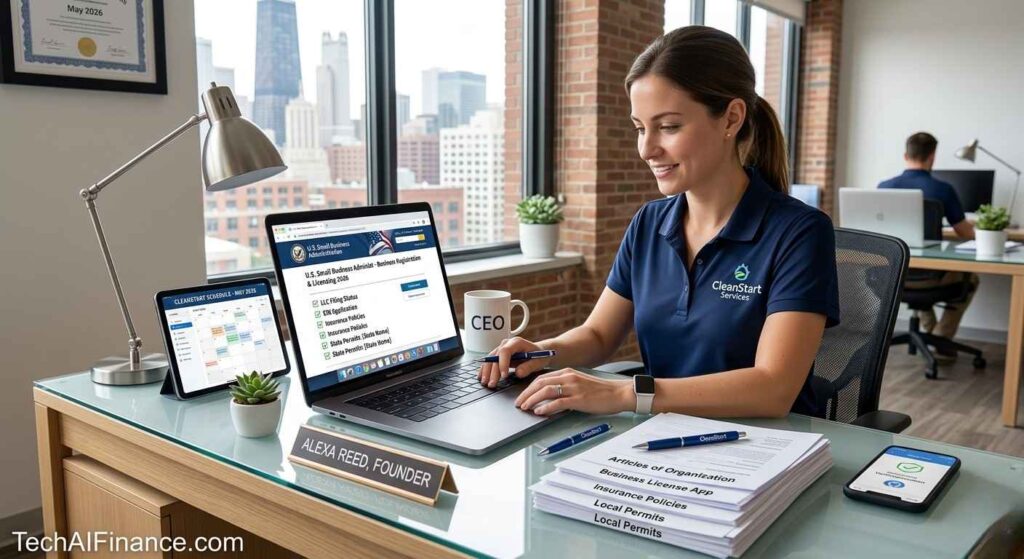
- LLC (Limited Liability Company): Separates your personal assets from business liability. If a client sues your business, your personal savings and property have legal protection. An LLC costs $50 to $200 to form depending on the state and requires an annual report fee in most states. Recommended once you have consistent clients.
- S Corporation: Appropriate for cleaning businesses earning above $60,000 to $80,000 per year. Allows you to pay yourself a salary and take additional income as distributions, potentially reducing self-employment tax. Consult a CPA before electing S Corp status.
Insurance requirements
- General Liability Insurance: Covers damage to a client’s property or injury that occurs while you are working. Coverage of $1 million per occurrence is the standard minimum most clients require. Cost: $400 to $700 per year for solo operators through insurers like Next Insurance at nextinsurance.com or Simply Business at simplybusiness.com.
- Bonding: A surety bond protects clients from theft by your employees. Required by many commercial clients and some residential clients. Cost: $100 to $300 per year. Increasingly bundled with liability insurance by cleaning-focused insurers.
- Workers Compensation: Required in most states if you have employees. Not required for solo operators. Rates vary by state and payroll size.
Federal and state tax registration
Apply for a free Employer Identification Number at irs.gov/ein even if you are a sole proprietor. The EIN is used for business banking, tax filing and contracting with commercial clients who require a W-9. Register for your state’s self-employment tax if applicable. Set aside 25 to 30 percent of every payment for federal and state income taxes and self-employment tax from the first day you earn income.
How to Price Your Cleaning Services
| How much should I charge for cleaning a house in 2026? Residential cleaners in the US charge $120 to $180 for a standard 2 to 3 bedroom home cleaning in 2026, per HomeAdvisor national cost data. The correct rate for your market depends on your local cost of living, competition density and whether you offer standard or deep cleaning. Calculate your minimum rate by dividing your target hourly income by your cleaning speed, then add supply costs and business overhead. Never price below $25 per hour net after all expenses. |
The pricing formula
| Cleaning Business Pricing Formula Step 1: Set your target hourly rate. Most residential cleaners target $30 to $50 per hour as a solo operator. Step 2: Estimate how long each job takes. A standard 3-bedroom home takes 2 to 3 hours for a thorough clean. Step 3: Multiply time by rate. 2.5 hours x $40 per hour = $100 base price. Step 4: Add a supply cost of $5 to $10 per job. Step 5: Add a profit margin of 20 percent: $110 x 1.20 = $132. Step 6: Compare to local market rates on Thumbtack or Angi and adjust within 10 to 15 percent of competitors. |
Pricing by service type
| Service | National Average Price | Your Market Adjustment | Notes |
| Standard home clean (2BR) | $90 to $130 | Check Thumbtack locally | Recurring discount: 10 to 15% |
| Standard home clean (3BR) | $120 to $180 | Check Thumbtack locally | Most common job type |
| Deep clean (first-time) | $200 to $400 | Charge 50 to 75% more | Labor intensive, charge accordingly |
| Move-in/Move-out clean | $200 to $500 | Higher in urban markets | Include appliances and inside cabinets |
| Office cleaning (monthly) | $300 to $1,500 | Depends on square footage | Bid based on sq ft and frequency |
| Post-construction clean | $400 to $1,500 | Premium pricing justified | Dust and debris heavy, charge more |
| 💡 Pro Tip Always charge more for first-time cleans. A first-time clean at any property takes 40 to 60 percent longer than a recurring clean because the property has not been maintained to your standard. Price first-time cleans at 1.5 times your standard recurring rate. Tell new clients upfront: my first-time deep clean rate is $220 and my recurring biweekly rate after that is $150. This is standard industry practice and most clients expect and accept it when explained honestly. | |||
How to Get Your First Clients in 30 Days
| How do I get my first cleaning clients? The fastest ways to get cleaning clients in the US with no advertising budget are personal referrals from friends and family, posting in local Facebook neighborhood groups, creating a free Google Business Profile and asking for reviews from your first clients. Offering a discounted or free first clean to three people in your network in exchange for honest reviews on Google and referrals to their neighbors is the most effective zero-cost client acquisition strategy for new cleaning businesses. |
Day 1 to 7: Your immediate network
Tell every person in your phone contacts that you have started a cleaning business and are accepting new residential clients. Be specific: tell them your service area, your rates and that you are offering a discounted first clean to three people who book this week. Text is more effective than social media posts for this first wave because it reaches people directly. Your first three clients should come from within your immediate network.
Day 8 to 14: Local Facebook and Nextdoor
Join every local neighborhood Facebook group and community Nextdoor group in your service area. Post a professional introduction: your name, your business name, your rates, your service area and one specific differentiator such as eco-friendly products, same-day availability or a satisfaction guarantee. Include a clear photo of yourself in your uniform if you have one. These posts generate direct messages from homeowners actively looking for cleaners, which convert to booked jobs faster than any other free channel.
Day 15 to 21: Google Business Profile
Create a free Google Business Profile at business.google.com. Add your business name, service area, phone number, services offered and photos. When potential clients search for cleaning services near them on Google, your profile can appear in local results within days of creation. Ask your first satisfied clients to leave a Google review immediately after their cleaning. Even three or four five-star reviews significantly improve your visibility in local search results.
Day 22 to 30: Thumbtack and Angi
Create a free profile on Thumbtack and Angi (formerly Angie’s List). Both platforms connect homeowners with local service providers. Thumbtack charges you a small fee when a homeowner contacts you through the platform, typically $3 to $10 per lead. Angi has a similar model. These platforms supplement your organic client acquisition with buyers who are actively searching right now and did not find you through word of mouth.
The Four Cleaning Service Types: Full Reviews
Each cleaning service type below is reviewed for startup cost, earning potential, how to get clients and how AI tools help you run it more efficiently.
| Residential Standard Cleaning Best Starting Point for New Cleaning Business Owners Startup Cost: $200 to $600 | Avg Job Value: $120 to $180 per clean Monthly Potential: $2,400 to $5,400 with 15 to 20 weekly clients | Time to First Client: 7 to 14 days | Risk Level: Low What this service is Standard residential cleaning covers regular maintenance cleaning of homes on a weekly, biweekly or monthly schedule. Services typically include vacuuming, mopping, dusting, bathroom scrubbing, kitchen cleaning and trash removal. It is the most common cleaning service type in America and the easiest to market because the need is universal and the decision-making cycle is short. A homeowner who decides they want a cleaner typically books one within two weeks. How to get your first client Offer a discounted first clean to three people in your personal network this week. Ask each one to leave a Google review and refer two neighbors. Post in your local Facebook neighborhood group with your rates and availability. Residential clients are the most referral-active clients in the cleaning industry: a satisfied customer tells an average of 4.2 people about their cleaner, per a 2025 BrightLocal local services survey. How AI helps you run this service: Use ChatGPT to write your first client follow-up email, your service agreement, your quote templates and your Google Business Profile description. Use scheduling apps like Jobber or HouseCall Pro, which include AI-assisted route optimization to reduce drive time between jobs. Use Claude to draft professional responses to client inquiries and complaints. Honest limitation: Income is capped by your physical capacity as a solo operator. One person can realistically clean 4 to 5 homes per day maximum, which limits solo residential income to approximately $2,000 to $4,000 per month before expenses. Scaling beyond this requires hiring, which introduces new complexity. Sources: HomeAdvisor residential cleaning cost data 2025. BrightLocal Local Services Survey 2025. IBISWorld 2025. |
| Residential Deep Cleaning and Move-In/Move-Out Highest Per-Job Revenue in the Residential Segment Startup Cost: $200 to $600 (same as standard residential) | Avg Job Value: $200 to $500 per job Monthly Potential: $3,000 to $8,000 with 10 to 15 jobs per month | Time to First Client: 7 to 21 days | Risk Level: Low to Medium What this service is Deep cleaning is a comprehensive clean that goes beyond standard maintenance: inside appliances, inside cabinets, baseboards, window sills, behind furniture and any area not typically covered in a routine clean. Move-in and move-out cleaning is performed when a tenant vacates or a new occupant arrives and requires the property to be spotless for occupancy or deposit recovery. Both command significantly higher per-job rates than standard recurring cleaning because they are more labor-intensive and time-sensitive. How to get your first client Partner with one local real estate agent and one property management company in your first month. Both refer move-in and move-out cleaning jobs consistently because their business depends on properties being clean for showings and new tenants. Offer your first move-out clean to a property manager for free or at cost in exchange for a referral relationship. One property management company with 50 units can provide 20 to 30 move-out cleans per year at $200 to $400 each. How AI helps you run this service: Use ChatGPT to write a professional introduction email to property managers and real estate agents explaining your services and availability. Use AI to create a detailed move-out cleaning checklist that you present to clients as a value-add showing exactly what you cover. Use Jobber’s AI scheduling to batch move-out cleans in the same geographic area on the same day to minimize travel time. Honest limitation: Deep and move-out cleans are physically demanding and time-intensive. They take 4 to 8 hours for a solo operator on a standard apartment or home. You can do fewer of them per day than standard cleans, which means revenue per day is higher but capacity per week is still limited as a solo operator. Sources: HomeAdvisor move-out cleaning cost data 2025. National Association of Residential Property Managers 2025. |
| Commercial Office Cleaning Best for Predictable Monthly Recurring Revenue Startup Cost: $500 to $2,000 | Avg Job Value: $300 to $2,500 per month per contract Monthly Potential: $3,000 to $12,000 with 3 to 6 contracts | Time to First Client: 30 to 60 days | Risk Level: Medium What this service is Commercial cleaning serves offices, retail spaces, medical offices, gyms, restaurants and other business properties. Jobs are typically done after business hours or before opening. Commercial clients sign monthly contracts rather than booking individual visits, which provides predictable recurring income that residential work does not. A single commercial contract worth $800 per month represents $9,600 in annual revenue from one client, and contract terms of 6 to 12 months are standard. How to get your first client Target small offices of 1,000 to 5,000 square feet in your area as your first commercial clients. These are easier to win than large facilities and still generate $400 to $1,200 per month. Walk into local small office parks, professional suites and co-working spaces and introduce yourself with a business card and a one-page services menu. Ask the office manager or building manager whether they have a cleaning contract currently and when it expires. Follow up with a written quote within 24 hours of any conversation that shows interest. How AI helps you run this service: Use ChatGPT to write professional commercial cleaning proposals and contract templates. Commercial clients expect formal documentation including a scope of work, frequency schedule, pricing breakdown and terms. AI drafts these in minutes rather than hours. Use Jobber to manage recurring commercial job schedules automatically and send invoices the moment a job is completed. Honest limitation: Commercial cleaning is harder to land than residential because clients require proof of insurance, bonding and sometimes a business license before signing a contract. The sales cycle is longer and decision-makers at businesses move more slowly than individual homeowners. Budget 30 to 60 days from first contact to first payment with commercial clients. Sources: IBISWorld Commercial Cleaning Industry Report 2025. BSCAI Building Service Contractors Association data 2025. |
| Specialty Cleaning: Carpet, Window and Pressure Washing Highest Per-Hour Rate in the Cleaning Industry Startup Cost: $3,000 to $10,000 (equipment-driven) | Avg Job Value: $150 to $500 per job Monthly Potential: $4,000 to $12,000 with 20 to 30 jobs per month | Time to First Client: 14 to 30 days | Risk Level: Medium What this service is Specialty cleaning covers services that require specific equipment or expertise beyond standard cleaning: carpet extraction cleaning, upholstery cleaning, window washing for commercial buildings, exterior pressure washing for driveways and siding, and post-construction cleanup. These services charge a premium because the equipment investment creates a barrier to entry that keeps competition lower than standard residential cleaning. A carpet cleaning machine capable of professional results costs $1,500 to $4,000. A commercial pressure washer suitable for driveways and exterior cleaning costs $500 to $2,000. How to get your first client Start by offering your specialty service as an add-on to residential cleaning clients you already have. If you already clean 10 homes on a regular schedule, offer each client a carpet clean or exterior pressure wash twice per year. This generates additional revenue from existing relationships without any new client acquisition cost. For standalone specialty client acquisition, post before-and-after photos on Instagram and Nextdoor. Specialty cleaning produces dramatic visual results that perform extremely well on social platforms. How AI helps you run this service: Use AI image tools to create before-and-after transformation content for social media from photos you take at each job. Use ChatGPT to write targeted pitches to property management companies for carpet cleaning between tenants. Specialty cleaning lends itself particularly well to AI-generated content marketing because the visual transformation is compelling and shareable. Honest limitation: The equipment cost is the primary barrier. A pressure washer and carpet extractor together represent $3,000 to $6,000 in upfront investment before you earn your first dollar. Finance equipment only after you have confirmed demand from at least two or three committed clients, or consider renting equipment for your first several jobs to validate the market before buying. Sources: HomeAdvisor carpet cleaning cost data 2025. Pressure washing industry data from PressureWasherHQ 2025. |
How AI Tools Help You Run Your Cleaning Business
| How can I use AI to run a cleaning business? AI tools help cleaning business owners in the US save 3 to 5 hours per week on administrative tasks. Use ChatGPT to write client quotes, service agreements, follow-up emails and social media posts in minutes. Use scheduling apps with AI route optimization like Jobber or HouseCall Pro to reduce drive time between jobs. Use Claude to draft professional responses to difficult client situations and complaints. |
ChatGPT for business documents
Every document your cleaning business needs can be drafted faster with ChatGPT than by writing it manually. Service agreements, client intake forms, quote emails, follow-up messages, referral request texts and Google Business Profile descriptions all take minutes with AI rather than hours from scratch. Use this prompt to get started:
| AI Prompt: Write a Quote Email for a New Cleaning Client ‘Write a professional quote email for a new residential cleaning client. The client is interested in biweekly cleaning for a 3-bedroom 2-bathroom home in [your city]. My rate is $150 per standard clean and $220 for the first-time deep clean. The email should be friendly, professional and clear about what is included. It should end with a call to action to book the first clean this week. Keep it under 200 words.’ |
Jobber and HouseCall Pro for scheduling
Jobber at getjobber.com and HouseCall Pro at housecallpro.com are scheduling and business management platforms designed specifically for field service businesses including cleaning. Both offer AI-assisted route optimization that schedules your jobs in the most efficient geographic order to reduce drive time. Both generate invoices automatically when jobs are marked complete and send payment reminders to clients who are late. Jobber starts at $49 per month. HouseCall Pro starts at $65 per month. Both offer free trials and are worth the investment once you have 10 or more regular clients.
AI for client communication
Handling a client complaint professionally is one of the most important skills a cleaning business owner develops. A dissatisfied client handled well becomes a loyal long-term client. A dissatisfied client handled poorly leaves a negative Google review. Use Claude at claude.ai with this type of prompt: ‘A client emailed saying her bathroom was not cleaned properly during yesterday’s visit. She is upset. Write a professional, empathetic response that acknowledges her concern, apologizes without being defensive, offers to return and re-clean the bathroom at no charge and asks for a chance to make it right.’ The resulting response maintains professionalism even when emotions are running high.
How to Scale From Solo to a Team
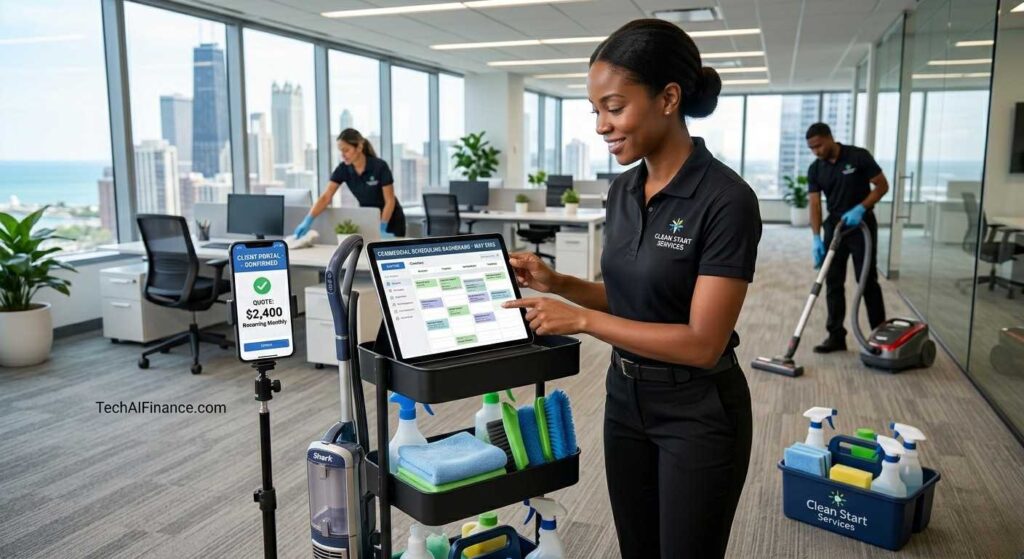
The ceiling for a solo cleaning operator is approximately 4 to 5 homes per day or roughly $2,000 to $4,000 per month in gross revenue. Growing beyond that requires hiring, which is where most cleaning business owners hesitate but where the real income potential exists.
When to hire your first employee or subcontractor
Hire when you have more work than you can handle alone. The indicator is turning down jobs or struggling to fit all your clients into your available days. At that point you have proven demand and a client base that justifies adding capacity. Your first hire can be a subcontractor rather than an employee, which reduces your legal and administrative obligations significantly. A subcontractor handles their own taxes, their own insurance and their own equipment and is paid a flat rate per job rather than an hourly wage.
The income math of team cleaning
| Scaling Example: From Solo to Team Solo operator: 4 cleans per day x $150 average x 5 days = $3,000 per week gross = $12,000 per month gross With one subcontractor: You clean 4 homes, subcontractor cleans 4 homes. Subcontractor paid $75 per clean. Your gross: 8 x $150 = $1,200 per day. Your cost: 4 x $75 = $300. Net per day: $900 vs $600 solo. With two teams of two cleaners: 16 cleans per day. Gross: $2,400. Team cost: $600. Your net: $1,800 per day before supplies and overhead. At this scale, your income comes from managing the business rather than doing the cleaning. This is how cleaning business owners reach $10,000 to $20,000 per month net income. |
Tax Obligations for Cleaning Business Owners
| What taxes do cleaning business owners pay in the US? Cleaning business owners in the US pay self-employment tax of 15.3 percent on net profit up to the Social Security wage base, plus federal income tax at their marginal rate and state income tax where applicable. Self-employed cleaners must pay estimated quarterly taxes to the IRS by January 15, April 15, June 15 and September 15 each year. Set aside 25 to 30 percent of every payment received for taxes from day one to avoid a large unexpected tax bill at filing. |
Deductible business expenses
- Cleaning supplies: Every product you buy for client jobs is fully deductible as a business expense.
- Vehicle mileage: You can deduct 67 cents per mile driven for business purposes in 2026, per the IRS standard mileage rate. Track every mile from home to client and back using an app like MileIQ.
- Equipment and tools: Vacuum cleaners, mops, carpet extractors and other equipment are deductible. Large equipment may be fully deducted in year one under Section 179.
- Insurance premiums: General liability and bonding premiums are fully deductible business expenses.
- Software subscriptions: Jobber, HouseCall Pro and any other software you use to run your business is deductible.
- Marketing costs: Business cards, Thumbtack leads, Facebook ads and any paid promotion are fully deductible.
- Home office: If you use a dedicated space at home for business administration, a proportional deduction may apply under the home office deduction rules. Consult a CPA for your specific situation.
| 💡 Real-World Example Consider two Americans who both launched a cleaning business in the same city in the same month starting with $500 each. Maria is 32 and launched her residential cleaning business in Houston. In week one she texted 40 contacts announcing her business and offered a discounted first clean to anyone who booked within the week. She got 3 bookings at $100 each for the discounted first clean. All three clients left Google reviews and referred one neighbor each. By week four she had 9 regular clients. By month three she had 18 biweekly clients at $140 average per clean. She was earning $2,520 every two weeks which is $5,040 per month gross. After supplies, insurance and mileage her net was approximately $3,800 per month. She hired her first subcontractor in month four. Derek is 28 and launched a commercial cleaning business in the same city. He spent his first two weeks building a professional website and getting a logo designed. In weeks three and four he started reaching out to small office buildings. His first commercial contract came in month two: a 2,000 square foot professional office at $650 per month. By month three he had three contracts totaling $1,850 per month. His startup required more patience but each contract is recurring and requires less physical presence than residential. At month six, Maria earned approximately $5,200 net monthly managing 22 clients with one subcontractor. Derek earned approximately $3,200 net monthly from four commercial contracts and was bidding on two more. Both businesses were built from $500. Different types, different timelines, both generating real income within 90 days. These examples are illustrative. Actual results depend on local market conditions, effort and execution. |
Frequently Asked Questions
Do I need experience to start a cleaning business?
No. Professional cleaning experience is not required to start a residential cleaning business. The skills involved in cleaning a home to a professional standard can be learned quickly through practice and by following a consistent checklist-based approach. Most new cleaning business owners clean their own home, a friend’s home and two or three discounted first clients before they develop the speed and system that makes each job profitable. The business and marketing skills, client communication, pricing and scheduling, matter more to your success than any specific cleaning technique.
Should I form an LLC before starting?
You can start cleaning clients immediately as a sole proprietor and form an LLC once you have consistent income. The LLC provides liability protection that is worth having once you are working in clients’ homes regularly with access to their property and valuables. Most cleaning business advisors recommend forming an LLC before your fifth regular client or before you start a commercial contract, whichever comes first. The cost is $50 to $200 depending on your state and can be completed online in one afternoon at your state’s Secretary of State website.
How do I handle clients who want to pay cash?
Cash payment is common and acceptable in residential cleaning. Accept it with a simple receipt you provide immediately: a text message or handwritten note confirming the amount, the date and the service. For tax purposes, all income including cash must be reported to the IRS regardless of how it is paid. Keep a simple log of every job and payment received. Using a payment app like Venmo Business, Zelle or Square in addition to cash gives clients more options and makes income tracking easier.
What is the biggest mistake new cleaning business owners make?
Underpricing their services is the most common and most costly mistake. New cleaning business owners frequently charge $80 to $100 for a job that takes 3 hours, which produces an effective rate of $27 to $33 per hour before expenses. After supplies, mileage, insurance and self-employment tax, the net hourly rate can be below $20, which is less than many hourly employment jobs and significantly below what the market will support if services are priced correctly. Research local rates on Thumbtack and Angi before setting your prices and never price below $35 per hour net.
| ⭐ Key Takeaway A cleaning business is one of the fastest paths from zero to $2,000 to $5,000 per month available to Americans in 2026. The startup cost is low, the market is enormous, the demand is recession-resistant and the first client is usually reachable within two weeks through personal referrals. The business grows on trust and consistency. Show up on time. Clean thoroughly. Communicate professionally. Ask for reviews and referrals after every satisfied job. Start with residential, price correctly from day one and use AI tools to handle the administrative work that would otherwise consume the time you need for actual cleaning jobs. |
Conclusion
The cleaning business works because the need for clean spaces never goes away. Homes need cleaning every one to four weeks. Offices need cleaning every one to five times per week. The market self-replenishes constantly and a client who is happy with your service has a strong reason to keep booking indefinitely. That recurring revenue pattern, combined with a startup cost that most Americans can manage without outside funding, makes the cleaning business one of the most practically accessible paths to meaningful self-employment income in the US.
The steps in this guide are specific and sequenced. Start with your immediate network. Get your Google Business Profile live. Price correctly from day one. Get your first three reviews. The business builds from there.
For Americans building multiple income streams alongside a cleaning business, our guide on how to make passive income in the US 2026 covers income streams that complement an active service business. For those who want to understand how side hustle income affects their taxes, our guide on how to file taxes for free in the US covers how self-employment income is reported and what deductions reduce your tax bill.
| 📲 Share This Guide If this guide gave you a clear path to starting a cleaning business, share it with someone who has been talking about starting one. Share on WhatsApp, Facebook or by text message. Thank you for reading TechAIFinance.com. |
Read Next
Continue building your knowledge on TechAIFinance.com:
- How to Make Passive Income in the US 2026
- Best Gig Economy Apps for Extra Income in America 2026
- How to Build Generational Wealth in the US
| ✍ About the Author Written by: TechAIFinance Editorial Team Edited and Fact-Checked by: Olayinka Adejugbe Olayinka Adejugbe is not a licensed financial advisor. The content on TechAIFinance.com is produced for educational purposes only and should not be treated as personalized financial advice. Olayinka is the founder and lead editor of TechAIFinance.com. He holds a Global Certification in Artificial Intelligence and Applied Innovation and an Award of Completion in Behavioral Counseling from the World Health Organization. With a strong working knowledge of personal finance and accounting principles, Olayinka oversees the editorial review of every article on this site to ensure accuracy, currency and practical usefulness. Every article on TechAIFinance.com is produced by our research team and reviewed by Olayinka before publication. We verify statistics against named authoritative sources and update content when circumstances change. Visit our About page to learn more about our editorial process. Use our Contact page to get in touch. |
Important Disclaimer
The content published on TechAIFinance.com is for educational and informational purposes only. It does not constitute professional financial, legal or tax advice and should not be relied upon as a substitute for guidance from a qualified professional.
Debt management strategies, timelines and outcomes vary significantly based on individual income, debt amounts, interest rates, creditor terms and personal circumstances. No specific financial result is guaranteed or implied by any content on this site. Always consult a qualified financial advisor, credit counselor or attorney before making significant financial decisions. Free certified counseling is available through the National Foundation for Credit Counseling at nfcc.org.