| Content Note This guide provides information about employee benefits available to American workers. It is not financial, tax or legal advice. Benefits offerings, eligibility rules and tax treatment vary by employer, plan design and individual circumstances. Always verify specific details with your employer’s HR department or benefits administrator. All tax figures and contribution limits reflect 2026 IRS rules verified in May 2026. |
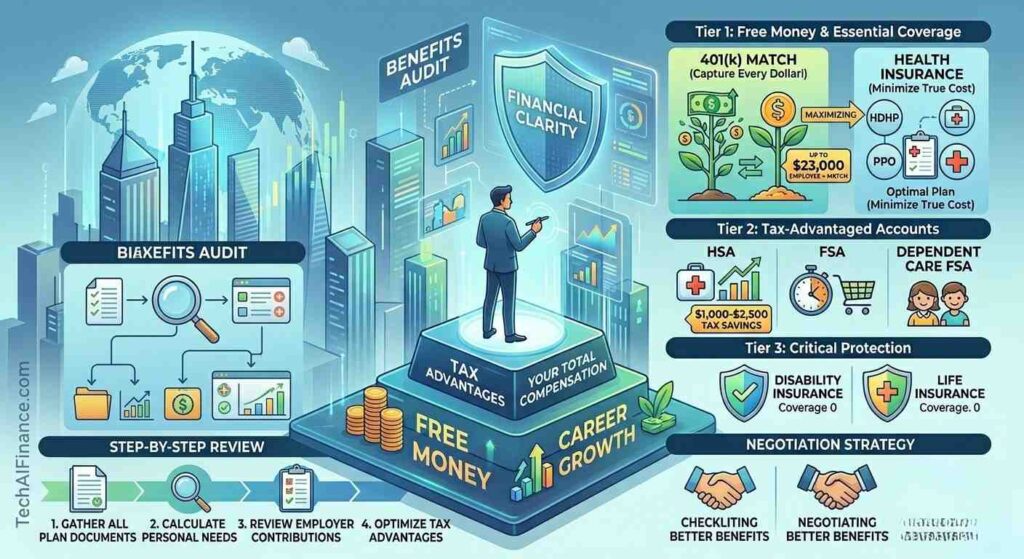
Most Americans think of their compensation as their salary. It is not. The total value of an American employee’s compensation package routinely exceeds the base salary by 25 to 40 percent once every employer-provided benefit is properly valued. The worker earning $75,000 in salary who receives a full benefits package is often receiving total compensation worth $95,000 to $105,000. The worker who does not understand, enroll in or use all available benefits is effectively choosing to take a pay cut every single year.
The challenge is that most employers present their benefits during a brief and overwhelming open enrollment window, hand employees a dense booklet or send them to a portal full of unfamiliar terminology and expect them to make optimal decisions about accounts, elections and coverage levels within a few days. Most employees do not make optimal decisions. They choose what they had last year, skip the benefits they do not immediately recognize and leave thousands of dollars in untapped value on the table every year.
This guide covers every major category of employee benefits available to American workers in 2026. For each benefit it explains what it is, exactly how to maximize it, the tax advantage it provides, the most common mistake employees make with it and the specific action to take this week. By the end of this guide you will know the exact dollar value of every benefit available to you and the precise steps to claim every dollar of it.
This guide was written by Olayinka Adejugbe, founder of TechAIFinance.com and holder of a Global Certification in Artificial Intelligence and Applied Innovation.
| ℹ Quick Summary Employee benefits in the US in 2026: the money most workers are missing The average employer in the US spends $13.84 per hour worked on employee benefits, representing 29.5 percent of total compensation costs, per the Bureau of Labor Statistics Employer Costs for Employee Compensation data, March 2025. Only 60 percent of eligible American employees maximize their 401k employer match, meaning 40 percent of eligible workers leave free matching contributions unclaimed every year, per the Vanguard How America Saves Report 2025. Americans forfeit approximately $6 billion annually in unused FSA funds, per the Employee Benefit Research Institute 2025. Only 22 percent of employees at companies offering Employee Stock Purchase Plans participate in them despite typical ESPPs offering an automatic 15 percent discount on company stock, per the National Association of Stock Plan Professionals 2025 survey. Americans with access to tuition reimbursement leave an average of $4,200 per year in unclaimed education benefits per eligible employee, per the Society for Human Resource Management 2025 Benefits Survey. Sources: BLS Employer Costs for Employee Compensation March 2025. Vanguard How America Saves Report 2025. EBRI 2025. NASPP 2025. SHRM Benefits Survey 2025. |
| 📘 What This Guide Covers In this guide you will find: The 401k employer match: how to capture every dollar of free money your employer offers Health insurance: choosing the right plan to minimize your true annual cost HSA and FSA: the pre-tax healthcare accounts that save $1,000 to $2,500 per year in taxes Disability insurance: the most undervalued and most financially critical benefit for working Americans Life insurance: when employer coverage is enough and when you need supplemental coverage Employee Stock Purchase Plans: the automatic discount most employees ignore Tuition reimbursement and education assistance: free career development most workers leave unclaimed Commuter and transit benefits: pre-tax savings on your daily commute Dependent Care FSA: tax savings on childcare expenses Wellness, EAP and supplemental benefits: the benefits nobody reads about in the enrollment packet How to calculate your true total compensation The open enrollment action plan: what to do before the deadline closes |
Table of Contents
- How to Calculate Your True Total Compensation
- Tier 1: The Benefits Worth the Most Money
- Tier 2: The Tax-Advantaged Accounts
- Tier 3: Insurance Benefits You Must Evaluate Carefully
- Tier 4: Benefits Most Employees Never Fully Use
- The Employee Benefits Audit: A Step-by-Step Process
- How to Negotiate Benefits When Accepting a Job Offer
- Frequently Asked Questions
How to Calculate Your True Total Compensation
Before optimizing individual benefits, you need to know what your complete compensation package is actually worth in dollars. Most Americans can name their salary immediately but cannot estimate the dollar value of their total package within $10,000. This gap represents the benefits they are not tracking and therefore not maximizing.
The total compensation formula
Total compensation equals base salary plus every benefit with a quantifiable dollar value. The calculation covers: annual base salary, employer 401k match in dollars, employer health insurance premium contribution, employer-paid life insurance, employer-paid disability insurance, paid time off in dollar value, employer HSA contributions where applicable, tuition reimbursement used or available, ESPP discount value, wellness reimbursements, commuter benefit contributions and any other employer-paid perks.
| Sample Total Compensation Calculation for a $75,000 Salary Base Salary: $75,000 Employer 401k Match (4% of salary): $3,000 Employer Health Insurance Contribution: $7,200 (average employer share per KFF 2025) Employer-Paid Life Insurance (1x salary): $300 estimated annual premium value Employer-Paid Long-Term Disability Insurance: $750 estimated annual premium value 15 Days Paid Time Off: $4,327 (15/260 working days x $75,000) Employer HSA Contribution: $600 Tuition Reimbursement (if used): Up to $5,250 tax-free per year Total Compensation Value: $91,177 to $96,427 depending on tuition benefit use This employee earns $16,177 to $21,427 more than their salary suggests. Sources: KFF Employer Health Benefits Survey 2025. BLS average benefit costs 2025. |
Tier 1: The Benefits Worth the Most Money
These four benefits represent the largest dollar-value items in most American employees’ compensation packages. Not maximizing any one of them is the equivalent of voluntarily reducing your compensation by thousands of dollars per year.
| 401k Employer Match The Highest Guaranteed Return Available to Any American Investor Estimated Annual Value: $1,500 to $7,500 per year depending on salary and match rate | Category: Retirement What this benefit is The 401k employer match is the most financially valuable employee benefit available to most Americans and simultaneously the most consistently underutilized. When your employer offers a match, they agree to contribute a set amount to your 401k based on what you contribute from your own paycheck. A common match structure is 50 percent of your contribution up to 6 percent of your salary, meaning the employer contributes an amount equal to 3 percent of your salary when you contribute 6 percent. This match is 100 percent free compensation: you receive it only by contributing enough to trigger it and you receive nothing by contributing less than the match threshold. How to maximize it Contribute at minimum up to the match threshold in every single pay period without exception. If your employer matches 100 percent of contributions up to 4 percent of salary, you must contribute at least 4 percent to capture the full match. If your employer matches 50 percent of contributions up to 8 percent of salary, you must contribute 8 percent to receive the full 4 percent employer match. Log into your 401k portal today and verify your current contribution percentage against your plan’s match formula. If you are contributing below the match threshold, increase immediately. This is not optional: leaving any portion of the match uncaptured is leaving free money on the table. The tax angle: Your 401k contributions are made with pre-tax dollars, reducing your taxable income for the year by the full contribution amount. A worker in the 22 percent federal bracket contributing $6,000 per year saves $1,320 in federal income tax on that contribution alone. The employer match is also not taxed when received, only when distributed in retirement. Combined pre-tax savings on contributions plus tax-deferred growth on both contributions and the match make the 401k the most tax-efficient retirement savings vehicle available to most American employees. The mistake most employees make: Contributing just enough to get the match but stopping there without considering whether increasing contributions beyond the match threshold would be financially beneficial. For workers who can afford it, the 2026 401k contribution limit is $24,500, per IRS Notice 2025-67, and every dollar contributed beyond the match threshold still saves federal income tax at your marginal rate while growing tax-deferred until retirement. Your action this week: Log into your 401k portal this week. Find your plan’s match formula on the plan summary document. Calculate the percentage you must contribute to capture 100 percent of the match. If your current contribution is below that number, increase it immediately. |
| Employer Health Insurance Contribution Largest Single Non-Salary Compensation Item for Most American Workers Estimated Annual Value: $7,200 to $22,000 per year depending on coverage level | Category: Health Coverage What this benefit is Your employer’s contribution to your health insurance premium is one of the most valuable items in your compensation package and one of the most invisible. When your employer offers group health insurance, they typically pay 70 to 85 percent of the total premium for individual coverage and a lower percentage for family coverage, with the employee paying the remainder through payroll deductions. The employer’s share is not visible in your paycheck but represents thousands of dollars per year in compensation that you would need to fund entirely yourself if you were self-employed or if your employer did not offer insurance. Per the Kaiser Family Foundation Employer Health Benefits Survey 2025, the average employer contributes $7,511 per year toward individual coverage premiums and $14,985 toward family coverage premiums. How to maximize it The health plan optimization covered in full detail in our guide on how to choose the right health insurance plan during open enrollment is the mechanism for maximizing this benefit. The key principle: do not automatically accept the plan your HR department marks as the default or the plan you had last year. During every open enrollment, calculate the true annual cost of every available plan option by adding the annual premium to your expected out-of-pocket costs. The plan with the lowest true annual cost, not the lowest premium, is the right choice. For many healthy employees with HDHP access, switching from a PPO to an HDHP with an HSA reduces both the premium and the out-of-pocket maximum while opening the HSA’s triple tax advantage. The tax angle: Health insurance premiums paid through payroll deduction are made with pre-tax dollars under a Section 125 cafeteria plan in most employer benefits systems, reducing your taxable wages by the employee premium contribution amount and saving both federal income tax and FICA taxes of 7.65 percent on the employee’s share of the premium. The mistake most employees make: Choosing the highest-premium plan without evaluating whether the lower out-of-pocket costs justify the additional premium cost. Many employees choose a Gold or Platinum PPO every year without running the true annual cost comparison, and consistently pay $1,500 to $3,000 more in total annual healthcare costs than they would under an HDHP with an HSA. Your action this week: Pull up your employer’s health plan comparison tool and list every plan’s monthly premium, deductible, out-of-pocket maximum and whether it qualifies as an HDHP. If an HDHP option is available, calculate the true annual cost comparison using your actual healthcare use from the past 12 months. |
| Paid Time Off and Vacation Benefits Most Frequently Forfeited High-Value Benefit in American Workplaces Estimated Annual Value: $2,900 to $8,700 per year depending on salary and accrual rate | Category: Time Off What this benefit is Paid time off represents compensation that has already been earned but must be actively used to be received. A worker earning $80,000 per year with 15 days of PTO has accrued $4,615 in earned compensation through that PTO balance. If they do not use those days before they expire or before they leave the company in states that do not require PTO payout, that $4,615 of earned compensation disappears. American workers forfeit an estimated 768 million vacation days per year, per the US Travel Association 2025 Vacation Report, representing approximately $65 billion in forfeited compensation annually. How to maximize it Track your PTO balance and accrual schedule from the first day of every calendar year. Know your employer’s policy on carryover, caps and payout at separation. If your employer has a use-it-or-lose-it policy with no carryover, block vacation days on your calendar at the beginning of the year before your schedule fills with other commitments. If your employer offers unlimited PTO, research the company’s actual average PTO usage among employees in your role: unlimited PTO policies frequently result in employees taking less time off than those with accrual-based policies because the social norm around taking unlimited leave is less clear. If your employer allows PTO payout at separation, track your balance as a financial asset that grows your effective compensation at your daily rate. The tax angle: In states where PTO is classified as earned wages, your accrued PTO balance is a legal financial asset. California, Colorado and several other states require employers to pay out all accrued PTO at separation regardless of company policy, which means uncapped PTO accrual in these states represents a growing financial account. Even in states without mandatory payout, PTO is compensation you have already earned and forfeiting it through non-use is the same as returning a portion of your paycheck to your employer. The mistake most employees make: Treating PTO as a luxury rather than as earned compensation. The American cultural pattern of taking less time off than available is financially irrational: you are declining compensation you have already earned and that your employer has already budgeted for your role. Taking all your PTO does not reduce your salary. It claims compensation that has already been allocated to you. Your action this week: Open your HR portal and check your current PTO balance and your employer’s carryover policy. If you have unused days that will expire before year end, block those dates on your calendar now before they are consumed by meeting requests and project deadlines. |
| Employee Stock Purchase Plan (ESPP) Automatic Discount on Company Stock Most Employees Never Claim Estimated Annual Value: $2,000 to $8,500 per year in automatic discount value | Category: Equity Compensation What this benefit is An Employee Stock Purchase Plan allows employees to purchase company stock at a discount, typically 10 to 15 percent below market price, through regular payroll deductions. The most generous ESPP structures use a lookback provision, meaning the discount applies to either the stock price at the beginning of the offering period or the price at the end, whichever is lower. This lookback combined with the 15 percent discount creates a situation where participating employees automatically profit regardless of which direction the stock moves during the offering period. If you can buy stock at 85 percent of its value and immediately sell at market price, you capture a guaranteed 17.6 percent return on every dollar contributed, which is the best guaranteed return available to any investor without leverage. How to maximize it Contribute the maximum allowed under your plan, typically 10 to 15 percent of your salary up to $25,000 per year per IRS limits. Set a policy of selling shares immediately after each purchase period ends unless you have a specific investment reason to hold company stock beyond what diversification principles would justify. Concentrating a significant portion of your wealth in company stock creates correlation risk: if your employer faces financial difficulties, you could simultaneously lose your job and see your investment portfolio decline. The ESPP discount is a compensation benefit, not a signal to hold the stock long-term. The tax angle: ESPP shares sold within two years of the offering date or within one year of the purchase date are classified as disqualifying dispositions and the discount amount is taxed as ordinary income in the year of sale. Shares sold after both holding periods are met produce qualifying dispositions where only the discount amount at purchase is ordinary income and additional appreciation is taxed at the lower long-term capital gains rate. For most employees who sell immediately after purchase, the discount is ordinary income taxed at their marginal rate. Even after paying tax at the 22 percent rate, an immediate sale after a 15 percent discount nets approximately 11 to 12 percent guaranteed after-tax return per offering period. The mistake most employees make: Not participating because the enrollment form seems complex or the immediate tax on the discount feels like a penalty. The after-tax return on ESPP participation with immediate sale consistently exceeds what any comparable investment produces with equivalent certainty. The only scenario where ESPP participation is genuinely suboptimal is when your cash flow is so constrained that the payroll deductions create financial hardship. Your action this week: Check your company’s HR portal or your offer letter for ESPP plan details. If your company offers an ESPP and you are not enrolled, enroll immediately during the next available enrollment window. Calculate the dollar value of participating at the maximum contribution level at your current salary. |
Tier 2: The Tax-Advantaged Accounts
These accounts convert pre-tax dollars into healthcare and dependent care spending, saving the typical American worker $1,000 to $4,000 per year in taxes that would otherwise be paid on those same expenditures. The accounts are covered in full detail in companion guides on this site, so this section focuses on the action steps and common maximization mistakes.
Health Savings Account and Flexible Spending Account
The HSA and FSA are covered in comprehensive detail in our HSA vs FSA guide. The maximization priority here is straightforward: if you are enrolled in an HDHP and eligible for an HSA, contribute the maximum $4,400 for individual coverage or $8,750 for family coverage in 2026, per IRS Revenue Procedure 2025-19. If you are not eligible for an HSA, contribute to a Health Care FSA an amount equal to your realistic predicted annual medical expenses. Either account saves you federal income tax plus FICA taxes of 7.65 percent on contributions, producing combined tax savings of $1,305 to $1,840 for a maximum individual HSA contribution at common tax brackets.HSA vs FSA guide
Dependent Care FSA
If you have children under 13 in paid childcare or preschool, or if you pay for qualifying adult dependent care, the Dependent Care FSA saves federal income tax and FICA taxes on up to $5,000 per household per year in childcare expenses. A family in the 22 percent bracket maximizing the $5,000 DC-FSA saves approximately $1,483 in combined federal and FICA taxes. This is entirely separate from the Health Care FSA and can be used simultaneously with either an HSA or a Health Care FSA.
Commuter and Transit Benefits
Under IRS Section 132, employees can set aside pre-tax dollars through payroll deduction for transit and parking expenses. The 2026 limit is $315 per month for transit passes and vanpool expenses and $315 per month for qualified parking, for a combined maximum of $630 per month or $7,560 per year. An employee commuting by subway or bus in a major US city who uses the full transit benefit of $315 per month saves approximately $1,121 per year in combined federal income tax and FICA taxes at the 22 percent bracket. If your employer offers commuter benefits and you commute regularly, this is one of the simplest and most overlooked tax savings available to American workers.
| ⚠ Watch Out The most expensive benefits mistake American workers make: Not reading the full benefits enrollment guide and assuming that selecting health insurance is the only decision that matters during open enrollment. Open enrollment is the one window per year where you make decisions that determine your tax liability, your retirement savings rate, your disability protection, your life insurance coverage and your access to pre-tax spending accounts for the entire coming year. Spending 20 minutes on enrollment decisions that govern 12 months of financial outcomes is one of the most disproportionately underinvested activities in most Americans’ financial lives. Block two hours this open enrollment season. Read every benefit your employer offers. Calculate the dollar value of each one. Make active decisions on every item rather than accepting defaults. |

Tier 3: Insurance Benefits You Must Evaluate Carefully
Insurance benefits protect against financial catastrophe. Most employees select them once and never revisit them, which means their coverage may be misaligned with their current life situation. These three insurance benefits deserve an annual review.
| Disability Insurance (Short-Term and Long-Term) The Most Undervalued Insurance Benefit for Working Americans Estimated Annual Value: $2,000 to $8,000 per year in premium value paid by employer | Category: Income Protection What this benefit is Disability insurance replaces a portion of your income if you are unable to work due to illness or injury. It is statistically more likely to be used than life insurance during a working career: the Social Security Administration estimates that a 20-year-old American has a 25 percent chance of becoming disabled before reaching retirement age. Yet most employees treat disability insurance as an afterthought during enrollment, accepting the default coverage without evaluating whether it is adequate for their situation. Short-term disability typically covers 60 to 80 percent of your income for three to six months following a qualifying disability with a brief elimination period. Long-term disability takes over after short-term coverage ends and typically covers 60 percent of income for a defined period, often until age 65 if you remain disabled. How to maximize it During open enrollment, verify that your employer provides long-term disability coverage and understand its terms: the benefit percentage, the definition of disability used by the policy, the elimination period before benefits begin and the benefit period. If your employer provides only a basic group LTD policy at 60 percent of base salary, evaluate whether your current expenses could be covered by 60 percent of your income for an extended period. Most financial planners recommend coverage of at least 60 to 70 percent of gross income. If your employer’s group coverage falls short, supplemental disability insurance purchased individually provides the additional protection. The key is making this evaluation deliberately rather than accepting whatever default coverage your employer selects for you. The tax angle: Employer-paid disability insurance premiums are not taxable to the employee. However, when an employer pays the premiums, disability benefits received are taxable as ordinary income to the employee. If you pay your own LTD premiums with after-tax dollars, the benefits are tax-free when received. Some employers allow employees to pay LTD premiums with post-tax dollars specifically to make any future benefits tax-free, which is worth evaluating if your plan offers this option. The mistake most employees make: Not reading the disability policy’s definition of disability before a claim becomes relevant. Policies use either an own-occupation definition, which pays if you cannot perform the specific duties of your current job, or an any-occupation definition, which pays only if you cannot perform any work at all. Own-occupation coverage is broader and more protective for professionals with specialized skills. Your action this week: Pull up your employer’s benefits summary and locate the long-term disability insurance section. Note the benefit percentage, the elimination period and the definition of disability. Calculate whether 60 percent of your current gross salary would cover your essential monthly expenses. If it would not, research supplemental disability coverage. |
| Life Insurance Employer Group Coverage as a Starting Point, Not a Complete Solution Estimated Annual Value: $300 to $900 per year in employer-paid premium value | Category: Life and Death Benefit What this benefit is Employer-provided group life insurance typically offers coverage equal to one to three times the employee’s annual salary at no cost to the employee. This basic coverage is a genuine financial benefit but is rarely sufficient as a complete life insurance strategy for employees with dependents. A worker earning $80,000 with employer-provided life insurance at two times salary receives $160,000 in coverage. For an employee with a spouse, children and a mortgage, $160,000 in life insurance typically covers one to three years of income replacement rather than the eight to ten years that most financial planners recommend for families with dependents. Most employers allow employees to purchase supplemental group life insurance at group rates during open enrollment, which provides additional coverage at lower premiums than individual policies. How to maximize it Accept the full employer-provided basic life insurance as a no-cost foundation. During open enrollment, evaluate whether supplemental group life insurance at your employer’s group rates is cost-effective relative to individual term life insurance for additional coverage. Group life insurance rates are favorable for older employees or those with health conditions that would increase individual policy premiums. For younger, healthy employees, individual term life insurance often provides better rates per thousand dollars of coverage than group supplemental policies. The enrollment window for group supplemental life insurance without medical underwriting is typically limited to new hire enrollment and open enrollment periods, making it important to evaluate this benefit when the window is available. The tax angle: Employer-paid basic group life insurance of up to $50,000 is excluded from your taxable income. The IRS-calculated cost of employer-paid life insurance above $50,000 is added to your taxable wages using the IRS Table I rates, which are very low for younger employees but increase with age. Premiums you pay for supplemental group life insurance are paid with after-tax dollars, and the death benefit is generally income tax-free to beneficiaries. The mistake most employees make: Not naming or updating beneficiaries on employer-provided life insurance policies. An outdated beneficiary designation, such as an ex-spouse or a deceased parent listed as beneficiary, overrides your will and directs the death benefit to the wrong person. Check your life insurance beneficiary designations annually, especially after major life events including marriage, divorce, birth of children or death of a previously named beneficiary. Your action this week: Log into your HR portal and check your life insurance beneficiary designation. Confirm the named beneficiaries are current and reflect your current family situation. While you are there, note your current coverage amount and compare it to your actual income replacement needs. |
Tier 4: Benefits Most Employees Never Fully Use
These benefits represent money and career investment sitting unclaimed in most employees’ benefits packages. They require active engagement rather than automatic enrollment, which is why most employees either do not know about them or do not take the steps to use them.
| Tuition Reimbursement and Education Assistance Up to $5,250 Per Year in Tax-Free Career Development Funding Estimated Annual Value: Up to $5,250 per year tax-free under IRS Section 127 | Category: Career Development What this benefit is Employer-provided educational assistance is one of the most financially valuable and most overlooked benefits in American workplaces. Under IRS Section 127, employers can provide up to $5,250 per year in educational assistance to employees on a tax-free basis, meaning neither the employer nor the employee pays tax on the benefit up to this limit. Eligible expenses include tuition, books, fees and supplies for courses at accredited colleges, universities and vocational schools. The courses do not need to be job-related for the Section 127 exclusion to apply, though many employers limit reimbursement to job-related programs as a policy matter. An employee who uses this benefit to complete a degree or professional certification receives the equivalent of a $5,250 tax-free raise for every year of participation, plus the long-term income premium that typically accompanies additional credentials. How to maximize it During open enrollment or in your first weeks at a new employer, read your company’s tuition reimbursement policy completely. Key details to understand: the maximum annual benefit amount, whether the employer requires courses to be job-related, the grade requirement for reimbursement, whether reimbursement requires employment for a minimum period after completion and whether the benefit requires upfront payment or advance approval. Many employers require employees to submit a reimbursement request for each term or course rather than reimbursing automatically, which means the process is opt-in and administratively requires action from you. If your employer offers tuition assistance and you have any interest in completing a degree, certification or professional development program, begin the application process immediately. The tax angle: The IRS Section 127 exclusion makes the first $5,250 of employer-provided educational assistance tax-free to the employee. Reimbursements above $5,250 per year are taxable as ordinary income unless the education qualifies as a working condition fringe benefit, meaning it maintains or improves job-required skills. For most employees using this benefit for undergraduate or graduate degrees, the $5,250 annual exclusion is the relevant limit. The mistake most employees make: Not pursuing the benefit because of the paperwork involved or because they intend to use it in the future but never get started. The tuition reimbursement benefit is use-it-or-lose-it in the same sense as PTO: the year you do not use it is a year of compensation you forfeited. If you have any educational interest at all, identify one course or certification program this week and research whether it qualifies under your employer’s policy. Your action this week: Read your employer’s tuition reimbursement policy today. If you are unsure where to find it, ask your HR department or search your company intranet. Identify one certificate, course or degree program relevant to your career and inquire about eligibility before the next enrollment cycle. |
| Employee Assistance Program (EAP) Free Confidential Professional Services Most Employees Never Access Estimated Annual Value: $600 to $1,500 per year in professional service value | Category: Mental Health and Personal Services What this benefit is The Employee Assistance Program is an employer-provided benefit that offers free, confidential counseling, referral services and support for employees facing personal or professional challenges. EAP services typically include a set number of free therapy or counseling sessions per year, legal consultation services, financial counseling, work-life balance resources, substance abuse support and crisis intervention services. These services are provided by third-party vendors contracted by the employer and are completely confidential: your employer does not receive information about your use of EAP services and accessing these benefits has no effect on your employment. The average EAP provides five to eight free sessions of therapy or counseling per year, which at market rates of $150 to $250 per session represents $750 to $2,000 in services available to you at no cost. How to maximize it Access your EAP through the contact information in your benefits portal or on the back of your insurance card. Most EAPs have a 24-hour phone line for immediate support and an online portal for scheduling counseling appointments. The counseling sessions can be used for any personal or professional concern including stress, anxiety, relationship challenges, financial anxiety, grief or work-related pressure. The legal consultation benefit is particularly valuable: most EAPs provide one free consultation with an attorney per legal matter, which can save $200 to $500 per consultation for standard legal questions about wills, contracts, landlord-tenant issues or family law. The tax angle: EAP benefits are generally excluded from your taxable income as employer-provided welfare benefit plan expenses. There is no tax implication for using EAP services. The mistake most employees make: Not using the EAP because of concerns about confidentiality or stigma. The EAP is legally protected from employer visibility by the terms of the vendor contract and HIPAA protections that apply to counseling and health services. These are professional services you have already paid for through your compensation package and that sit idle if not used. Your action this week: Find your company’s EAP contact information in your benefits portal. Save the phone number in your contacts now so it is available if you or a family member needs it unexpectedly. If you have any current personal or professional stressor, scheduling one EAP session this week costs you nothing. |
| Wellness Reimbursements and Supplemental Perks $200 to $2,400 Per Year in Reimbursable Expenses Most Employees Never Claim Estimated Annual Value: $200 to $2,400 per year depending on employer | Category: Wellness and Quality of Life What this benefit is Many American employers offer wellness reimbursement programs that cover fitness expenses, health-related purchases and preventive health services up to an annual limit. Common wellness benefits include gym membership reimbursement of $20 to $80 per month, fitness tracker or wearable device reimbursement, mental health app subscriptions such as Calm or Headspace, ergonomic equipment for home offices, smoking cessation program costs, weight loss program memberships and nutrition counseling. These benefits are often listed in a miscellaneous section of the benefits guide that few employees read, and the reimbursement typically requires submitting a receipt through an online portal rather than being applied automatically. How to maximize it Search your benefits portal or contact your HR department specifically for wellness reimbursement programs. Ask whether your employer offers: gym reimbursement, fitness device reimbursement, mental health app reimbursement, home office equipment stipends, ergonomic equipment allowances and any annual wellness fund that can be used flexibly. For benefits that require receipt submission, set a monthly or quarterly calendar reminder to submit receipts before the reimbursement window closes. Some wellness programs run on a calendar year basis and submissions must be made by a December deadline, which many employees miss because they forget to submit throughout the year. The tax angle: Wellness reimbursements are generally taxable as ordinary income to the employee unless they qualify as an excluded medical expense under IRS rules. Gym memberships reimbursed by employers are typically taxable. Reimbursements for medical equipment, smoking cessation programs and certain preventive health programs may qualify as excluded medical expenses. The tax treatment varies by program, so clarify with your benefits administrator or a tax professional. The mistake most employees make: Not reading the wellness benefits section of the enrollment guide because it seems like a minor benefit. The employee who claims a $50 per month gym reimbursement, a $100 fitness tracker reimbursement, two $50 mental health app subscriptions and a $200 home office equipment allowance collects $1,300 per year in benefits that required only 30 minutes of paperwork across the year. Your action this week: Read the wellness benefits section of your employer’s benefits guide this week. List every reimbursable expense category your employer covers. For each one you currently spend money on, look up the reimbursement process and submit any pending receipts from the current year. |
The Employee Benefits Audit: A Step-by-Step Process
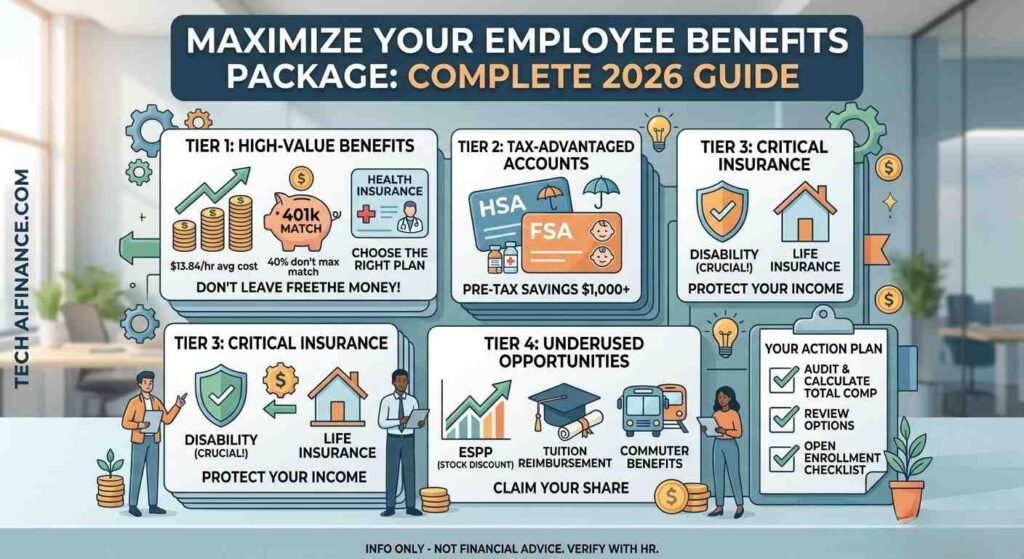
The benefits audit is the process of reviewing your complete benefits package annually, calculating the dollar value of each benefit, confirming your enrollment in every available benefit that makes sense for your situation and identifying any benefit you are currently leaving unclaimed. This process should take two hours once per year during open enrollment.
- Pull your employer’s complete benefits guide from the HR portal. If a physical copy is not available, request one from HR. Read every section including sections you have previously skipped.
- List every benefit in a spreadsheet with three columns: benefit name, annual dollar value estimate and current enrollment status.
- For each benefit, calculate the annual dollar value using the formulas in the total compensation section above. Benefits with no quantifiable value such as EAP and flexible work arrangements deserve a notes column rather than a dollar value.
- For each benefit you are not enrolled in, evaluate whether you should be. The question is not whether the benefit seems relevant but whether the cost of not being enrolled exceeds the cost or inconvenience of enrolling.
- For benefits you are enrolled in, verify that your enrollment levels match your current situation. Life insurance beneficiary designations, 401k contribution percentages, disability coverage levels and FSA contribution amounts all benefit from annual review.
- Identify three specific changes to make before the enrollment window closes. Prioritize by dollar value: 401k match capture, ESPP enrollment and FSA or HSA contribution level adjustments typically represent the highest dollar-value changes.
- Set four quarterly calendar reminders during the year to check FSA balances, submit wellness reimbursements and track any benefit with use-it-or-lose-it provisions.
How to Negotiate Benefits When Accepting a Job Offer
Salary is not the only negotiable component of a job offer. Benefits are frequently negotiable, particularly at smaller employers, startups and mid-size companies without rigid compensation bands. Understanding which benefits are negotiable and how to approach the negotiation protects you from accepting a lower total compensation package than the role warrants.
Benefits that are frequently negotiable
- Additional vacation days: Particularly at smaller employers, an extra five to ten days of PTO negotiated at hire is worth $1,500 to $3,000 per year at typical salaries and is often easier to obtain than equivalent salary increases.
- Sign-on bonus: Compensates for unvested equity, unpaid bonus or benefits forfeited at your previous employer. Typically one to three months of base salary at professional roles.
- Remote work arrangement: Two days of remote work per week saves the average American commuter $3,000 to $8,000 per year in commuting costs and several hours per week of time.
- Professional development budget: An annual conference, training or certification budget of $1,000 to $5,000 is often available even when companies have rigid salary bands.
- Earlier performance review: A 90-day review instead of a 12-month review means any merit increase is effective nine months earlier, which adds meaningfully to first-year total compensation.
How to negotiate benefits professionally
After receiving a job offer, complete your total compensation calculation including every benefit offered. If the total falls short of your target, identify the two or three specific items with the highest dollar value impact. Frame your request around total compensation rather than individual items: the conversation is more effective when you say the total compensation is approximately X and you were hoping to reach Y, which leads naturally to a discussion of which component
s have flexibility.
| 💡 Pro Tip Use this calculation before negotiating any job offer: Write down every benefit the offer includes and assign a dollar value to each: PTO days times daily rate, employer 401k match as a percentage of salary, employer health premium contribution estimate, ESPP availability, tuition reimbursement limit, wellness allowances. Add all values to the base salary. Compare the total to your target total compensation. When you know your total compensation is $87,000 and you were targeting $95,000, the conversation with the employer becomes specific and professional: I have calculated the total compensation at approximately $87,000 including the full benefits package. I was hoping to reach $95,000 in total compensation. Is there flexibility on the base salary, an additional week of vacation or a sign-on bonus that would help bridge that gap? |
| Benefit | Avg Annual Value | Action to Maximize | Common Mistake |
| 401k Employer Match | $1,500 to $7,500 | Contribute at least up to match threshold | Contributing below match threshold |
| Health Insurance Contribution | $7,200 to $22,000 | Choose plan with lowest true annual cost | Choosing PPO without running cost comparison |
| Paid Time Off | $3,000 to $8,700 | Use all days before expiration | Forfeiting days through non-use |
| ESPP (if offered) | $2,000 to $8,500 | Enroll at max, sell immediately | Not enrolling due to form complexity |
| HSA (if HDHP eligible) | $1,305 to $2,500 in tax savings | Contribute max, invest all funds | Holding HSA funds as uninvested cash |
| FSA (if no HSA) | $978 to $1,500 in tax savings | Contribute realistic spending estimate | Over-contributing and losing to forfeiture |
| Dependent Care FSA | $1,483 in tax savings | Max at $5,000 for qualifying childcare | Not knowing the account exists |
| Commuter Benefits | $600 to $1,500 | Maximize monthly transit/parking limits | Not enrolling for transit or parking |
| Disability Insurance | $2,000 to $8,000 in premium value | Verify adequacy of LTD coverage | Accepting default without reading policy |
| Tuition Reimbursement | Up to $5,250 tax-free | Apply for one program per year | Not using because of application effort |
| EAP Services | $750 to $2,000 in service value | Use counseling and legal consultation | Not accessing due to stigma or unawareness |
| Wellness Reimbursements | $200 to $2,400 | Submit receipts quarterly | Forgetting to submit before year-end deadline |
| 💡 Real-World Example Consider two hypothetical employees at the same mid-size technology company in Austin, Texas, both earning $82,000 per year. Jordan is 31 and has been with the company three years. During each open enrollment, Jordan spends about 15 minutes selecting the same PPO plan and contributing 3 percent to the 401k. Jordan does not participate in the ESPP, has never submitted a wellness reimbursement, has $1,800 in unused FSA funds at year end that are forfeited annually and has never used the tuition reimbursement benefit. Jordan’s actual compensation capture: $82,000 salary, $1,640 in 401k match captured (3% contribution triggers 2% employer match, full 4% match requires 4% contribution), $7,200 employer health premium. Total captured value: approximately $90,840. Jordan leaves uncaptured each year: $820 in additional 401k match by contributing 1% more, $1,800 in FSA forfeiture, $3,000 estimated ESPP discount not claimed, $5,250 tuition reimbursement not used, $600 wellness reimbursements not submitted. Total compensation left uncaptured annually: approximately $11,470. Priya is 33 and joined the same company two years ago with a deliberate approach to benefits. During open enrollment she spent two hours reviewing every benefit. She switched from the PPO to the HDHP, opened an HSA and contributes $4,400 per year. She contributes 4 percent to her 401k to capture the full employer match. She enrolled in the ESPP at 10 percent of salary and sells shares each period. She uses the $700 in tuition reimbursement for an online certification program. She submits $480 in wellness reimbursements quarterly. Her FSA election of $600 is spent completely by November. Priya’s total compensation capture on the same $82,000 salary: $82,000 base, $3,280 full 401k match, $7,200 employer health premium, $8,200 ESPP participation, $1,305 HSA tax savings, $700 tuition reimbursement, $480 wellness reimbursements. Total captured value: approximately $103,165. Priya earns $12,325 more in total compensation per year than Jordan from the same employer and the same salary through benefits optimization alone. These examples are illustrative. Actual amounts depend on employer plan designs, individual tax rates and market conditions. |
Frequently Asked Questions
What is the first benefit to maximize if I can only focus on one thing?
The 401k employer match, without exception. If your employer offers a match and you are not contributing enough to capture the full match, every dollar of uncaptured match is free compensation you are voluntarily declining. No other financial action in your benefits package produces a comparable guaranteed return. Increase your 401k contribution to at least the match threshold before taking any other benefits action.
Can I enroll in the ESPP partway through the year?
Most ESPP plans have specific enrollment periods, typically at the beginning of each six-month or twelve-month offering period. If you miss an enrollment window, you generally must wait until the next enrollment period opens. Check your plan document for the specific enrollment dates. Because the ESPP discount creates an automatic guaranteed return on participation, missing an enrollment period represents real financial cost: contribute to the next available window and make enrollment in the ESPP the first action you take at your next opportunity.
Does using my EAP affect my employment status or health insurance premiums?
No. EAP services are provided through a confidential third-party vendor and your employer does not receive information about your use of the program, the nature of your sessions or any personal information you share with EAP counselors. Your use of EAP services has no effect on your employment status, your health insurance premiums or any other employment matter. The confidentiality of EAP services is a contractual and often legal protection that makes the program safe to use without any employment-related concern.
What happens to my 401k and ESPP if I leave my job?
Your 401k balance is always fully yours for the portion you contributed. Employer match contributions may be subject to a vesting schedule, meaning you earn ownership of the employer’s contributions gradually over time, typically over two to four years. If you leave before the vesting schedule is complete, you forfeit the unvested portion of the employer match. Your ESPP shares become yours once purchased at each purchase date, but you should be aware of the tax implications of selling shares before the qualifying disposition holding periods are met, which may result in higher ordinary income tax rather than the lower long-term capital gains rate. Review your vesting schedule and your ESPP plan’s tax treatment before leaving any employer.
My employer is small and does not offer all these benefits. What should I prioritize?
If your employer offers limited benefits, the optimization priorities shift to maximizing the benefits that are available and compensating for the missing ones independently. If your employer offers no 401k, open a Roth IRA and a traditional IRA at Fidelity or Schwab and contribute the maximum amounts independently. If no health insurance is offered, explore ACA marketplace plans at healthcare.gov, where premium tax credits may significantly reduce your cost. If no disability insurance is offered, purchase an individual long-term disability policy independently since this is the highest-risk benefit gap for most workers. A fee-only financial advisor can help you build a complete benefits strategy when your employer does not provide a complete package.
| ⭐ Key Takeaway Your salary is not your compensation. Your total compensation is your salary plus every benefit your employer provides, and for most Americans that total is $15,000 to $25,000 more than the salary number on their offer letter. The average American employee leaves between $5,000 and $12,000 per year in unclaimed benefits through under-enrollment in the 401k match, ESPP non-participation, FSA forfeiture, unused tuition reimbursement and unclaimed wellness reimbursements. Two hours during open enrollment, spent reading your full benefits guide, calculating the true value of every available benefit and making active enrollment decisions, is the highest-return financial activity available to most American workers relative to the time invested. Start with the 401k match today. Everything else can be optimized at open enrollment. |
Conclusion
Employee benefits are not supplemental to your compensation. They are compensation, and in most American workplaces the gap between what employees are offered and what they actually claim is measured in thousands of dollars per year. The 401k match that goes partially uncaptured, the ESPP that sits unenrolled, the tuition reimbursement that expires unused and the wellness reimbursement receipts that were never submitted all represent earned compensation returned to the employer by default.
The framework in this guide gives you the specific actions for every major benefit category. Two hours during your next open enrollment window, spent systematically working through the audit process and making deliberate enrollment decisions, is the investment that closes the gap.
For the specific account-level detail behind two of the most valuable benefits in this guide, see our dedicated guides on HSA vs FSA: which one should Americans choose in 2026 and how to choose the right health insurance plan during open enrollment. For Americans building long-term wealth through the investment accounts funded by optimized benefits, our guide on how to build generational wealth in the US covers the seven-pillar framework that employee benefits optimization supports.
| 📲 Share This Guide If this guide helped you identify a benefit you have been leaving unclaimed, share it with a coworker who might be in the same situation. Share on WhatsApp, Facebook or by text message. Thank you for reading TechAIFinance.com. |
Read Next
Continue building your financial knowledge on TechAIFinance.com:
- How to Choose the Right Health Insurance Plan During Open Enrollment
- How to Build Generational Wealth in the US
- Best Stock Trading Apps for Beginners in the US 2026
- How to Retire Early Using the FIRE Method in the US 2026
| ✍ About the Author Written by: TechAIFinance Editorial Team Edited and Fact-Checked by: Olayinka Adejugbe Olayinka Adejugbe is not a licensed financial advisor. The content on TechAIFinance.com is produced for educational purposes only and should not be treated as personalized financial advice. Olayinka is the founder and lead editor of TechAIFinance.com. He holds a Global Certification in Artificial Intelligence and Applied Innovation and an Award of Completion in Behavioral Counseling from the World Health Organization. With a strong working knowledge of personal finance and accounting principles, Olayinka oversees the editorial review of every article on this site to ensure accuracy, currency and practical usefulness. Every article on TechAIFinance.com is produced by our research team and reviewed by Olayinka before publication. We verify statistics against named authoritative sources and update content when circumstances change. Visit our About page to learn more about our editorial process. Use our Contact page to get in touch. |
Important Disclaimer
The content published on TechAIFinance.com is for educational and informational purposes only. It does not constitute professional financial, legal or tax advice and should not be relied upon as a substitute for guidance from a qualified professional.
Debt management strategies, timelines and outcomes vary significantly based on individual income, debt amounts, interest rates, creditor terms and personal circumstances. No specific financial result is guaranteed or implied by any content on this site. Always consult a qualified financial advisor, credit counselor or attorney before making significant financial decisions. Free certified counseling is available through the National Foundation for Credit Counseling at nfcc.org.